


Exploring 8 worlds in the Gucci Cosmos

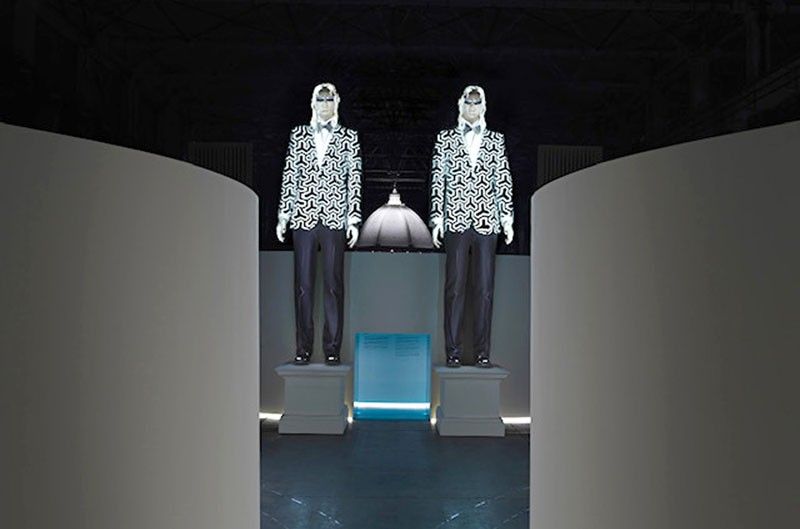
SHANGHAI, China — Two 10-meter-high statues loomed over us, like giant sentinels to some modern temple. Longhaired and clad in suits, they were identical twins that instantly recalled Alessandro Michele’s last “Twinsburg” collection for Gucci. Vibrant colors and patterns were projected onto their suits, like butterflies unfurling their wings and flying over their shoulders. It was so captivating, so mesmerizing, that I just wanted to stand there and watch the entire loop, as ever-changing as the seasons of fashion.
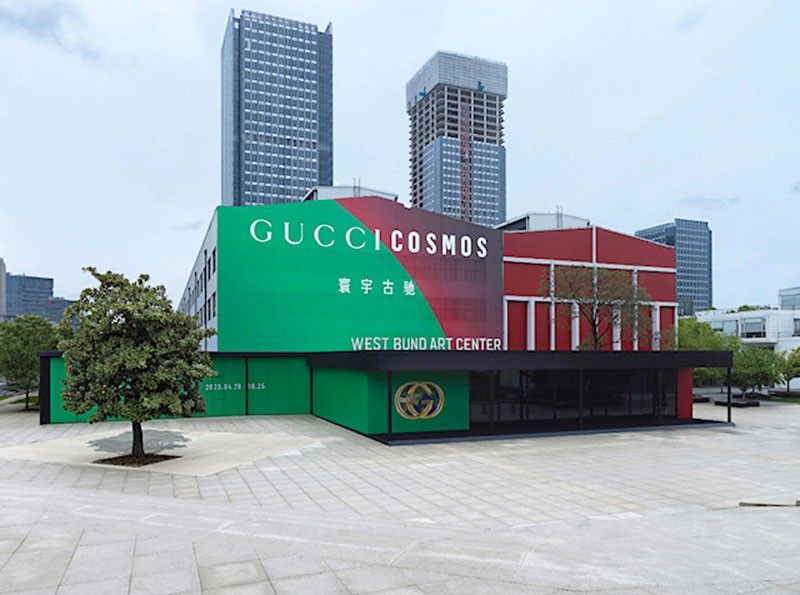
This was just one of the “worlds” in Gucci Cosmos, an exhibition spanning the Italian luxury brand’s 102-year history that opened on April 28 at the West Bund Art Center in Shanghai, and featured the brand’s most seminal icons.
“Walking through the exhibition, I realized even more that the essence of our brand story has been told through the exceptional talents of designers and artisans, who have defined the creativity and craftsmanship of the house’s first century and the beginning of the next,” said Gucci global CEO and president Marco Bizzarri in a message read by chief brand and client officer Susan Chokachi. “Gucci Cosmos is really a tribute to them.”
Added Chokachi, “This is the first time that these treasures — many of them previously unseen — have traveled outside of the Gucci Archive that’s located in the House’s founding city in Florence, Italy,” she said. “When we opened the Gucci Archive in Florence in July of 2021, it was the year that we were celebrating our centennial anniversary. We immediately decided that China would be the first global destination to bring this historic exhibit about the House and its heritage to life.”
Gucci Cosmos was designed and built on a massive scale inside a former airplane factory by English artist Es Devlin, who’s worked with the world’s top fashion houses and recording artists — designing stages for the likes of Beyoncé, Adele and U2 — and curated by eminent Italian fashion theorist, critic and professor Maria Luisa Frisa.
The two spent the last year working on the exhibit: “We've been wearing the clothes; the clothes have shaped us,” Devlin said. “We've shaped them back. And that's really what I wanted to express in this exhibition is the origin story and the myth that's at the heart of this house until the 20th century.”
She likened building the House of Gucci to a cathedral, and how such edifices could only be completed by passing down the knowledge and expertise from one generation to the next. “It's also about the individual artisans,” she said. “The myth of the house is kept alive, not just through the creative directors, the designers, the ambassadors, yourselves in the stories you tell, but also each individual craftsperson who stitches the embroidery, who cuts out the pieces of fabric — it's a grand collaboration over generations. And I hope that's the story that the exhibition tells.”
“We’re not mirroring but defining a time,” Frisa pointed out. “I chose objects that have value in art history. We shape objects, and fashion is the architecture closest to our body.”
Frisa cited Gucci’s horse-bit loafers from 1953, noting they signified a change in masculinity. “They represent a more relaxed, sensual lifestyle, connected to leisure time.” The loafers were so iconic they were included in the Metropolitan Museum of Art in New York.
“(The loafers were) revamped by Tom Ford, who reinterpreted the shoe in a new way — a more relaxed image of men with bright colors like pink, blue and no socks — a very strong change.”
Gucci’s most recent creative director, Alessandro Michele, for his part reinterpreted the loafers into slippers and Frisa said it was another turning point in the way of dressing. “Gucci can really intersect lifestyle and changes in the way of life.”
Devlin and Frisa wanted the audience to participate in the exhibition, so they devised eight worlds in which viewers could have a relationship with the objects on display. “There’s a very immersive side, with vision, objects, and fashion text to communicate intentions,” Frisa said. “You can walk through it, feel emotional, go back to specific objects and explore more fully.”

World 1: Portals
“Portals” tells the story of the House’s founding father, Guccio Gucci, and how he became aware of the aspirational lifestyle as a young man working as a porter at London’s Savoy Hotel. The Savoy was the first to have an elevator, but it was a slow one, giving the young Gucci ample time to study every detail of the affluent clientele’s luggage. Hence, when he later founded Gucci, he knew exactly what his luxury clients wanted.
We entered through one of eight revolving doors — a nod to the Savoy’s entrance — and saw three moving, circular carousels carrying Gucci’s most exquisite luggage designs, including one of the earliest signature suitcases designed by Guccio in the late 1920s, a case featuring a distinctive GG-print canvas created by Aldo Gucci in the 1960s as an homage to his father, and Disney-print luggage from the Epilogue collection, designed in 2020 by Alessandro Michele as a sophisticated pop-culture remix.
The outer ring also features eight multimedia dioramas inspired by cultural icons from Gucci’s past and present, including Jacqueline Kennedy Onassis, Princess Grace of Monaco, Princess Diana, and global brand ambassadors Chris Lee, Ni Ni, Lu Han, and Xiao Zhan.
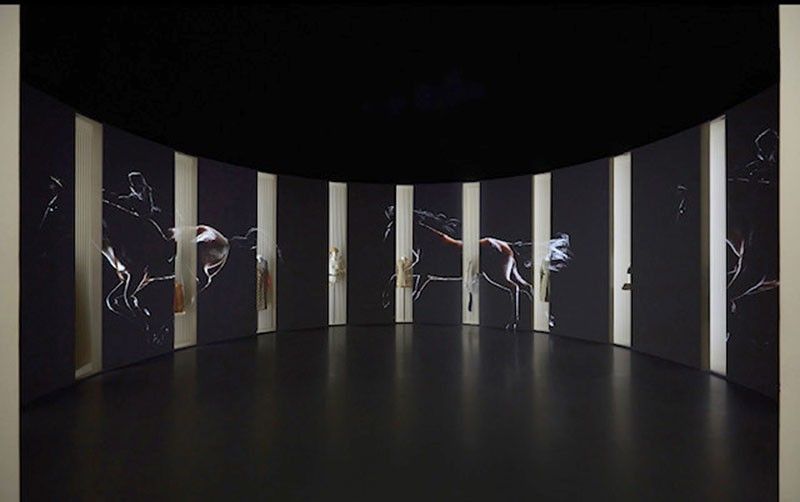
World 2: Zoetrope
Exploring Gucci’s equestrian heritage, horses gallop around large, wraparound screens accompanied by the sound of their galloping and a voiceover reciting horse-riding-inspired words to the beat.
“‘Zoe’ means ‘life’ and ‘trope’ means ‘turning,’ and a zoetrope was invented at the end of the 19th century,” says Devlin. “It was the first time that humans saw the illusion of a moving image.”
The film fades out to a gallery of archival pieces bearing the House’s equestrian icons such as the Horsebit, invented by Aldo Gucci in 1953, and the iconic green-red-green Web stripe, inspired by the strap that holds a horse’s saddle in place.
Later pieces by Gucci creative directors Ford and Michele playfully subvert equestrianism’s traditional aristocratic practices to suggest more erotic possibilities, like Ford’s riding crop and Michele’s Horsebit black leather corset.

World 3: Eden
When Rodolfo Gucci was acting for Italian film studio Cinecitta, he met stage designer Vittorio Accornero de Testa, and commissioned him to illustrate a silk scarf created for Princess Grace of Monaco in 1966. This became the exquisite Flora print, which became the leitmotif for Gucci’s 1981 ready-to-wear collection, and later ignited the artistry of Tom Ford, Frida Giannini and Alessandro Michele.
“For 10 years from 1961 Accornero was painting these exquisite designs for scarves and other elements: he was painting flora and fauna from life, and you see many examples of these actual scarves, which I think are in China for the first time,” notes Devlin.
For “Eden,” she and Frisa took 37 species from Accornero’s Flora scarf and made those animals in plaster, hanging them from the ceiling and making them a striking white backdrop for pieces like the Flora-print silk mini-dress from 1969, Michele’s signature embroidered shearling-lined denim jacket with its “L’Aveugle Par Amour” motto, and a series of silk scarves and fabric bags.
World 4: Two
Two 10-meter-tall white statues symbolize Gucci’s trailblazing belief in unisex fashion and its ability to shift societal ideas and behavior. Projected onto the statues’ “blank canvases” in a loop are images of men’s and women’s suits from Gucci’s past and present, including the celebrated unisex red velvet suit by Tom Ford in 1996; a striking Frida Giannini-designed checked suit with a cinched waist; and Michele’s sparklingly floral unisex versions from 2016 and one from his “Twinsburg” collection shown in 2022.
World 5: Archivio
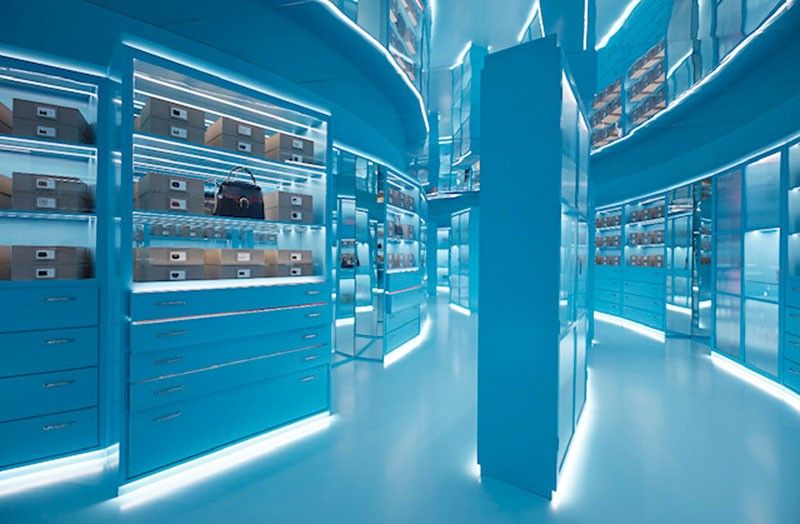
I felt like Alice in Wonderland stepping into the maze of this circular blue room with its corridors and mirrored ceiling creating a feeling of infinity. Reminiscent of the Gucci Archive in Florence with its myriad cabinets and drawers, Archivio explores the origins of the House’s most iconic bags, like the Bamboo 1947, the Jackie 1961, the Horsebit 1955, the Gucci Diana, and the Dionysus.
You can open some of the drawers to find illustrations by Vittorio Accornero de Testa, artisans’ sketchbooks and vintage advertising campaigns.
“There's a phrase that comes from within the Gucci house, about an archive,” says Devlin, “and it says an archive is not a dead, cold, clinical, indexed mausoleum. It's a living, breathing organism.”
“It’s an obsessive labyrinth that helps you understand what an archive is,” adds Frisa. “The heart of a fashion brand is a precious place. Gucci is opening its archive to the audience and we enter its beating heart.”
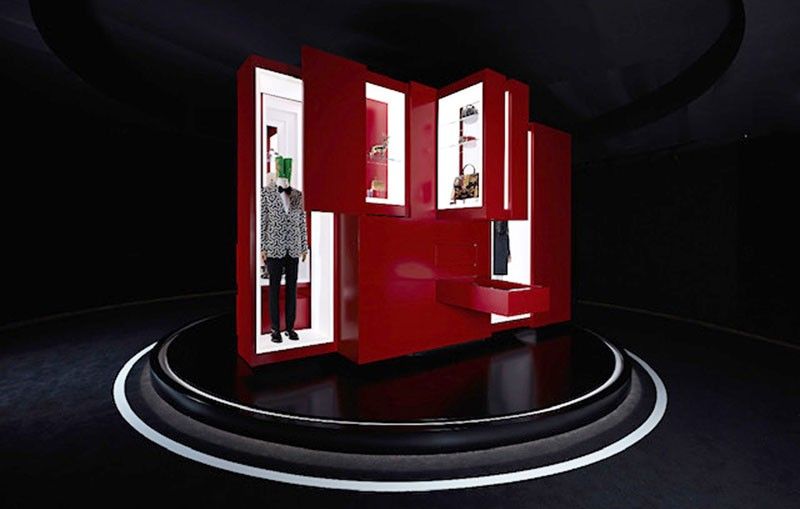
World 6: Cabinet of wonders
In this room, a three-meter-high monolithic cube covered in deep-red lacquer revolves to the sound of a heartbeat and as it turns, drawers and closets slide out to reveal wildly eclectic garments, accessories and curios, from Tom Ford’s 2001 black leather bustier, to Frida Giannini’s 2006 golden evening gown, to Alessandro Michele’s 2018 dress embroidered with lace, pearls and beads.
I personally liked the punk-inspired spherical leather bag with metal spikes from 2019; was struck by the silver deer-shaped beakers from the early 1970s; and loved the Tom Ford-era electric guitar.
“For me, personally, the revolving box is something I've been working with for the last decade,” says Devlin. “I make my theater design sometimes with this box, because it's like a movie. You can sit still; it will turn and reveal different objects to you as it turns. And I think Maria Luisa has curated the objects inside it in a very special way.”
“It was fun, because I wanted to convey Tom Ford’s suit and Frida’s dress, like nightwear clutches and jewels,” Frisa says. “The challenge in the cabinet was to make it empathic to the audience.”
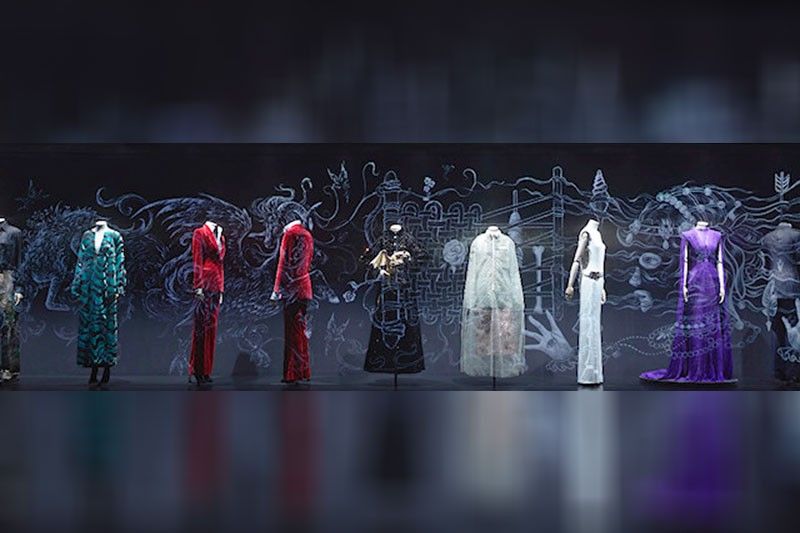
World 7: Carousel
Behind a mesh screen painted over with drawings by Chinese artists Victo Ngai, Vikki Zhang, Li Jianmei, and Currynew, a parade of 32 mannequins wearing Gucci clothing from the 1970s to the present day glide by, like fashion models on an ever-moving catwalk. Frisa arranged these looks — each from a specific season — not by chronology but by color and inspiration: Tom Ford’s red velvet unisex suits from 1996 rub shoulders with Alessandro Michele’s Game of Thrones-inspired black cloak from 2018 with baby-dragon accessory; Frida Giannini’s chain-embroidered flapper dress from 2012 gives way to a 1970s silk shirt and skirt combo with a G-cube motif. It’s a powerful statement on how topical yet timeless Gucci has been throughout the decades.
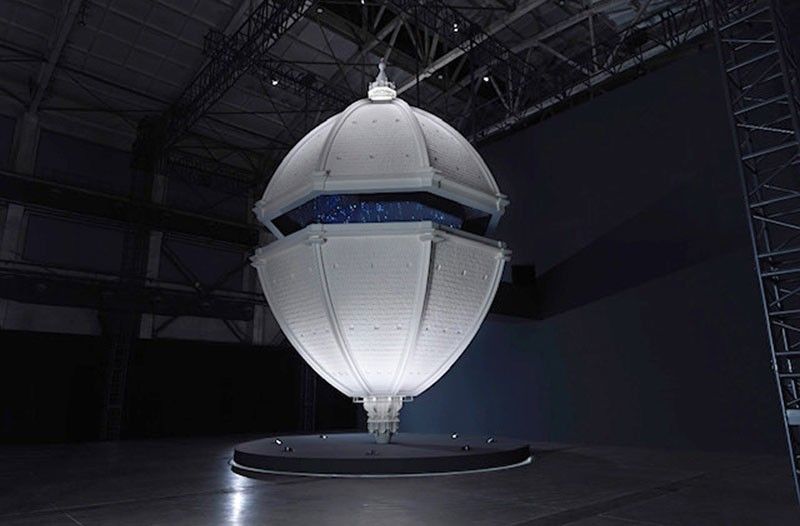
World 8: Duomo
While Gucci’s craftsmanship, innovation and elegance made it the house of choice for the international jet set and the most celebrated stars, it has always remained anchored in its spiritual and aesthetic home, the city of Florence. Gucci Cosmos fittingly culminates in Duomo, two large-scale reproductions of Filippo Brunelleschi’s 15th-century dome for Florence’s cathedral, Santa Maria del Fiore, which has come to symbolize the city.
One dome is inverted beneath the other, like a reflection, and you can actually go inside by climbing stairs to reach the suspended viewing platform. Inside, designs and patterns from Gucci’s past and present are projected onto the dome’s interior in a light-and-sound spectacle that includes flowers inspired by Vittorio Accornero de Testa’s Flora. What I found most powerful, though, was the feeling of ascending from the red flames projected on the bottom dome up to the top of the Duomo, then breaking through to see the starry sky and the eye of God.
It’s not often you have a spiritual experience when viewing a fashion exhibition, but I felt as if I had that after seeing Gucci Cosmos.
“What I hope young visitors to this exhibition will learn is that a house like Gucci is preserving its past in its future,” Devlin says. “It's enacting cathedral thinking and it's valuing objects, allowing them to be protagonists, to be agents, and actually paying them respect, paying the materials — the planetary resources that go into objects — the respect that we should be paying them. There's nothing ‘fast’ about it. It's carefully made. It's being honored. And that's really what we all going forward are going to learn from a house's attitude like this, is how to think in a cathedral way, how to respect resources, and how to pass objects down through generations in a way that is actually at its heart entirely sustainable.”
* * *
Gucci Cosmos will run for two months until June 25, 2023 at the West Bund Art Center, 2555 Longteng Avenue, Xuhui District, Shanghai, China, after which it will travel the world.
In the Philippines, the Gucci flagship store is located in Greenbelt 4, Ayala Center, Makati City.