Pause or cut

Domestic inflation slowed for the third consecutive month, pointing to signs that the easing of price pressures could be sustainable. This caused BSP Governor Felipe Medalla to hint at a possible pause in tightening or even rate cuts later this year.
Easing inflation for the US and Philippines
Last week, the government reported that domestic inflation eased to 6.6 percent year-on-year in April from 7.6 percent in March, and a recent high of 8.7 percent in January. Medalla said, “Demand is no longer contributing to inflation, and the supply shocks are beginning to wane.” US inflation was likewise lower at 4.9 percent in April from fiver percent in March, thereby giving the US Federal Reserve (Fed) some leeway to pause its tightening.
Maintaining interest rate differential
Though the BSP may cut rates this year, Medalla highlighted the need to preserve the interest rate differential between the Philippines and the US. Below are some of the BSP Governor’s recent comments.
“We have more than adequate reserves. The problem is every time the US policy rate becomes very close to ours – and very close is 100 to 125 basis points – the peso tends to weaken.”
“If US inflation is sticky and the cuts are slow, it’s very dangerous for the Philippine central bank to cut faster than the US even if its inflation is falling faster.”
“Right now, unless there are large changes in US interest rates, I think we’re alright. And listening to what the Fed is saying, they will no longer have large changes in the policy rate, and in fact, they may pause after their last increase of 25 basis points.”
Fed funds rate vs. BSP policy rate
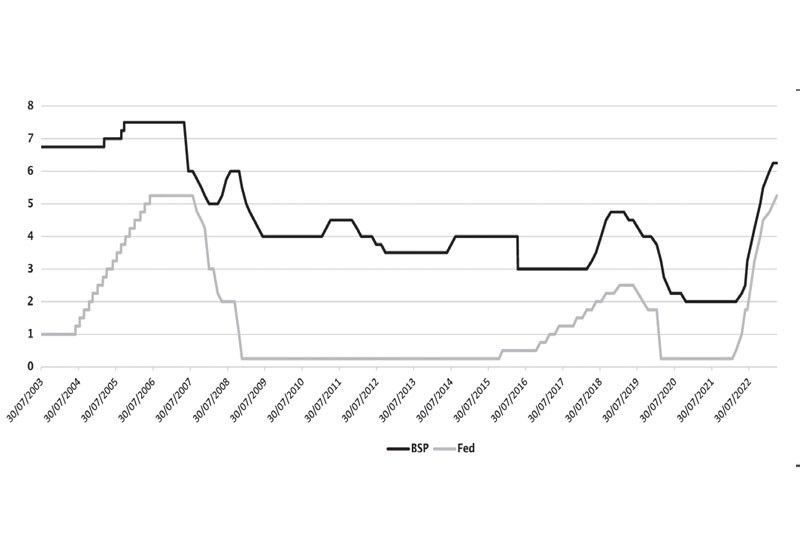
Source: Bloomberg, Wealth Securities Research
Linkage between US and Phl interest rates
Based on the recent statements of Medalla, it is clear that there is a strong linkage between the Fed funds rate and the BSP policy rate. The statements and policies of the Fed have a direct effect on what the BSP should do. As such, the BSP cannot allow its policies to veer away from the Fed’s monetary actions. Specifically, the BSP would probably avoid cutting interest rates sharply if the Fed maintains its policy stance.
Cutting reserve requirements
While the BSP may not reduce rates immediately, Medalla said that another way to stimulate the economy is by cutting reserve requirements. The BSP may cut the reserve requirement ratio (RRR) for banks by 200 basis points to 10 percent in the third quarter if inflation continues to move towards the government’s target range of two to four percent. The RRR reduction may come before any potential policy rate cut. The prospective RRR cut would add liquidity to the financial system and reduce intermediation costs for banks.
Stable peso contributes to price stability
As the BSP Governor explained, the peso indeed tends to weaken significantly when the interest rate differential between the Phl and the US becomes too narrow. A volatile or sharply depreciating peso creates instability and drives inflation through the higher cost of imported goods. Thus, by maintaining the interest rate differential, the BSP would support a stable peso that would contribute to overall price stability. Barring any negative shocks or surprises, the peso should be relatively stable against the US dollar. A stable peso, easing inflation, coupled with a pause in monetary tightening or a cut in interest rates, would support economic activity and corporate earnings.
Philequity Management is the fund manager of the leading mutual funds in the Philippines. Visit www.philequity.net to learn more about Philequity’s managed funds or to view previous articles. For inquiries or to send feedback, please call (02) 8250-8700 or email [email protected].






- Latest
- Trending