


A season of women at the crucible
The Force is female all right, but not in a hackneyed, contra-canonical Disney’s Star Wars way.
We are talking about a more artful type of creative energy: an invisible field that summons individuals like a voice in the wilderness or brambles on fire, and gets that urge to fill white shroud-like canvases with form, figures, color, stories and life. Many artists have realized that it takes a lifetime to understand and harness it; but most of the time, the light of inspiration cuts through the gloom like a sabre. It all suddenly makes sense.
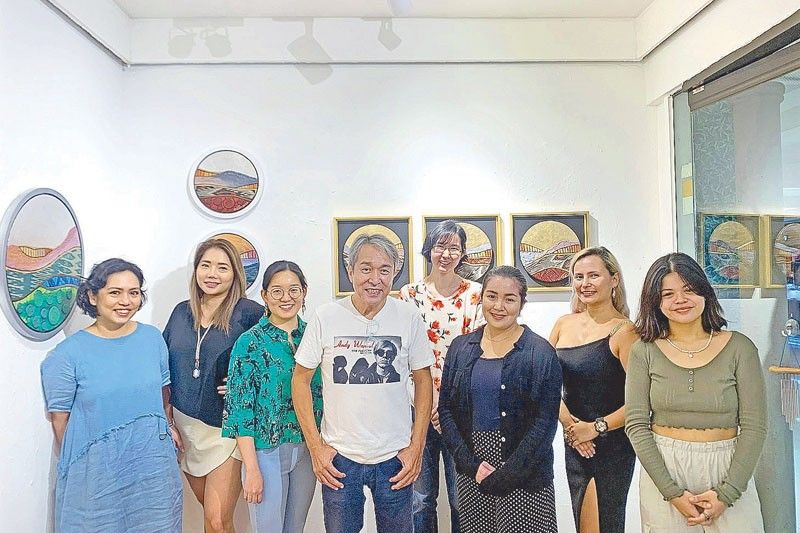
For The Crucible’s Sari Ortiga, the gallery’s successive solo shows from May until August feature female artists — from established ones to those exhibiting for the first time. But as Ortiga met with the participating artists and saw their works, he realized that the most striking thing about them was not solely their femininity, but their individuality, artistry and passion for making art out of chaos or nothingness. These women have found ways to get inspired by occurrences, thoughts or materials that may not be interesting to those of us just seemingly trudging along blindly, simply getting by; those in the dark, the uninspired.
A woman from Davao looks at indigenous weaves, gold leaf and sand, and reflects on the aspects of roots and culture.
Another notices how the organic interaction of colors, patterns and forms can refresh the weariness of modern eyes bombarded with digital dazzlement to the point of ennui.
A third one purges herself of that maelstrom of heavy thoughts and emotions (shadowed by loss, hounded by unsaid apologies) to tap into her calming inner world via gestural, guttural paintings.
A fourth one watches short films — darkly humorous, humorously dark — and feels a connection. She also finds walls, long stretches of cement and fills them with tales that are both absurd and full of wonder, while her loving father patiently waits nearby.
A fifth one sees bottles, plastic packaging, and containers, and senses flowers, foliage and butterflies just waiting to be born, fluttering and petalling out of all those discards.
A sixth one, a realist, aims to traverse a new road, depicting subjects she never thought she would enjoy — cars and motorcycles — and gaining appreciation for their form and engineering.
The seventh one dresses like Neil Gaiman’s Death and relishes that quiet interval in time and space where things grow — precisely that Japanese concept of Ma, which is depicted in kanji as sunlight peeping through the crevices of a door.
“Each one of them is a buzz on her own,” explains Ortiga. “(Mounting a series of shows titled “A Season of Women”) was an afterthought. They are all grounded in the Modernists but they are very contemporary in their execution. We at The Crucible chose these artists for their originality — it just so happened that they are all women.”
Someone once said that women artists are not just “a novelty, a trend, or a token,” but the “custodians of colliding memories and unexpected futures,” and with tempests and tranquility at the tip of their fingers.
At The Crucible, it is the season when the space, the spotlight are all theirs.
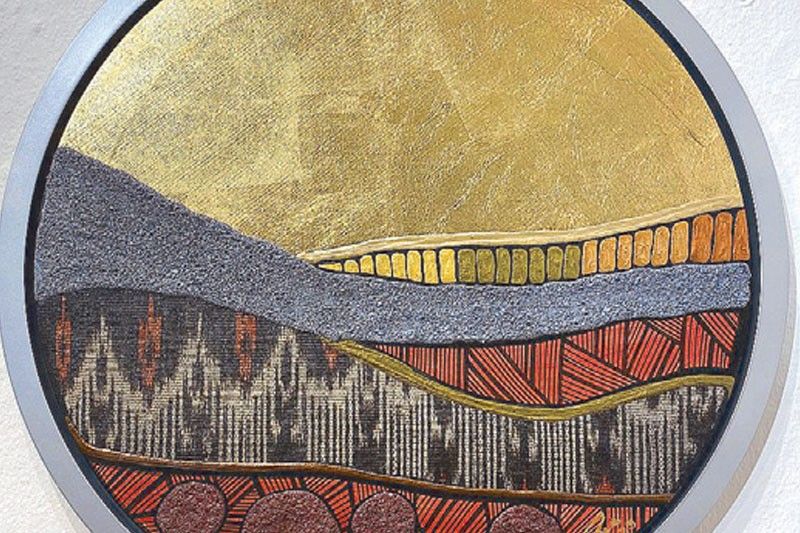
Tanya Gaisano Lee “Habi ng Kalikasan” May 2 to 14
Tanya Gaisano Lee’s concept for her show is to highlight her roots in Mindanao, but not in the usual way.
“You know how people sometimes say, ‘Oh, it’s ethnic art or tribal art’ — but I do it in a more aesthetically appealing way.” The artist started out with patterns (black and white, neutral colors) and then later on incorporated bolder colors. For her pieces at The Crucible, she made use of a traditional handwoven textile called T’nalak made by the T’boli people of South Cotabato. Thus paint, textile, gold leaf and sand from the beaches of Mati interact in Zen-like variations of the horizon, the shades of which are endless. She also observed a pattern in terms of the role of women in her surroundings, and found a way of going against it.
Tanya explains, “As a woman, who grew up in a traditional Filipino-Chinese household, the roles I was taught to play were very different from a man’s: mostly subservient, obedient and complementary to whoever it was I would marry. But with my art, I am the main character. Everything I put into the canvas is mine and mine alone. It serves no other purpose except to represent me. As selfish as that sounds, I derive so much pleasure from it.”
And the eyes of others do as well.
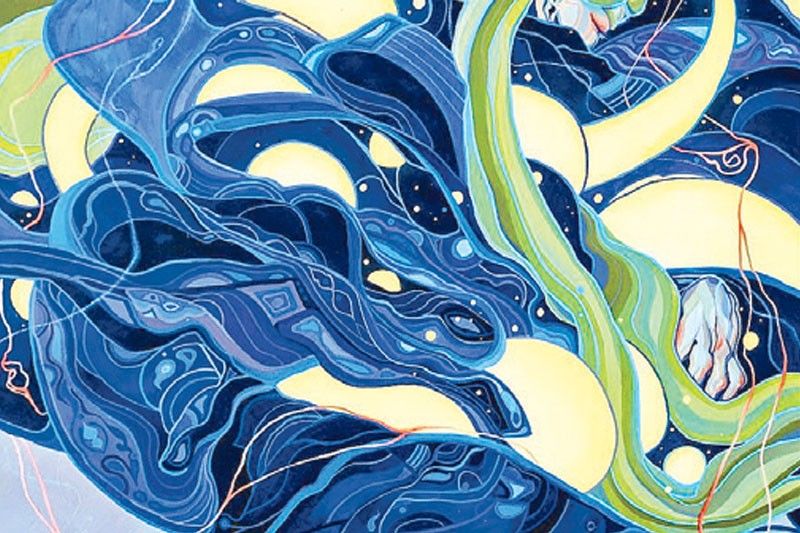
Camille Chua Tan (Frillion) “Thought Patterns” May 16 to 28
“‘Frillion’ is the alias I made up as a kid to serve as my artist identity on the internet,” explains Camille Chua Tan.
She began reflecting on the concept for her show during the height of the pandemic when all of us were locked down, exiled indoors, left alone with our thoughts. The colors of her big abstract swirl, approximating and interpreting the flow of brainwaves during intimate thought-making.
The artist says, “Thoughts can take the form of depth and of frequency, represented in my acrylic paintings and my ink prints, respectively. The collection depicts wispy synapses, shapes and patterns. The ink-works and their sketch-like linework, akin to coloring books, represent the fleetingness of our daily thoughts.”
Frillion has always depicted resting women, women in restful poses. The works at The Crucible are an evolution of that motif.
She concludes, “In psychology, the feminine figure represents fluidity and chaos, and I think my art process of doing a lot of projects at the same time and taking opportunities as they come as ‘meant to be’ would probably be my womanly trait and it has helped me so far.”
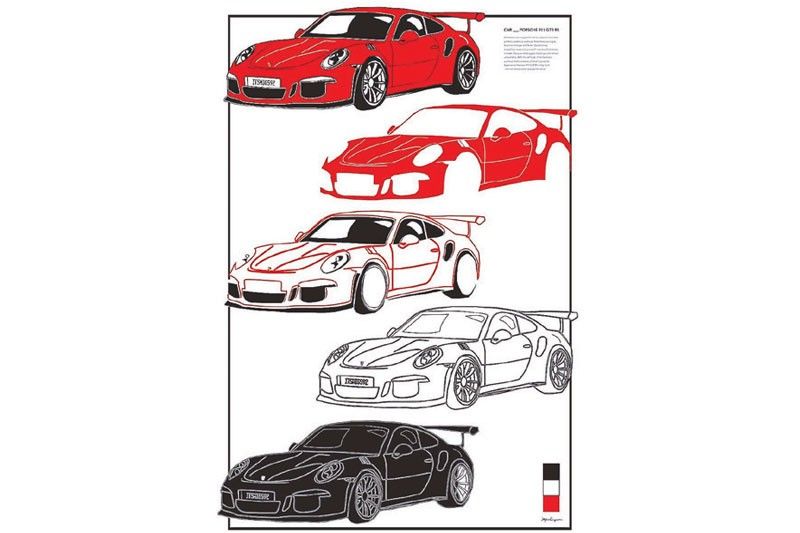
Mykie Concepcion “New Roads” July 11 to 24
Mykie Concepcion credits her mom (Karen Fabie Concepcion) and her art teacher (Mr. Grennan) for starting that fire of art in her. “Mr. Grennan was supportive of all the styles I wanted to explore. And my mom is my number one source of inspiration; she always tells me, ‘Just paint what brings you joy.’ We enjoy going to museums together to look at masterpieces. Simply observing a work already teaches you so much about how it was achieved.”
Mykie says, “My upcoming show at The Crucible is about me taking the leap to showcase a subject that was foreign to me — cars and motorcycles — and, most especially, doing it in more experimental ways. I was never involved in that world until I got married. Now, I have a newfound appreciation for their form, the engineering, and the level of nerdiness that I can relate to with my own obsessions — like Star Wars.”
Mykie is ready for the next fork in the road.
“This show is more of a self-exploration, a jumping-off point, a reset into what I feel I’m capable of as an artist.”

Janey Chua “Through the Little Weird Doors” June 13 to 25
Janey Chua has a degree in BS Biology but prefers to walk on the wild side of art.
Her exhibition at The Crucible takes inspiration from and pays tribute to several short films about characters that are placed in situations that are generally surreal and absurd. Some are haunting, some are darkly humorous and playful, some poignant. “I think all of these films tell different but connecting stories about being human,” the artist explains. “To me they represent the diversity of the human imagination as a response to boredom, loneliness, fear and longing.”
The films include adaptations from Franz Kafka, Edgar Allan Poe and Lewis Carrol masterpieces in fiction (A Country Doctor and Metamorphosis, The Tell-Tale Heart, Alice in Wonderland, respectively), as well as works by Allison Schulnik and Raoul Servais.
In her paintings, the narrative hinges upon the weirdness of being. “It is hidden in plain sight: this weirdness of people. We are always trying to figure out what the purpose or what the meaning of life is. Sometimes it feels as if there is no meaning at all. The simple act of being alive is kind of confusing.”
But if absurdity and the surreal are constants, then so are redemption, beauty, wonder.
The artist concludes, “I think when you have this awareness that every living thing has its own unique experience of life, you become more thoughtful and observant and curious, and your own life becomes that much more colorful.”
As Tim Burton once wrote about Oyster Boy, “Normal is not something to aspire to, it’s something to get away from.”
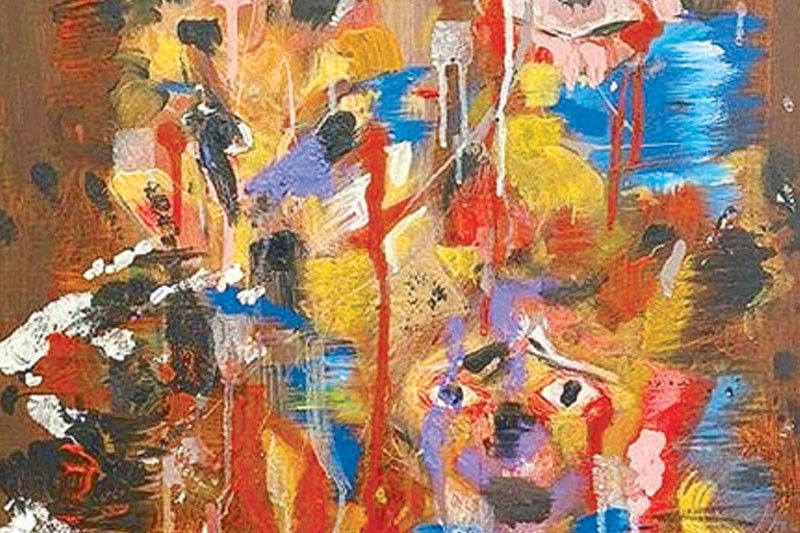
Ranya Mendoza “Healing Through Art: A Reflection on Mental Health” May 30 to June 11
Ranya Mendoza — the daughter of Jordan Mendoza and the granddaughter of Jose Mendoza, who are both acclaimed sculptors — shares her origin story in abstract art:
“What brought that about was an experience in school. I was in contemporary arts class and my teacher made us do an exercise where we had to close our eyes and just draw from our feelings, intuition, or inner vision. From there, I was just immediately inspired to make abstract paintings. I felt like it gave me permission and the freedom to tap into my inner world and create from there.”
For her show at The Crucible, Ranya focuses on issues pertaining to mental health.
“I find that art-making is very healing. Art is the way I share myself and my inner world. I have gained so much feeling my feelings and then expressing them through art. I like it when others feel comfort when they see through my art that they are not alone in their challenging experiences. So, hope is part of what I would like to share. I enjoy playing with color as one way to do this, especially in portraying heavier or darker emotions. Something about the contrast shifts the perspective in a very interesting way. I think it’s also my way of infusing a sense of hope even when there is pain.”
There is a quote attributed to a Grunge legend that reminds me of what artists such as Ranya are going through:
“Thank you for the tragedy,” Kurt Cobain supposedly said. “I need it for my art.”
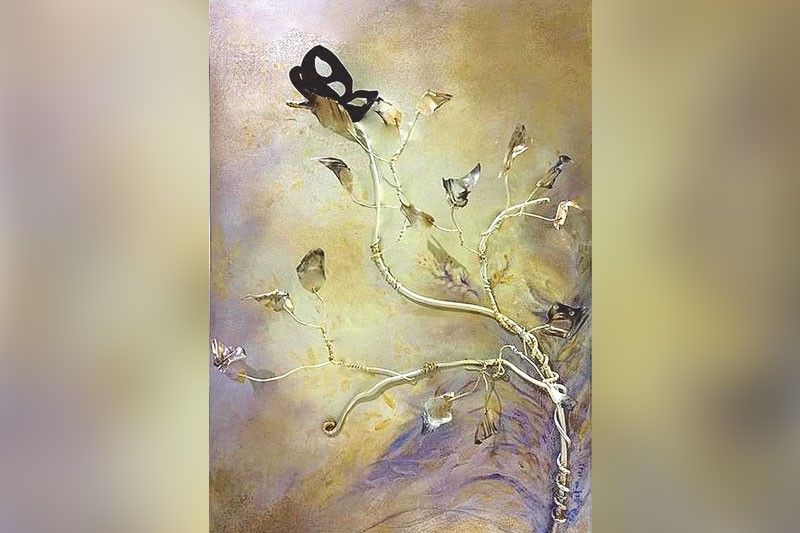
Bettina Silverio “Intimations on a Summer’s Day” June 27 to July 9
Bettina Silverio’s “Intimations on a Summer’s Day” is a celebration of nature and the vibrancy of life. It’s an explosion of colors, and the art pieces are bursting with flowers and colorful foliage. The artist describes it as “walking through a quaint cottage garden” that is “bursting with life.”
The artist explains, “Natural motifs are often part of my art pieces — flowers, foliage and butterflies especially. And my works often touch on the beauty of the natural world and the human condition. I’m a very optimistic person, and I believe that is reflected in my art. My pieces often carry very hopeful and positive messages.”
Bettina — the daughter of trumpet player extraordinaire Butch Silverio — pursues more traditional methods and materials in painting and sculpture, but her focus now is on sustainable art and working with discarded materials.
She reflects on art and femininity.
“They say women are not afraid of showing their emotions, and to a large (extent) that is true. As an artist I allow my emotions to shine through, and I’m not afraid to show my vulnerability. I find that when I let my inhibitions down I’m at a better place to produce great art.”
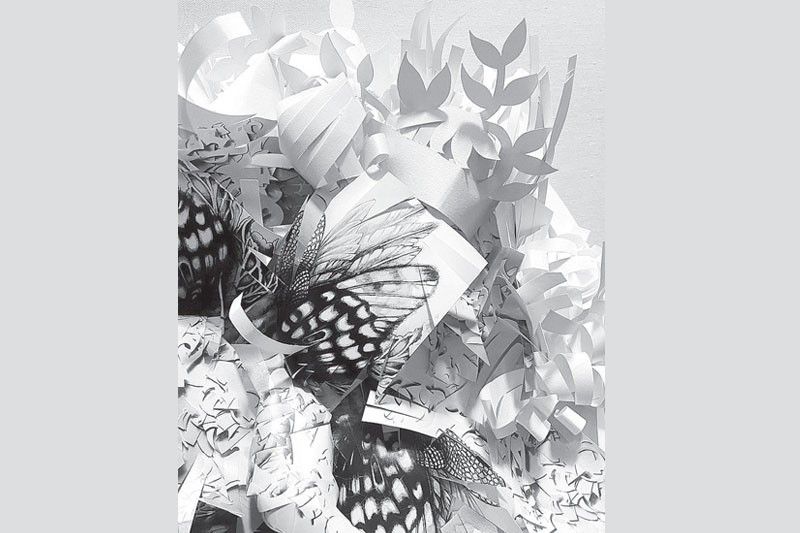
Katya Angara “Dendrophilia” July 25 to Aug. 6
When you look at Katya Angara’s CV or list of favorite things, you would think she was a compendium of the best female characters created by Neil Gaiman, plus a dab of pixie dust from Siouxsie Sioux and Zola Jesus.
Katya is a Plant Diwata and a Blonde Ninja Vampire (her pseudonyms). As an artist, she examines resonant themes in botany, literature, dark psychology and the occult; her work is an exploration of the ecstasy of the shadow self; and her evolving oeuvre finds flowers in madness, with her drawings, paper art, black and white photographs shifting shapes, defying categorization, communicating darkly incandescent narratives.
The mixed media work and assemblages she does now are a natural progression from her preference for black and white illustration and photography. This technique of combining different media is the result, admits Katya, “of curious thirst and fertile boredom.”
She adds, “Dissatisfaction is the artist’s friend, it drives you to create inventive ways to say something that’s been regurgitated time and again in our post-postmodern world.”
Do women in art have a ritualistic power that men could only dream of?
“We women are Yin, full of water, the riverine nurturer and source of all life; yet we can also become the goddesses of destruction, moving continents in our wake. I am my own goddess and muse; the process of making art is the prayer and the spell. When you are confident in your power, it shows in your art.”
Such is the magic of art: viewers are spellbound and yet, in some ways, pulled to bits.