BBM should adopt an austerity budget
Former Central Bank governor Jose Cuisia Jr. believes that President Marcos should show more political will to adopt an austerity budget to arrest the country’s growing debt-to-gross domestic product ratio, which is now close to six percent when the prudent level should be three percent to GDP.
Having a higher level of debt means that the country has to spend more for interest payments on its borrowings, both from domestic and foreign lenders. The Philippine government continues to fall short in raising enough funds from taxes that should be the source of funding for vital social and economic projects.
It has less leeway to impose new taxes, especially with the economy slowing down due to several factors that include geopolitical conflict in the Middle East that has raised energy prices all over the world, but greatly impacts non-oil producing countries like the Philippines which relies on imported oil.
While the government has been increasing the national budget, Congress – where the national budget measure must originate – has tended to treat budget allocations as its personal pork barrel for political trade-offs with the Executive branch.
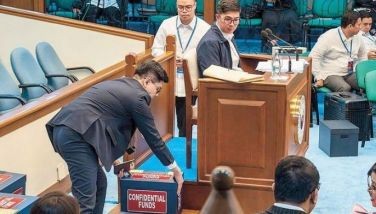
And this is once again happening in the proposed 2027 national budget amounting to a whopping P7.2 trillion which, according to critics in the House of Representatives, has been loaded with an estimated P180 billion worth of new infrastructure projects that reward political allies of the President.
According to Act Teachers Partylist Rep. Antonio Tinio, one glaring example is the additional funding allocation for the Ilocos Norte 1st district engineering office (DEO) which serves the congressional district of President Marcos’ son, House Majority Leader Sandro Marcos.
The allocation for Rep. Marcos’ DEO amounts to a hefty P4.38 billion.
In a recent interview with business reporters, Cuisia lamented the government’s debt problem that resulted from huge increases in the national budget, but unfortunately was not spent on productive activities and instead was lost to corruption.
Replying to questions from reporters, Cuisia explained, “If you look at the debt, look at what happened in 2023, 2024, 2025. Huge increases in the budget. Where did it go?... to corruption. Over P1 trillion were pork barrel funds. We all pointed this out…the People’s Budget Coalition, the roundtable for inclusive development...and yet, today, for 2027, they’re doing the same thing. All these insertions that they’re putting in… even after what happened in the 2026 budget. And this is why we’re appealing to the Senate, because the Senate can still block it. They cannot pass the budget without the Senate concurring.”
Cuisia expressed his doubts that President Marcos will veto the proposed 2027 budget. “We don’t know, we don’t know whether he will veto it, but you know it’s going to be terrible because, again, we’re going to squander billions for what? Pork barrel?... when our country is in a very dire position. What’s going to happen?”
Furthermore, he lamented, “How can we attract foreign investors when they see this happening?…The peso is skidding…the more they will not bring in money…when you see this, and then this corruption in the House of Representatives... it’s just so blatant. I don’t know what has happened to our House of Representatives. Parang wala na talagang hiya!”
Cuisia further pointed out that “only about one third of the budget would be left after taking out all that is required to pay for salaries, debt servicing, all the mandatory payments…only about a third is left for the government to work with in terms of infrastructure, health, education, etc.”
He continued, “So, that’s becoming less and less because the debt burden keeps growing bigger and bigger. So, if you were a foreign investor, would you come to the Philippines? That’s why you see our foreign direct investments have been going down. You look at the figures…but that’s the unfortunate thing, because that also affects the exchange rate right? If we had foreign direct investments coming in, we can rely on those dollars coming in.”
Additionally, he explained, “The portfolio investments are leaving the country. Foreign investors are selling out of the Philippine market, going elsewhere. So what happened? They need more dollars. When they sell their local stocks, they have to buy dollars. That adds to the demand. So it’s a very tough problem. I wouldn’t want to be in the shoes of Gov. Remolona. I’m sure he has sleepless nights.”
The former central banker noted that “foreign investors have been leaving the stock market over the last eight years, when you look at, from 2018, there have been, what? Net sellers? I mean, well, they’re going to safer markets, safe havens…the US, Japan, other other major countries…the EU.”
Cuisia adds, “the other problem is that because of the Middle East war, I think remittances have also been affected. Remittances have come down too. So we’re getting even less, less dollars. Now, when the peso depreciates, the exporters will tend to hold back the dollars, because they see the peso there. So that compounds the problem. So, you know, the BSP is caught in a bind. Well, you know, they don’t want to interfere or they don’t want to intervene in the market unless there’s really so much, you know, volatility.”
The other thing Cuisia highlighted is, “They also have to keep in mind that our reserves are heavily coming down. Our international reserves. They cannot squander it. You know, in 1999, during the financial crisis. The Bank Negara of Malaysia tried to defend the Malaysian ringgit, and they lost so much. Same thing with the Central Bank of Thailand. Because they cannot go against the market, and that’s why Gov. Ramolona keeps saying, we cannot intervene in the market, except to smoothen out volatility.”









- Latest
- Trending