Market’s narrowing breadth

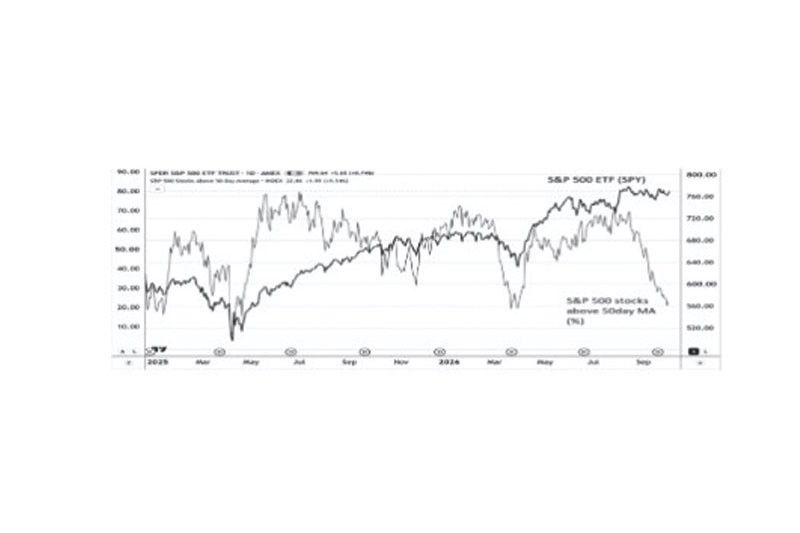
Market breadth has deteriorated sharply the past month. Only 22.9 percent of S&P 500 stocks are trading above their 50-day moving average, a key measure of market trend. In other words, more than three out of every four stocks are in a downtrend.
There were many times in the past that market breadth was weak. In March 2025, the S&P 500 fell as tariff worries and fears of a US recession intensified, following the DeepSeek scare that had already hit tech stocks earlier in the year. In March 2026, breadth deteriorated again during the so-called “SaaSpocalypse,” as investors feared that agentic AI would disrupt traditional software companies.
In both instances, when breadth was weak, the S&P 500 index was also down. Today, breadth has dropped to similar levels even as the S&P 500 trades near its all-time highs.
78% of S&P 500 down in September
According to FactSet data, 78 percent of S&P 500 stocks were down in September. This tells us how few stocks are actually carrying the market. As of Oct. 2, 2026, the Nasdaq Composite logged its 25th straight session where new 52-week lows outnumbered 52-week highs. This represents the longest such streak in 18 months.
While most stocks are struggling, it is mostly semiconductors and a few tech giants that are keeping the indices afloat. Higher interest rates usually hurt tech stocks. But companies are still spending heavily on AI, which keeps demand for chips and data centers strong. As long as earnings keep growing, investors continue to favor these companies despite higher rates.
Rates, oil and inflation bite
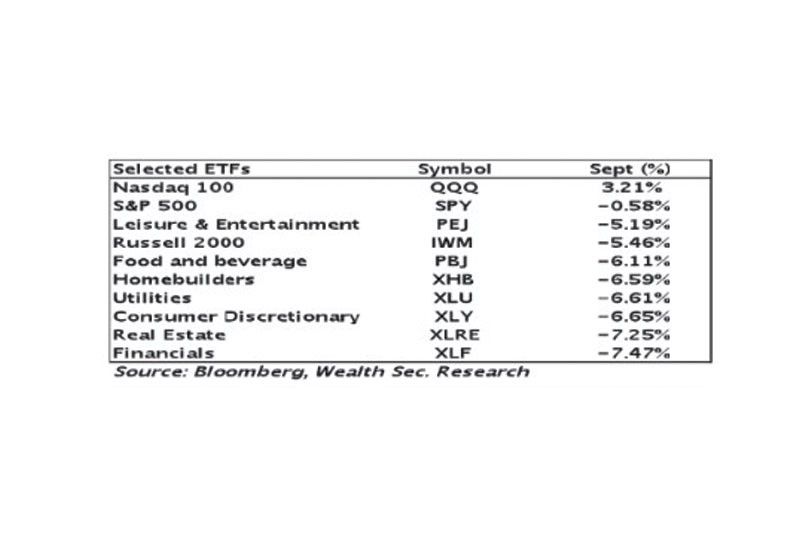
Higher bond yields have hit the most rate-sensitive parts of the market. The 10-year US Treasury yield surged to 5.34 percent last Thursday, its highest level in 24 years. The 30-year yield also climbed to 5.69 percent, its highest level since 2002. Utilities, real estate and home builders have weakened as borrowing costs climbed and mortgage rates moved back above seven percent. Small and midcap companies, which rely more on borrowing, have also lagged.
At the same time, higher oil prices and inflation are weighing on consumer stocks. Airlines took the biggest hit as jet-fuel costs surged. Travel, leisure, restaurants and other discretionary names are also down, as higher fuel costs and inflation squeeze both company margins and household spending.
Banks face new threat
Financials were also among the laggards in September. Aside from higher funding costs and bond market volatility, there’s now a new threat coming from agentic AI. Apollo chief economist Torsten Slok recently raised the possibility of an “agentic bank run,” where AI agents automatically move deposits from low-paying bank accounts into higher-yielding alternatives. If this happens, banks could eventually lose one of their key advantages, which is a stable base of cheap deposits.
Weakness spreads overseas
Hong Kong banks were also hit hard last Friday. HSBC and Standard Chartered fell sharply as higher US yields tightened financial conditions through the Hong Kong dollar peg. European banks also experienced a sector-wide selloff. France is at the center of concern amid worries over its fiscal deficit and mounting public debt. France’s 10-year benchmark yield briefly breached the critical five percent level and credit-default swaps rose to their highest levels since 2013.
Back to the US dollar
Higher bond yields and growing sovereign risk worries have pushed investors back toward the dollar in recent weeks. The US dollar index (DXY) has gained more than three percent since early September. Investors are running to the dollar and US markets – the deepest and most liquid markets in the world.
Friday, however, brought some relief. Weaker-than-expected employment data pulled Treasury yields lower and sparked a broader equity rally. The improvement in market breadth was a welcome change after weeks of increasingly narrow leadership.
Can breadth recover?
Poor breadth does not necessarily mean the bull market is over. So far, the broadening within tech has been enough to carry the market higher. Over the past three weeks, the iShares Expanded Tech-Software ETF (IGV) has gained 3.9 percent, while the VanEck Semiconductor ETF (SMH) is up by 10.9 percent. Software and semiconductors are now moving up together, supported by strong earnings and continued AI capital spending.
The AI revolution has carried the market to new highs over the past four years. Rightly so. Earnings growth and capital spending have been concentrated in technology, particularly AI. Money has also continued to flow into the US, home to many of the world’s leading AI and tech companies. As we explained in our previous article, “Size begets size,” money flows to where size, liquidity, earnings growth and opportunities abound.
Hopefully, if tensions between Iran and the US ease, crude oil prices will come down, inflation will cool and interest rates will start to top out. The rest of the market should then follow tech’s lead.
Philequity Management is the fund manager of the leading mutual funds in the Philippines. Visit www.philequity.net to learn more about Philequity’s managed funds or to view previous articles. For inquiries or to send feedback, please call (02) 8250-8700 or email [email protected].



- Latest
- Trending