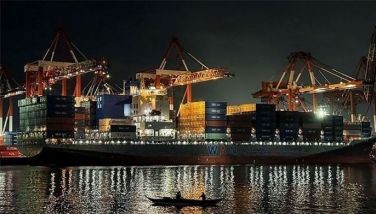
Our shipping industry needs help too!
Transport Secretary Vince Dizon is quick to trumpet the transport sector’s accomplishments but remains silent on areas that badly need his attention, particularly the shipping sector, where progress remains slow and complicated.
For an island nation such as ours, a robust shipping sector should have been a pillar of our transport sector, providing a cheaper means of connecting our more than 7,000 islands and moving people, vital goods and machinery across the country. But sad to say, while most of our Asian neighbors are among the top ranked countries for maritime connectivity, we are nowhere near compared to their shipping connectivity.
China tops the list in maritime connectivity, followed by South Korea and our ASEAN neighbors Singapore and Malaysia. The US ranks fifth globally, followed by Vietnam in sixth place, Japan in seventh, Spain, India and the United Kingdom.
Unfortunately, our shipping sector instead is quietly racking up losses, burdened by high port fees and shipping costs, with the government seemingly unbothered and not ready to provide relief tosuch an important sector.
Thus, we tend to focus more on our airports and complain about their inadequacies, even though in reality the development of a modern and reliable shipping sector would contribute so much more to our growth in the transport of vital resources and movement of people.
A reliable shipping sector would also help our tourism sector more by providing a better experience to foreign tourists who could better enjoy our island nation with a leisurely cruise to more local destinations than to a select few cities or island resorts.
According to the shipping grapevine, Doris Magsaysay-Ho is ready to throw in the towel on Lorenzo Shipping Corp. (LSC) due to continued losses.
In March 2026, LSC moved to hike authorized capital stock to P2 billion with subscription support tied to NMC Container Lines to settle obligations and support operations. Following declining shipping activity and financial losses, LSC began shifting in July 2026 from active cargo shipping to leasing out vessels and assets.
However, according to a Bilyonaryo report, LSC reported steep losses as it wound down cargo shipping operations in favor of asset leasing, with third-quarter 2026 revenue dropping 77.8 percent to P78.5 million against P174.6 million in direct costs.
SM’s 2GO Group Inc. is also reportedly facing financial headwinds, but is not required to disclose its financials since it is part of the SM Group as an integrated logistics and sea travel provider.
With local shipping lines struggling, it is foreign shipping lines that are now providing most of the shipping requirements for the movement of most goods and products in our country, with shipping sources admitting that the shipping cost is actually much cheaper with the foreign firms than domestic shipping companies.
Of course, there are still some winners, such as Aznar Shipping Corp., which saw its net income jump 155 percent in the first half of 2026 as revenue more than doubled after adding vessels, following full-year 2025 net income of P51.78 million.
Better optics
We all know that the best wins are always those that are already near completion and ready to be launched, even if one was late to the party.
In the news lately, Sec. Vince has been riding on the success of the installation of more e-gates at the Ninoy Aquino International Airport (NAIA).
The 78 biometric Amadeus e-Gates in Terminals 1 and 3 were funded by private operator New NAIA Infra Corp. (NNIC) at no cost to the Bureau of Immigration.
The BI only provides the operational immigration components, but did not provide any funding for the new e-gates that the NNIC installed at its own cost and has been trying to make operational despite the move of the BI to impose an $8 fee (or roughly around P480) round-trip user fee on the e-gates.
The BI, through funding releases from the Department of Budget and Management (DBM), has supported multiple phases of e-Gate installations outside Metro Manila, including in Clark, Cebu and Davao. These include a P2-billion release for Phase 1, a P1.5-billion contract with iWave/Amadeus for 47 e-Gates and 57 biometric counters, and an ongoing P1.347-billion procurement for Phase 2.
However, the proposed $4 each way ($8 round-trip) fee is tied to a separate, unsolicited P10.74-billion Public-Private Partnership (PPP) called the Civil Aviation and Immigration Security Services (CAISS) project with US-based Securiport LLC.
Unlike the government-purchased e-Gates, Securiport would shoulder the upfront cost to install, maintain and upgrade broader border security systems (including advanced passenger analytics, watchlist screening, and additional contactless gates) across 11 airports, one seaport and six mobile border stations.
Securiport would recover its investment over 20 years through the passenger ticket fee, keeping $3.80 of every $4 collected, with $0.20 going to the BI.
I wonder what Sec Vince’s position is on this “wrinkle” that will burden Filipino travelers.
I was also wondering why the government would again want to get into such a contract where a foreign entity could hold hostage all that information if it gets into a dispute over the contract, similar to the election controversy with Smartmatic.
I think there was also a similar problem with the Land Transportation Office over its IT service providers.
Does our government, perhaps through the Department of Information and Communications Technology, not have the capacity to develop our own IT solutions for our government agencies?






- Latest
- Trending