Inflation cools to 6.1 percent in August
Lowest in 5 months
MANILA, Philippines — Inflation eased further in August to its lowest level in five months, driven mainly by the slower increases in food prices, according to the Philippine Statistics Authority (PSA).
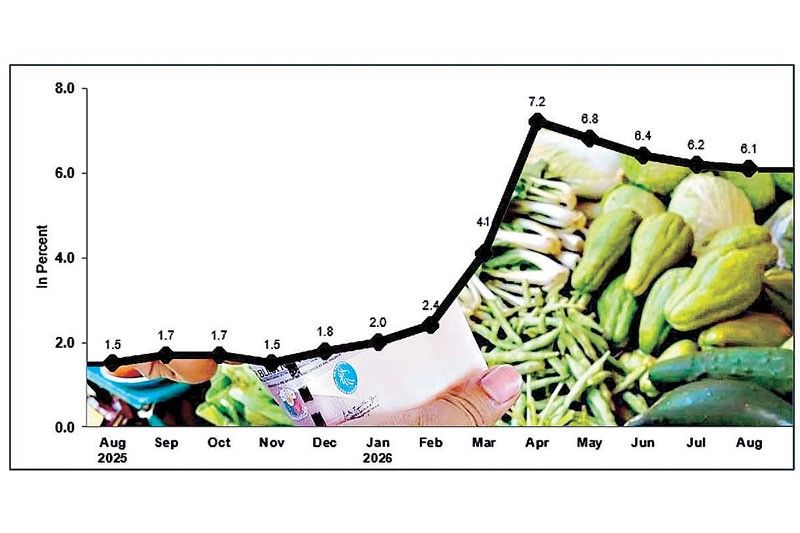
In a press conference, National Statistician Dennis Mapa said the headline inflation – the annual change in the prices of goods and services typically purchased by Filipinos – slowed to 6.1 percent in August from the previous month’s 6.2 percent.
This is the lowest inflation print since the 4.1 percent in March.
While inflation eased from the previous month, the August reading was much higher than the 1.5 percent print in the same month last year.
The latest inflation result fell within the Bangko Sentral ng Pilipinas (BSP)’s forecast range of 5.5 to 6.5 percent for August.
Driving the continued downtrend in overall inflation was the slower annual increase in food and non-alcoholic beverage prices at 4.6 percent in August from 5.2 percent in July.
Inflation for food alone also had a slower annual increase of 4.6 percent in August from 5.3 percent in July. This was mainly driven by the decline in vegetable inflation at 3.4 percent from the previous month’s 8.4 percent increase.
While food inflation eased, inflation for rice quickened to 19.4 percent in August from 17.1 percent in July.
Mapa said the August rice inflation was the highest since July 2024 when rice inflation was recorded at 20.9 percent.
Also driving the slower overall inflation was the housing, water, electricity, gas and other fuels commodity group, which moderated to 7.9 percent in August from the previous month’s 8.2 percent.
Core inflation, which excludes selected food and energy items, eased to 4.1 percent in August from 4.2 percent in July.
From January to August, overall inflation averaged 5.2 percent, above the government’s two to four percent target for the year.
“While the overall figure remained stable, the moderation in key drivers such as food inflation gives us confidence that we are moving in the right direction,” Department of Economy, Planning and Development (DEPDev) Secretary Arsenio Balisacan said.
Mapa said the recent heavy rains and flooding, however, may affect inflation.
“As we noticed in the previous months and years, there is a direct effect from disasters like flooding. This has an impact first on food products, particularly vegetables,” he said.
While inflation for vegetables declined in August, Mapa said that it may change direction in September.
He said that the El Niño episode, which is expected in the latter part of the year, may also affect prices and inflation.
“El Niño is a factor. It has an impact, and of course the intervention of our national government particularly in providing rice to the public at a lower price would impact the prices,” Mapa said.
For its part, the BSP said it would continue to closely watch the impact of recent developments in the Middle East and weather-related disturbances.
“Going forward, the BSP will remain guided by incoming data and its assessment of risks to the inflation outlook,” the central bank said.
ING regional research head for Asia-Pacific
Deepali Bhargava said that inflation risks remain tilted to the upside, with rice inflation expected to continue to accelerate and El Niño conditions now firmly established.
“The risk of renewed food?price pressure is rising, especially for rice and other weather?sensitive crops. This could slow the disinflation process,” she said.
In terms of monetary policy, she said that ING expects one additional 25-basis-point rate hike in the fourth quarter.
At its last policy meeting in August, the BSP raised the benchmark interest rate by 25 basis points to five percent.
“Uncertainty surrounding the severity and duration of El Niño, higher oil prices, depreciating PHP and the extent of wage pass-through is unlikely to be fully resolved before then,” Bhargava said.
“Together with persistent core inflation and elevated inflation expectations, these factors should keep the BSP focused on ensuring that inflation returns to target on a sustained basis,” she added.
To help manage price pressures and support vulnerable sectors, the DEPDev said the government continues to implement interventions under the Unified Package for Livelihoods, Industry, Food and Transport or UPLIFT program.
Government interventions include expanding access to affordable food through over 700 Kadiwa outlets nationwide, distribution of free rice through the “Bawat Bayan Makikinabang” Program and fuel assistance to vulnerable transport groups.
With El Niño seen to pose risks, the government also continues to update its response plan by prioritizing irrigation, input assistance, inventory monitoring and other measures to keep food prices stable.
“Our priority is to strengthen the foundations of long-term price stability through improved food security, more efficient logistics and targeted support for vulnerable sectors,”Balisacan said.
“These are not short-term fixes; they are investments in a more resilient economy capable of withstanding future disruptions,” he said.
“As we noticed in the previous months and years, there is a direct effect from disasters like flooding. This has an impact first on food products, particularly vegetables.”








- Latest
- Trending