Why Japan’s handrails refuse to be ordinary

If you have been to Tokyo and have seen this train station staircase, don’t think you are having a panic attack or a flashback to that modern art museum. At first glance, this wavy stainless steel handrail looks less like urban engineering and more like a bent paper clip in an existential office drama. When I published this photo on Facebook, I received one comment suggesting sadomasochism.
That gave me an immediate reason to hit the “block” button on my network.
Another message came from a former work colleague, Nick Marcelo who wisely noted that the handrail’s design is “a good way to prevent people from using it as a slide.”
I agree entirely. That was the first thing on my mind about this playful architectural design choice.
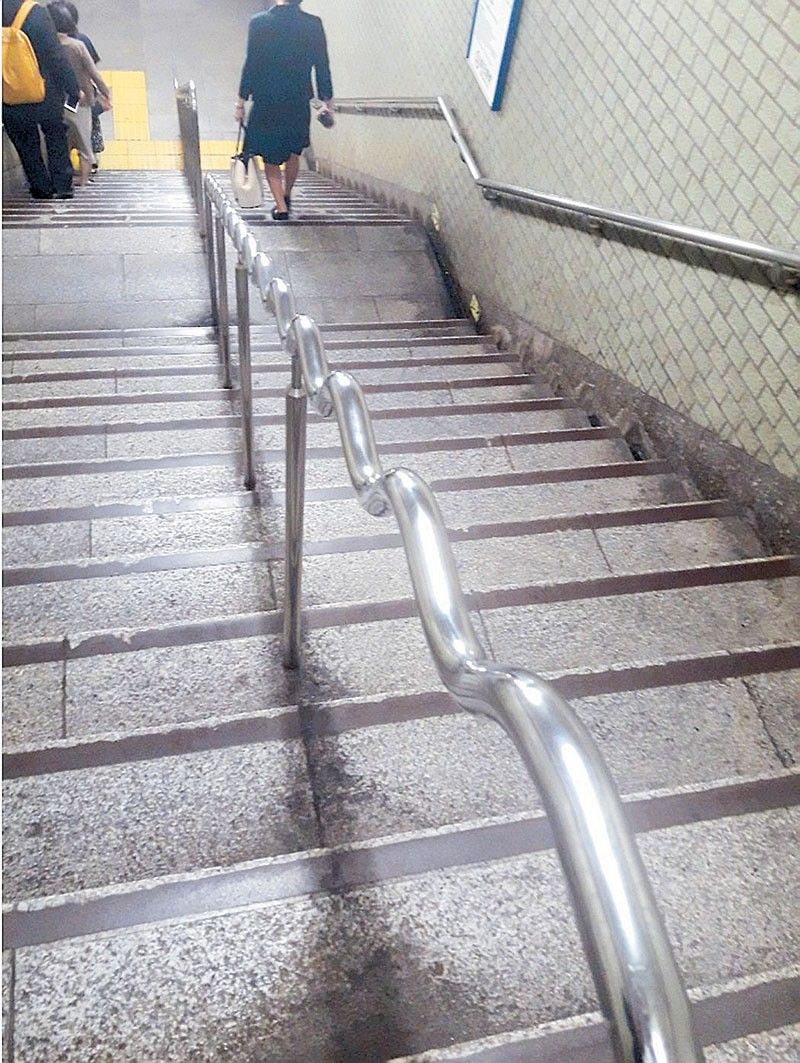
This wavy handrail, known commercially in Japan as Qunetto or J-WAYVES is a masterclass in human-centered ergonomics.
To my mind, the design with its rhythmic bends copies the natural mechanics of the human body.
The website of j.wayves.com gives you more reasons and elegant examples on how they improvise handrails for the betterment of humanity and perhaps the bewilderment of tourists like me when I took the photo years ago.
The wavy design incorporates both the horizontal and vertical sides, engineered so that the vertical dips can securely catch a person’s weight, allowing tired commuters to pull themselves up with zero guesswork.
It turns out Japanese designers realized standard straight rails were basically slippery slides for distracted pedestrians. So, instead of letting them slide to their doom, they spent years studying how real humans move, including how we stumble, shuffle, and desperately reach for support when carrying four bags of convenience store snacks.
Imagine the plight of Filipino tourists lugging their bags of tax-free limited-edition of Kitkats, Matcha treats, and Ichiran ramen boxes from Don Quijote, commonly known as Donki. The result is functional ingenuity disguised as a piece of architectural comedy.
Basic principles
Beyond its unusual appearance, this wavy handrail offers an interesting lesson for managers. Sometimes, the best improvement does not require expensive technology or complicated procedures. It begins by observing how people actually work, identifying their difficulties, and redesigning the environment to make things easier and safer.
These are under the Kaizen and Lean Thinking (KLT) principles:
1. Pokayoke (mistake-proofing). This means designing a process or environment so that human error becomes physically impossible or immediately obvious. The wavy J-WAYVES patented design doesn’t scold people for being distracted or clumsy.
Instead, it physically guides human hands (including playful children) into secure contact points. They are designed to prevent people from resting their torsos or legs on them. It encourages using the correct posture and grip by design, without needing a stern, ugly sign that says: “Please hold the rail.”
2. Ergonomics and the elimination of human fatigue. KLT isn’t limited to factory tools and equipment. It’s about human ergonomics, safety and eliminating physical strain. Conventional handrails may not provide the same range of gripping positions or support options as this wavy design.
The horizontal-meets-vertical design aligns with human biomechanics and reduces the physical strain of ascent and descent.
3. Seeing is to see actual problems. The best place to solve a problem is at the Gemba or the actual place where it happens. In this case, train stations where the commuter traffic flows. That’s where real insights happen. You don’t innovate by sitting in an air-conditioned boardroom.
You go to the place where people stumble and shuffle with or without their shopping bags. Engineers may have spent countless hours standing on Tokyo train station stairs watching how commuters use the handrails while being distracted by their smart phones or luggage.
They recognized a flawed standard environment and reinvented it.
4. Continuous improvement in public spaces. KLT means change for the better, often through small, creative, low-cost modifications rather than massive, over-engineered technical overhauls.
Besides, a handrail seems like the most boring, immutable piece of engineering. I suppose Japanese urban designers looked at it and said: “Can we make this better?” It proves that no process, object, or standard is ever too simple to escape the relentless, creative pursuit of improvement.
Rey Elbo is a quality and productivity activist. Send your comments, stories or ideas to [email protected] or DM Facebook, LinkedIn, X or via https://reyelbo.com/contact-us.







- Latest
- Trending