South China Sea code 70% 'agreed'
MANILA, Philippines — About 70% of the proposed South China Sea code of conduct has been "agreed," a Department of Foreign Affairs official said, but it remains to be seen whether ASEAN and China will conclude the talks by the end-2026 deadline they set for themselves.
"I would also like to stress that 70 percent of the COC package has already been agreed," Dominic Xavier Imperial, DFA deputy assistant secretary for ASEAN affairs and ASEAN spokesperson, told ANC's Headstart on Thursday, November 12.
"I think during the Philippines chairmanship, we can say that that is already good progress when it comes to the COC negotiations," he added.
The DFA official stressed however that talks are ongoing and he could not say whether the long-stalled code would be concluded before the Philippines' ASEAN chairship ends in December. "I cannot really pre-empt how the COC negotiators will conclude this year," he said.
The ASEAN spokesperson's remarks tempers expectations that a legally enforceable South China Sea code would come during Manila's year as ASEAN chair.
The countries' negotiators have been holding monthly meetings to iron out the code of conduct since January.
In July, Foreign Affairs Secretary Theresa Lazaro said ASEAN and China had the political will to wrap up negotiations by year-end.
The target of completing the code by 2026 was set in 2023 when ASEAN and Chinese foreign ministers adopted guidelines to speed up the talks and agreed to conclude them within three years.
But what are the internal disagreements this time? Imperial declined to describe what issues are pending with the other 30% amid ongoing negotiations.
"What I can share with you is that the remaining 30% ... still covers some of the milestone issues that were discussed in previous meetings. We're looking at very specific items in each paragraph of the agreement," he said.
Lazaro said in June that four core issues remained unresolved: whether the agreement will be legally binding, its geographic scope, its relationship to the 2002 declaration, and its terms of reference. ASEAN has long pressed for a binding code, which China objects to.
Talks on a binding code of conduct follow the 2002 Declaration on the Conduct of Parties in the South China Sea, a non-binding pact that has largely failed to prevent tensions at sea.
"The COC should be able to dictate the behaviour of all parties in the South China Sea," Imperial said, adding that it should also "respect the rights of third parties and not just those negotiating the COC."
"We [will remain pushing] for those priorities in the negotiations," Imperial added.
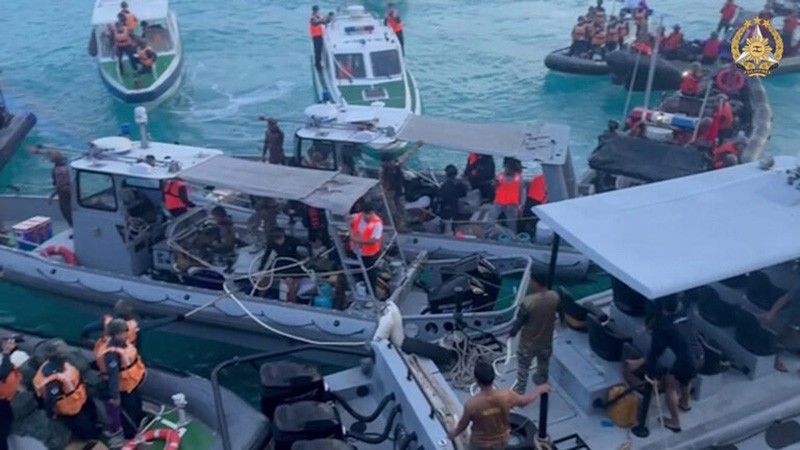
The negotiations for the code have been taking place amid repeated confrontations between Philippine and Chinese vessels this year, including at Scarborough Shoal and Ayungin Shoal.
China claims nearly all of the South China Sea, overlapping with the claims of the Philippines, Vietnam, Malaysia and Brunei.
A 2016 arbitral ruling in a case brought by Manila found that Beijing's expansive claims had no legal basis. China has never recognized this ruling.
Even as it is at a low point, relations between Manila and Beijing will not be a focus of the ASEAN summit itself, Imperial said.
Chinese Premier Li Qiang will attend the ASEAN-China Summit in Manila.
"We recognize the breadth and the depth of the relations between ASEAN and China," Imperial said.
"We are looking at a broad range of issues and topics ranging from peace and security to economic and to social-cultural issues," he added.


- Latest
- Trending