AMRO trims Philippines growth forecasts
MANILA, Philippines — The Association of Southeast Asian Nations Plus 3 (ASEAN+3) Macroeconomic Research Office (AMRO) has lowered its growth projections for the Philippines amid high inflation and weak public investment.
Its Quarterly Update of the ASEAN+3 Regional Economic Outlook for October showed that AMRO now expects the Philippine economy to grow by 3.3 percent this year, slightly lower than its 3.4-percent forecast in August following its annual consultation visit to the country.
The revised 2026 gross domestic product (GDP) forecast is also below the 3.5- to 4.5-percent growth target for the year.
AMRO also trimmed the 2027 GDP growth forecast to 4.6 percent from 4.8 percent previously.
The new 2027 growth projection remains below the government’s five- to six-percent growth goal for next year.
In a press conference, AMRO chief economist Dong He said the Philippines was among those hit harder by the energy shock linked to the Middle East conflict.
Despite the government’s swift response to the conflict’s impact, he said economic growth still slowed significantly and inflation rose quickly.
The economy grew by 2.3 percent in the second quarter, the slowest in five years, bringing average growth in the first half to just 2.6 percent, below the government’s target.
While inflation eased slightly to 6.1 percent in August from 6.2 percent in the previous month, it remained elevated.
From January to August, inflation averaged 5.2 percent, above the government’s two to four percent target.
With inflation above the target range, AMRO raised its inflation forecast for the Philippines to 5.6 percent this year from the 5.4-percent estimate provided in August.
AMRO also raised its inflation forecast for 2027 to 4.6 percent, up from its previous estimate of 3.8 percent.
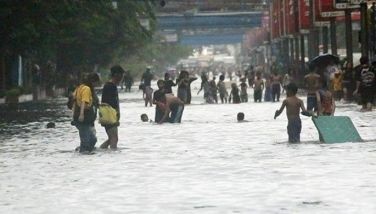
Dong He said the slower public investment due to flood control issues was also a factor in the revised growth projections for the Philippines.
“The growth outlook is very dependent on how fast public investment and construction-related activities can pick up,” he said.
Even as the Philippines continues to face challenges, he said there are bright spots for the economy, citing its clear policy frameworks, robust remittance flows, the information technology-business process management sector and service exports.
“In this kind of situation, I think it’s important for the authorities to make use of the very robust policy framework they have, but ensure that public investment – well-governed public investment – can pick up speed and reach the government’s plan to complete this project,” he said.
“That’s very important for the Philippine economy to come back to its potential growth,” he said.
For ASEAN+3, AMRO kept its growth forecast of 4.1 percent for this year, slower than last year’s 4.3 percent growth.
However, AMRO slightly raised its 2027 GDP forecast for ASEAN+3 to 4.1 percent from the previous projection of four percent.
AMRO cited artificial intelligence (AI)-related demand as a risk to the growth outlook for ASEAN+3, noting that it could either strengthen or weaken exports and investment.
ASEAN+3 plays a substantial role across multiple segments of the global AI supply chain, with the region accounting for almost half of global exports of AI-enabling goods and ASEAN contributing about 15 percent in 2025.
However, the Philippines’ participation is limited compared with others in the region, with the country accounting for five percent of global exports of analog and amplifier integrated circuits last year.
Other downside risks to AMRO’s growth outlook are renewed disruptions in the Middle East and a more persistent El Niño, along with financial-market volatility and further protectionist measures.
“El Niño is firmly established and likely to become very strong toward end-2026, with its macroeconomic effects likely to extend into 2027,” AMRO said.
It said the impact could be felt in agricultural output and rural incomes, food prices and trade, water availability and power generation.
AMRO said the Philippines is exposed to El Niño in terms of production, with agriculture accounting for 8.6 percent of GDP and 20.5 percent of employment.
It said the Philippines has higher exposure to food price shocks, with rice accounting for 8.9 percent of the consumer price index basket, or the basket of goods typically purchased by consumers.


- Latest
- Trending