The waiting room: Grassroots innovation vs systemic waste

Many times, I’ve encountered situations that are naturally funny, but in truth are downright stupendous, like a stranger’s clumsy fall due to a wet floor courtesy of a diaper-less pet dog inside a shopping mall.
Somehow, you marveled at seeing that person safely landing on his two feet, like Peter Parker discovering his newfound talent in Spider-man. It was so perfectly timed, you feel it was scripted. Yet, beneath the surface lies an unseen human resiliency quietly working behind the glamour.
Then you pause long enough to examine the overlooked problem, the silent forces at play, and the comedy transforming itself into wonder. That moment reminds us that life’s sharpest humor frequently masks its extraordinary designs and rewards only those willing to look past the punchline into the deeper meaning.
The waste of waiting
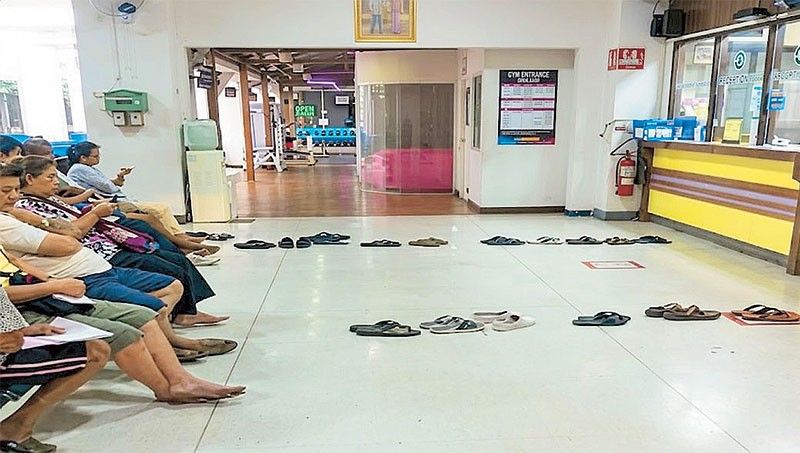
Analyze the following photo. People wait in line using their slippers to mark their spot while waiting for the opening of two service counters during a lunch break. It’s one of my favorite examples to dramatize the waste of waiting in my Kaizen and Lean Thinking (KLT) seminar-workshops.
The situation highlights the interchange between grassroots problem-solving and management operational flaws.
This forces people to think of practical solutions in the midst of management indifference like the case of a government agency “forcing” the public to use plastic chairs in filling-up some forms.
But that’s another interesting case I’d like to share in the future. In the meantime, let’s examine the waste of waiting from the perspective of KLT:
One, the primary reason. Long waiting times force customers to invent practical, non-traditional queueing mechanisms, like footwear as “placeholder” holding a spot for their owners. That easy and practical solution provides humor relief but solves people’s discomfort.
Two, the secondary waste. By “allowing” the customers do the extra physical movement to place their footwear, return to seats and retrieve them when called is another waste. Customers must spend additional time and effort placing their footwear, returning to their seats and retrieving it when called.
Three, the bottom-up innovation. The photo illustrates human ingenuity in response to a system that is not particularly human-centric. Customers self-organize a clever, visual indicators “queue system” without management intervention, but an orderly, democratic way of managing order.
Four, the limits of local optimization. While the “slipper queue” solves customer discomfort (sitting vs. standing), it does not solve the root cause, like the slow throughput at the reception counter. It’s a customer band-aid intervention versus management’s neglected root-cause solution.
Root cause analysis
Given the situation, KLT requires us to do root cause analysis using Five Whys (among other tools) to scientifically examine the problem. That’s assuming that management of the service counter recognizes it as a problem. So, here are the questions and their hypothetical answers:
One, why are slippers holding spots in the line? Because people want to sit while waiting without losing their place.
Two, why do people have to wait for long periods? Because the counter staff is on a one-hour lunch break.
Three, why can’t they have a rotational lunch break? Because they don’t have enough workers to cover the service counters.
Four, why don’t they hire additional workers? Because they don’t have any budget for additional manpower.
Five, why don’t they have the budget for additional workers? Because their revenue is not enough to cover their salaries.
These are hypothetical answers. You can do your own depending on your experience. You may come up with different questions. And your team, including their line supervisors and managers can ask as many whys as possible as long as they are not satisfied with the answers, even with the 20th why.
To naïve managers, the solution is laughably simple, cheap and practical. A numbered ticketing system may organize the queue, but it doesn’t necessarily reduce the waiting time. Somehow, it may redeem customers’ indignity. Then, congratulations! You’ve successfully choreographed the waste. The line still there.
The real solution is less polite for management. Stop tolerating a system that treats human time as disposable. Tear the root causes of waiting and ask a bold question: In the first place, why must customers wait that long?
Rey Elbo is a quality and productivity activist. Send your comments, questions or stories to [email protected] or via Facebook, LinkedIn, X or https://reyelbo.com.


- Latest
- Trending