


Pop psychology with a twist

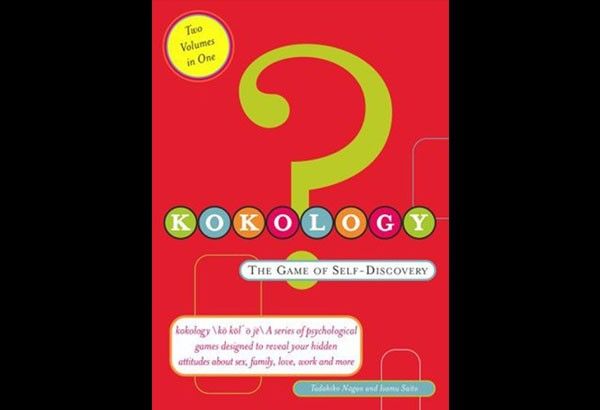
One interesting gift I received last Christmas is a handy two-volume book with an intriguing name, Kokology: The Game of Self-Discovery, a fascinating, addictive pop-psych quiz-game compilation authored by Isamo Saito, a renowned psychology professor at Risho University in Japan, and Tadahiko Nagao, head of the Kokology Project team. The tomes were published in the late ’90s but were recently reissued to appeal to a new batch of readers.
Kokology comes from the combination of two words with different origins: “kokoro,” a Japanese word that means mind, spirit or feeling, and “logia,” a Greek term that means the study of something. It’s “a popular term for the interpretation of the hidden meanings of human behavior and situational responses.”
• Kokology is a game, but the sense it brings can’t be ignored. It’s a portable version of a psychologist or a psychoanalyst, which allows you the same process of discovery, but packaged with a large dose of interest and fun. It is a collection of life and work experiences — sweet memories, emptiness inside, hanging out, making judgments, blowing your horn, or spreading your wings — viewed in a form of play that is less threatening.
• Kokology helps open the inner eye and sharpen its vision. It allows you to study and comprehend the mind using psychological triggers and quizzes. It randomly presents a variety of scenarios that are seemingly unimportant and trivial, but actually serve as levers to see the insights in your hidden attitudes and feelings about sex, love, and relationships, among others, filtered through the medium of riddles.
Consider this one: “It’s a morning like any other: last-minute preparations before you run out the door. Hair? Check. Clothes? Check. Everything’s ready to go. You get on your way at the usual time, but halfway to work you realize your wallet is not where you always keep it. A quick search confirms the worst; you left it at home! And there is no time for you to turn around and go back for it. You begin going through your pockets and bags to see how much spare cash you have to get you through the day. How much more do you find?”
Kokology’s analysis of this sequence of events says that the amount of cash you find represents the amount of money you forget about in your daily life. It also pictures the amount of money you feel comfortable lending to others. Just how much did you say you found? It could be a reasonable figure, an amount that could make you popular with friends, or nothing at all, which makes you cheap or just broke.
Another instance: Imagine what instrument you would play in an orchestra. The one you choose gives an indication of your strongest sexual techniques. The violin denotes precise hand technique, while the string bass symbolizes power and domination. A trumpet represents a strong oral personality, and a flute exemplifies extreme patience towards your partner.
The whale-watching game asks you to visualize a family of whales. The characteristics of the family you see determine how you feel about your own family, whether it’s too much dependence on your mother, craving for physical affection, equal appreciation for both your mom and dad, or achievement of personal autonomy.
Look at postmarking the future: Lounging around the house one afternoon, you are startled out of your reverie by the doorbell. When you open the door, you are greeted by a most unusual surprise: a pair of animal messengers has come to deliver news of your life in the future! But when you open their messages, you see they contain very different predictions of what lies in store for you. One of the animals has brought a letter foretelling a life of happiness and contentment; the other prophesies only disaster and despair. In this scenario, the animal you choose as the bearer of the message of happiness represents the type of person you perceive as an ideal spouse, while the doomsayer animal is the type you fear would drag you down into the depths.
Other conundrums are somewhat more spirited and vigorous, bringing up the parlor-game aspect of the book. In the puzzle, “The Stolen Berries,” you are asked what you would do if you saw a fenced-off field of berries. What does the fence look like? How many berries would be eaten? Berries turn out to be a symbol of sexual attraction and desire, and the game measures attitudes towards forbidden love. Sorry, but there is no record of what your attitude is if you simply don’t like berries.
• Kokology is a communication tool. The answers you provide in the games, surprisingly enough, accurately reflect your true personality, and that of others. “This makes the game a great way to bridge communication gaps between friends and lovers, to bring you closer and help you understand each other better, to open up conversations on what might otherwise be difficult, sensitive, or forbidden subjects,” Saito stresses.
• Kokology shouldn’t be confused with psychotherapy, or with other personality tests. It’s a worldwide fad that has taken off, and has been as satisfying as astrology or tarot. You can use the riddles to create excitement in small get-togethers, as icebreakers during group meetings, tension-lifters after heated discussions, or as a form of entertainment during long drives. Its conclusions are open to argument, but those could be humorous or pave the way for some self-introspection or group evaluation.
When the life-sucking virus hits you, threatening to destroy your business, your family, and the tapestry of your soul, and robbing you of the joy, hope, and will to move on, pause and let Kokology inspire and lighten your mood with quotes like these:
• You’ll never change the world just by complaining.
• Justice never sleeps.
• A love life without worries is no love life at all.
• Compassion for others is a mark of wisdom.
• Believe in yourself and the world will follow suit.
• One of the truest signs of strength is accepting one’s own weaknesses.
• Being able to make people laugh is great, but it takes on a different meaning if they are laughing at you, not with you.
• It won’t kill you to wear that same pair of socks one more day.
• Love and danger go hand in hand.
• The first step toward being loved is learning to love what you see when you look in the mirror.
• Every human personality is the product of an innate drive to create something unique from one’s raw individual experience.
•A bad hair day is not a valid excuse for calling in sick.
• You can’t stop the rain by worrying about it.
• If you chase after everything at once, you stand a good chance of ending up empty-handed.
• Dissatisfaction can be a source of inspiration if you learn to control it.
• Good or bad, it’s the little surprises that keep life interesting.
• Nobody’s so great that they can’t get better.
• Your mother didn’t raise you to be a child forever.
• The only thing you really have to prove is yourself.
* * *
Email bongosorio@gmail.com for comments, questions or suggestions. Thank you for communicating.