Art educator Bing Tac-an finds a muse in the Philippine eagle


Willa Freah “Bing” Tac-an is a wife, mother, artist, teacher, and a passionate advocate for the preservation and promotion of the Philippines’ native flora and fauna. A dedicated art educator, she even once taught my nephews, Patrick and Peter. In 2019, she founded both the Philippine Botanical Art Society and the Philippine Fauna Art Society — two pioneering organizations that have played a vital role in bringing native species into the spotlight.
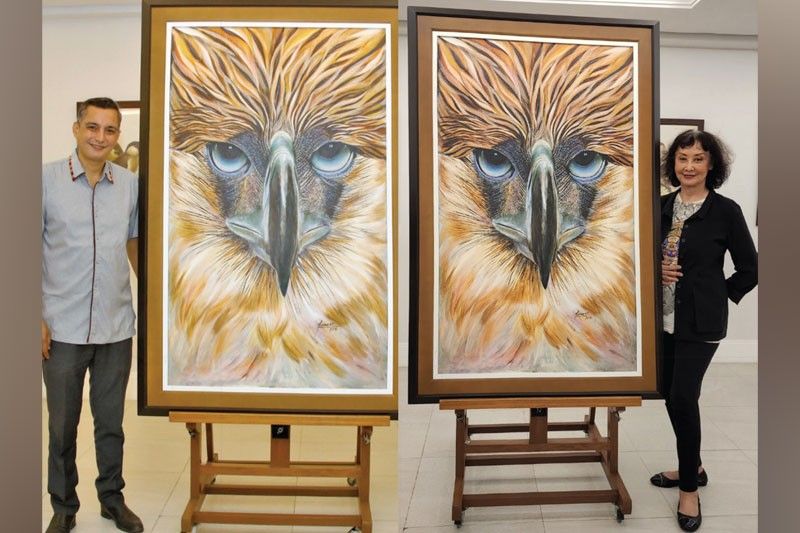
Her latest initiative, Agilakbay, furthers this mission by aiming to send her Philippine eagle paintings to every Philippine embassy and consulate worldwide. She has already completed 14 out of 97 donations, with the goal of completing all by her 60th birthday in January 2034.
In the conversation that follows, Bing shares her journey — her beginnings, struggles, inspirations and the passion that drives her art and advocacy. Meet the woman behind the brush, whose work is as heartfelt as it is powerful.
What was your childhood like and when did you realize that you were artistic?
Bing: “I grew up with a box of crayons and a lot of curiosity. As a child, I never really thought of myself as an ‘artist.’ I just loved drawing and colouring. I would sketch endlessly: little things from nature, or even cartoon characters like Garfield. My childhood wasn’t glamorous, but art was always my escape and my playground. It gave me joy in a way nothing else did.
“In high school, I started joining art contests and sometimes I’d win. But I always felt inadequate because I only had crayons and pencils, while the other contestants had soft pastels and fancy Cray-Pas sets. Still, I poured everything into what I had. I also remember illustrating my school projects and even doing realistic portraits of scientists. Looking back, those small moments were really the beginnings of seeing myself as an artist.”
When did you decide to become a professional artist?
Bing: “The decision came much later. For years, art was something I did quietly, almost shyly, on the side. It wasn’t until 2016 that I took it seriously, when I began painting Philippine endemic and indigenous flora and fauna. That was when I felt a real calling, bigger than myself. It wasn’t just about painting anymore, it was about advocacy, about giving a visual voice to species that most people overlook. That’s when I embraced the idea of being a professional artist.”
What was your journey as an artist like? Your struggles, victories and such?
Bing: “My journey has been both humbling and surprising. The struggles? Plenty. There’s always self-doubt, financial challenges and the feeling of being unseen despite working so hard. When I first painted Philippine species, no one paid much attention, then suddenly, everyone else started painting them, too. Part of me felt overlooked, but another part took pride in knowing I had sparked something bigger than myself.
“The victories have been beautiful. Donating my Philippine eagle paintings to embassies and institutions worldwide has been a deeply fulfilling part of my journey. Founding the Philippine Fauna Art Society and the Philippine Botanical Art Society gave me the chance to build communities around this advocacy. Holding solo exhibits both locally and abroad allowed me to put Philippine biodiversity on the world stage.
“I also created projects that bring art beyond traditional walls: Ikot Museo, which brings art to places not reached by museums or galleries; Agilakbay, which combines exhibitions and community murals to bring the Philippine eagle across the world; and Painting Forward, an initiative that gives children and adults alike the chance to paint for free and learn from my workshops. Each milestone, whether big or small, feels like proof that following your calling will eventually make waves.”
How did your fascination for flora and fauna and the Philippine eagle come about?
Bing: “It really began in 2016, when I came across a Facebook post about the planting of cherry blossom trees in Benguet. Back in 2015, they had planted a hundred, but only a handful survived. In 2016, they tried again, with the vision of holding a Cherry Blossom Festival in Benguet so Filipinos wouldn’t have to travel abroad to see one. At first it sounded beautiful, but then it made me sad. Why were we aspiring for a festival of trees that weren’t even ours, when the Philippines has so many flowers and plants that are alive, breathing, and truly our own?
“Sure, we have the Panagbenga Festival in Baguio, but most of those are exotic or cut flowers. Even with my limited knowledge at the time, I knew we had countless native flowers. I just didn’t realize how many until I started researching. I was stunned to discover we have thousands of native flora species, and all of them are beautiful. Yet no one was painting them. Most artists were focused on exotic species. I searched for anyone who consistently painted native flora and fauna, and I found no one. That struck me deeply. I even discovered that our national flower, the Sampaguita, isn’t native to the Philippines, a fact I’ve been including in my talks since 2016.
“As I dug deeper, I learned that the Philippines is one of the 17 megadiverse countries in the world, yet biodiversity wasn’t represented in our art scene. That realization shaped my path: I began creating solo exhibits dedicated entirely to our flora and fauna.
“Then in 2018, my family visited the Philippine Eagle Centre. That was when everything crystallized. The eagle captivated me completely, majestic, rare, yet critically endangered. I remember its gaze piercing my heart and soul. There it was, standing tall and regal, and yet it was slowly disappearing. Painting it became my way of honouring and protecting it.
“Over time, it grew into more than fascination. It became an advocacy… I chose the Philippine eagle as my muse because it’s an umbrella species: once you protect the eagle, you protect everything else in its habitat. To me, it isn’t just a bird. It’s a living symbol of hope, heritage and survival.
“This realization also led me to establish the Philippine Botanical Art Society and the Philippine Fauna Art Society. I knew I couldn’t paint all our native species alone. We needed an art community to paint them collectively. After all, there are thousands of native flora and fauna waiting to be recognized. Botanical art in the Philippines had been dormant since the time of Father Blanco in the 18th century, and with the birth of the Philippine Botanical Art Society, that huge gap was finally closed. I am also honored that through these societies, we have had the privilege of partnering with the National Museum of the Philippines, the Department of Foreign Affairs, DENR–BMB, San Beda Museum and Archives and the UP Manila Museum of the History of Ideas, institutions that believed in and supported this vision.”
Aside from painting, what are your other passions?
Bing: “I’m passionate about teaching and sharing, whether through workshops, mentoring younger artists, or building communities around art and conservation. Over the years, I’ve done free art workshops for orphans, for informal settlers, for gifted and special children, and even for farmers. Recently, I’ve been teaching and facilitating community mural projects, engaging with our kababayan abroad and bringing my advocacy for the Philippine eagle and biodiversity to them.
“Before I embraced painting fully, I was actually a potter first. That journey started unexpectedly through Ma’am Ging Pajaro, who I met while buying a pair of shoes at Via Venetto. She invited me to join the Pansol Potters, led by Sir Jon and Ma’am Tessy Pettyjohn, and that opened another creative door in my life.
“I also love writing. I keep a blog where I document my art and life journey. Traveling is another passion, not just for the sake of seeing new places but for the way it allows me to connect art with heritage wherever I go.
“And if I go back even further, my first real passion wasn’t art at all, but environmental work. In 2010, I authored and implemented a zero-waste management program in our village called Let’s Go for Zero Waste. It’s still being enforced today, and other villages have even replicated it. Knowing that something I started continues to make an impact gives me the same sense of fulfilment as my art.”
What challenges do you face as an artist? And what are the rewards?
Bing: “The challenges are very real: sustainability, recognition and the constant balancing act of art with the demands of everyday life. Many times, people look at my paintings and only see ‘pretty pictures’ without realizing the advocacy behind them. But I keep pushing, because the reward is bigger: seeing my work spark pride in Filipinos, inspire conservation, and hang in embassies and consulates around the world as symbols of who we are.
“Funding is another challenge. All my Philippine eagle donations to embassies and consulates worldwide are self-funded. I am deeply grateful to my husband, who works hard to support me, and to my collectors because every time someone buys a painting, I allocate part of it for my next donation. In a way, each collector also becomes part of this mission.
“The rewards, however, far outweigh the struggles. Embassies and consulates have recognized my work and advocacy, inviting me to hold solo exhibitions and giving me platforms to share my message with our kababayan abroad. These opportunities often expand into community murals, with the Philippine eagle at the center, a living symbol of unity, heritage, and conservation. This November, for instance, the Philippine Embassy in Norway has invited me to mount a solo exhibition featuring 20 of my eagle paintings.
“I’ve set myself a goal: by 2034, when I turn 60, I hope to finish donating to all 97 Philippine embassies and consulates worldwide. That vision keeps me going.
“And perhaps one of the most rewarding moments of all was seeing my Philippine eagle painting installed at the National Museum of Natural History. Standing there, I felt that my art had found its rightful place, not just on a wall, but in history.”





- Latest
- Trending