Hybrid Electric Road Train rolled out in Cotabato
GENERAL SANTOS CITY, Philippines — Will a bus that looks like a train help solve Metro Manila’s transport woes?
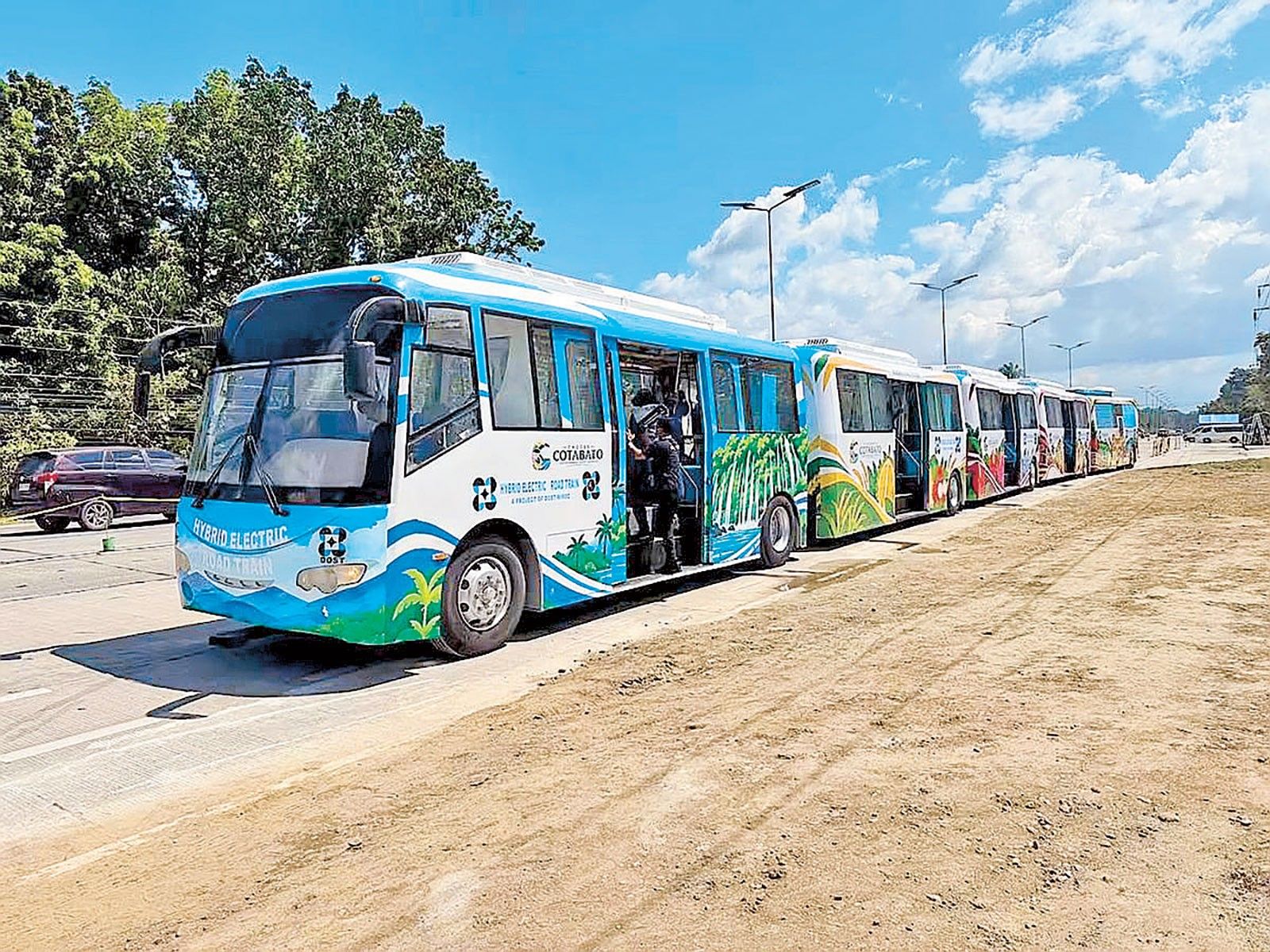
The Department of Science and Technology (DOST) on Friday turned over a five-coach Hybrid Electric Road Train (HERT) to the provincial government of Cotabato, making the province the first test area in Mindanao for the innovative transport project aimed at improving mobility while being environmentally friendly.
Developed by the DOST-Metals Industry Research and Development Center, the HERT runs on both diesel and electric power and features five interlinked, air-conditioned coaches that can accommodate up to 60 people each.
“We are turning over to our local government partners a locally developed alternative vehicle for mass transportation,” DOST Secretary Renato Solidum Jr. said.
Cotabato will need one more month to evaluate loading and unloading stations before rolling out the HERT, according to Gov. Emmylou Taliño-Mendoza.
The vehicle will make its pilot run from Kidapawan City to the town of Matalam – a 10-kilometer drive along the Davao-Cotabato Road – with students initially served for free.
Cotabato will then assess whether the vehicle can potentially reach the towns of Kabacan and Carmen, extending up to Sayre Highway.
The DOST first turned over the HERT to Cauayan City, Isabela, in 2019, with eight stops that pass by the city hall, public market, state university and the airport.
Asked whether the HERT is feasible in Metro Manila – a region bogged down by traffic jams and long queues at transport terminals – Solidum sounded positive but clarified that the ball is in the hands of the local government units (LGUs) and the Department of Transportation (DOTr).
“This can be used at the EDSA bus carousel, but (authorities) need to think about how this will be implemented,” the DOST chief said.
“We, at DOST, dream of having this rolled out, but the consideration will come from LGUs and those managing the transport systems. We want to show through use cases not only in Cauayan but also in Kidapawan that this vehicle is a good idea and a good alternative to single bus trips,” he added.
Each coach costs around P9 million each to produce, but the price of a unit will go down once the DOST finds a manufacturer to mass-produce it.
The HERT plied the roads of Metro Manila in 2016, not for public transportation but as part of a road-sharing project called “EDSA Evolution,” with a demonstration that transported passengers from Museo Pambata in Pasay to Luneta Park in Manila, traversing Roxas Boulevard.
The government has experimented throughout the decades on how to improve the commuting experience in Metro Manila. The country, for instance, rolled out double-deck buses, first in the 1980s, then in late 2015, but were halted due to cost and regulatory issues, and because units still got stuck along the main highway.






- Latest
- Trending