Hontiveros disputes Marcoleta: SC can overturn unanimous rulings
MANILA, Philippines (2nd update. First published: August 6, 8:55 p.m.) — Sen. Risa Hontiveros clarified a point raised by Sen. Rodante Marcoleta during discussions on Vice President Sara Duterte’s impeachment trial, saying that the Supreme Court en banc has, in some cases, reversed unanimous decisions.
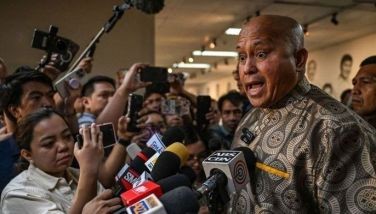
Marcoleta, who moved to archive the impeachment articles on Wednesday, August 6, first argued with Senate Minority Leader Tito Sotto over the likelihood of the high court reversing a unanimous decision.
When Sotto suggested that the Supreme Court could still reverse a unanimous decision, which he described as a possible “unanimous mistake,” Marcoleta countered that this has never happened before.
"Wala pa pong nangyayaring ganu'n, Mr. President," he told Sotto, saying he shouldn't be arguing based on speculation. (That does not happen, Mr. President.)
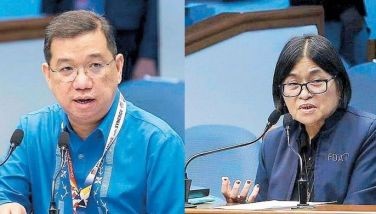
Hontiveros, however, flagged the contradiction in Marcoleta’s statement, noting that his stance also assumes the high court won’t overturn its ruling.
"Earlier, Mr. President, Sen. Marcoleta said he refuses to speculate on reversal, but the good gentleman's own position is based on his own speculation that the SC will not reverse its decision," she said in her manifestation.
This came after Sotto moved to table Marcoleta's motion to dismiss the impeachment, which Hontiveros seconded.
Marcoleta rejected claims that he was speculating, insisting his position was based on decades of experience as a litigation lawyer.
He said he had not encountered a case where the Supreme Court unanimously ruled a matter unconstitutional or a violation of due process and later reversed that decision.
"Mr. President, unang una, 'yung sinabi ko pong speculative, sapagkat it was not based on my own speculation, it was based on my long practice as a litigation lawyer. Wala pa po akong nakitang unanimous decision," he said.
"What do we expect? We expect that eight of them will reverse themselves altogether?" he asked.
Hontiveros then came forward with two Supreme Court cases where a motion for reconsideration was granted by the en banc, effectively overturning an earlier unanimous decision.
"So hindi lang po tulad ng sinabi ng minority leader na there's always a first time, it has happened before. So 'yung ganitong klaseng milagro na hinahanap, posibleng mangyari rin dito sa kasong pinaguusapan natin," she said.
What cases did Hontiveros cite?
She referred to the League of Cities of the Philippines vs. Commission on Elections and the International Service for the Acquisition of Agri-Biotech Applications Inc. vs. Greenpeace Southeast Asia cases.
However, there seems to be some confusion surrounding the first case.
According to Lawphil, which is considered a reliable library of jurisprudence, the first decision made in the League of Cities vs Comelec case in 2008 appeared to have been concurred in by all 15 Supreme Court justices. The decision declared the cityhood laws unconstitutional.
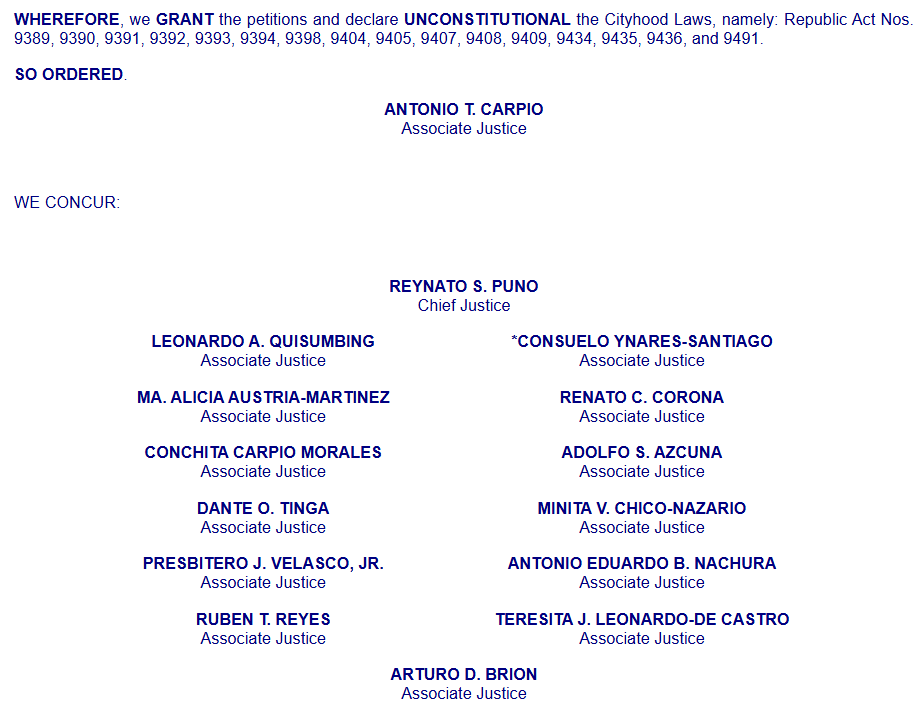
However, the vote breakdown remains unclear, with credible sources presenting conflicting information. According to Lawphil, the vote seems unanimous, while other libraries state otherwise.
Even the Supreme Court E-Library shows discrepancies. Its webpage version lists then-Associate Justice Renato Corona at the time as concurring, while the attached PDF indicates he dissented.
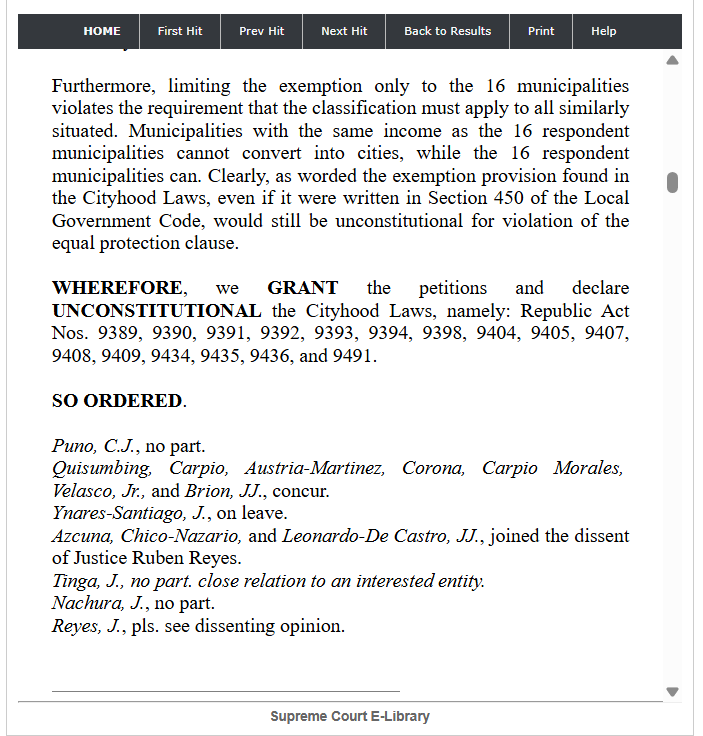
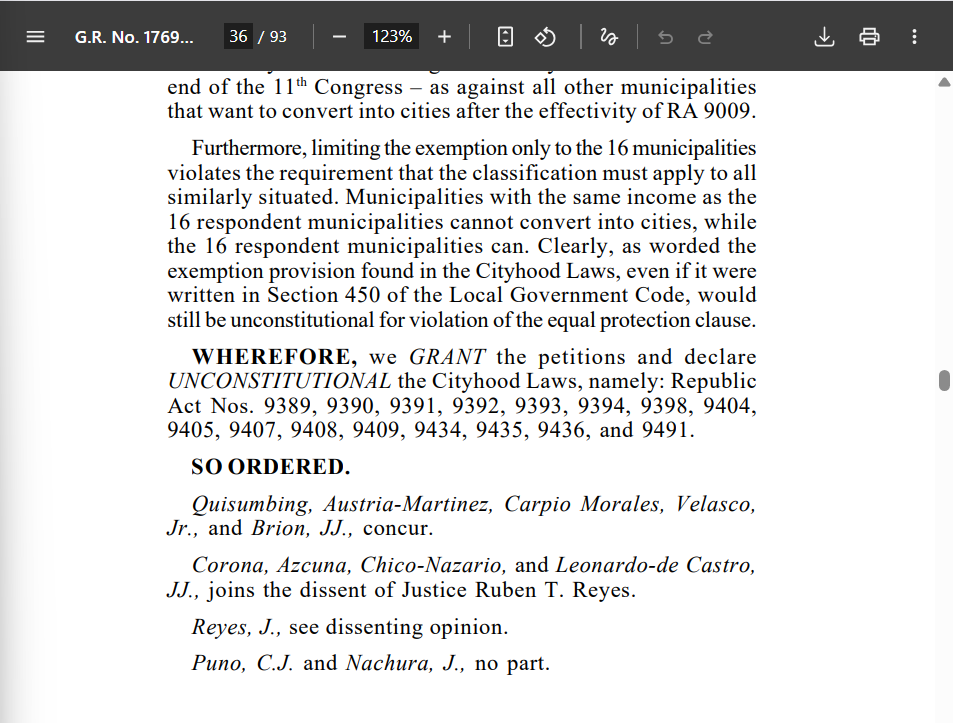
In 2009, the city respondents filed a motion for reconsideration. The Supreme Court granted the motion on Dec. 21, 2009, reversing its earlier ruling and setting aside its declaration of unconstitutionality. It then upheld the cityhood laws as valid and constitutional.
The case did not end there as the petitioners filed a motion to annul the 2009 decision in 2010, which eventually led to a 2010 decision where the Supreme Court reinstated its 2008 decision that the cityhood laws were unconstitutional.
The respondents filed a motion for reconsideration a few weeks after the high court's ruling in 2010. By February 2011, the Supreme Court granted the respondent's motion to reverse its 2010 decision, which had declared the laws in question constitutional again.
However, the petitioners challenged the 2011 ruling through an ad cautelam motion for reconsideration, to which the high court denied with finality in April 2011.
Clear unanimous decision overturned. While the League of Cities case remains muddled, Hontiveros brings up a clearer precedent — one where the Supreme Court justices initially agreed unanimously, and later reversed their stance.
In the second case, which centered on environmental and health risks posed by the genetically modified eggplant "Bt talong," all justices who participated concurred in the Dec. 8, 2015 decision to deny the petitions seeking to overturn the Court of Appeals’ earlier ruling that halted the field tests.
In 2016, the Supreme Court granted the petitioners' motion for reconsideration and reversed its 2015 decision.
This comes after the high court declared the petition for a writ of kalikasan moot when the biosafety permits had already expired and the field tests in question had been completed.
Marcoleta's contentions
After Hontiveros referenced these two en banc cases, Marcoleta immediately asked if these were en banc decisions.
Despite the minority lawmaker’s assertion that these were en banc decisions, Marcoleta remained unconvinced.
He pressed for “jurisprudence” and later sought clarification by citing qualifications on whether the cases involved rulings that declared a matter unconstitutional, void ab initio, and violative of due process.
"May I know from the good senator if these are en banc decisions or division?" Marcoleta asked.
"Yes, Mr. President, en banc decisions po," Hontiveros answered.
"Well, you have to cite the jurisprudence. ... All 15 of them, unanimous? Baka kasi division lang 'yan," Marcoleta said, dubious of Hontiveros' references.
What is undisputed, however, is that a unanimous decision by the Supreme Court en banc could be overturned, as it has already happened in the past decade.
The Senate junked Sotto's motion in a 5-19 vote, paving the way for Marcoleta’s amended motion to archive the articles of impeachment, which was subsequently approved in a 19-4-1 vote.
--
Editor's Note: This article has been updated to include the timeline of the cases cited by Sen. Risa Hontiveros and to clarify the source of confusion regarding the unanimous vote of justices in the first cited jurisprudence.


- Latest
- Trending