When a theory is no match to practical knowledge

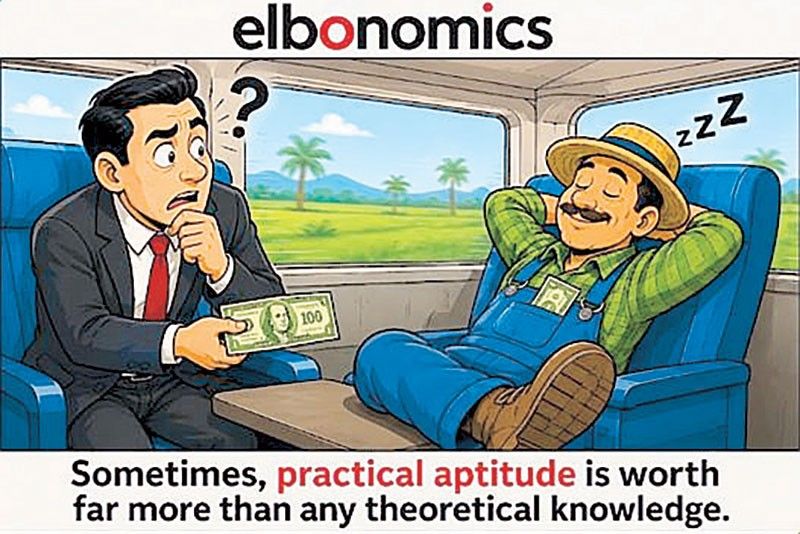
MANILA, Philippines — A cocky management consultant on vacation sits next to a farmer on a three-hour train ride to a rural town. Quickly bored without a book to read, the consultant suggests a puzzle to pass the time. “Let’s play a little game,” said the consultant. “I’ll ask you a question. If you don’t know the answer, pay me one dollar.
“Then, you ask me another question. If I don’t know the answer, I’ll give you one hundred dollars. Game?” The sleepy farmer agrees. The consultant begins with his first question:
“What is the term used for continuous improvement often referred to as a Japanese invention?” Without saying a word, the farmer takes one dollar bill from his pocket and hands it over to the consultant.
Now, it’s the farmer’s turn to ask a question. He thinks for a moment, then asks: “What animal with three legs that could climb a tall coconut tree and flies down with its wings?” The consultant was puzzled.
He thought for about three minutes, but couldn’t give an answer. Finally, he gave up, took a hundred-dollar bill from his pocket and gave it to the farmer. With a devilish smile, the farmer takes the money and settles down comfortably for a nap.
The curious consultant, unable to leave the question unanswered, wakes him up and insists: “So, what’s the answer?” Without saying a word, the farmer forks over one dollar from his pocket, gives it to the pesky consultant, then goes back to sleep.
What’s the lesson? Sometimes, practical aptitude is more valuable than any theoretical knowledge.
The answer
That story offers a striking lesson on the misaligned metrics between a consultant and the farmer. The former relies on theories, while the latter relies on practicality.
The consultant discussed a topic known to many managers. The answer, of course is Kaizen. For him, every answer must come from an academic viewpoint. On the other hand, the farmer approaches it by actual result while maximizing return with minimal effort.
He doesn’t need to give a correct theoretical answer to deliver financial results.
The farmer’s response reveals the limits of bookish knowledge. Continuous improvement does not arise from identifying and knowing theories. Rather, it grows from daily observations, small experiments and the willingness to act on what is practically right.
The key is to balance the situation. Theories supply a shared language and direction, while we need practical aptitude that delivers results.
How to do it
In making it possible, we can use the following approaches to drive an effective continuous improvement program. It emphasizes relying on frontline reality, measuring tangible operational progress, learning from skilled workers and accepting losses quickly.
Hire a management consultant only to jumpstart an existing framework while avoiding long-term dependency and prioritizing actionable internal knowledge:
1. Start or review a continuous improvement program. Frontline experience must set the agenda with managers providing support. Encourage the humility of saying “I don’t know.” Learn from reality and move like the practical farmer.
2. Measure success by visible improvements. Eliminate defects, improve cycle times, reduce inventory levels, among others. Then, monitor performance indicators using an hourly-updated dashboard. Go to where the action is. Don’t stay long in the boardroom.
3. Hire and train people for experience. Reward and recognize people who can both explain theoretical concepts and make them work. If not, deliver the exact value required for the task at hand, even without a theory.
4. Accept loss quickly. Learn a lesson or two from the experience. Prevent problems and mishaps. Exploit the consultant’s overconfidence, then disengage from the game with the efficient use of practical knowledge and focus on what matters.
5. Guard against over-reliance on consultants. Hire them only for a certain framework. Use them to jumpstart what an organization has done before with a stalled program. Ensure that they transfer only usable methods and not create lifetime dependency.
In summary, true organizational strength comes from trusting your own team to face uncomfortable realities and execute practical solutions with fewer resources. If you need a six-figure worth of advice to manage a business, your biggest problem isn’t strategy – it is that you’ve hired an expensive tourist to drive your bus.
Rey Elbo is a quality and productivity activist. Send your comments, questions or stories to [email protected] or via Facebook, LinkedIn, X or https://reyelbo.com.








- Latest
- Trending