


‘Blanket class suspensions deepen literacy challenges’
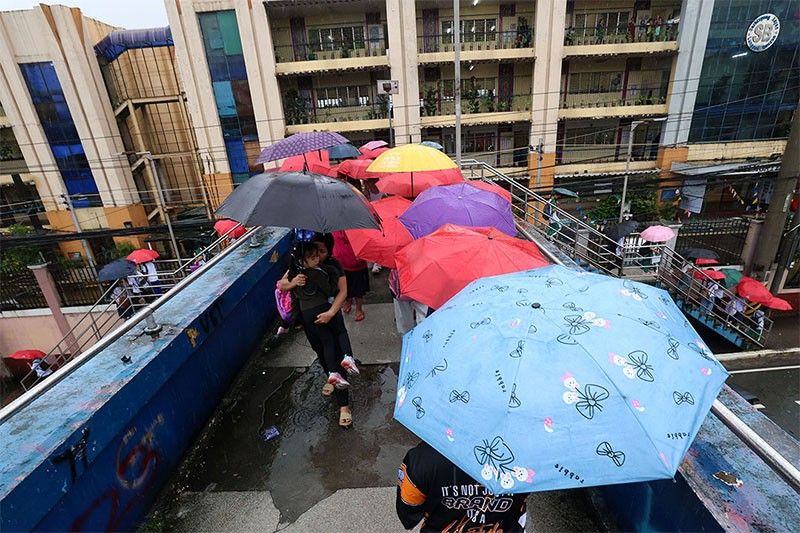
MANILA, Philippines — Blanket class suspensions could deepen literacy challenges as schools continue to lose significant teaching days to weather-related hazards, a new study released by the Second Congressional Commission on Education (EDCOM2) warned.
The study – “The Hidden Cost of Class Suspensions: How Blanket Orders Could Deepen the Learning Crisis” – found that blanket class suspension orders may be imposing a learning cost even on schools that are not directly exposed to unsafe conditions.
The report noted that the increasing number of class suspensions has become a routine feature of the school calendar.
In school year 2025-2026, a typical public elementary school forfeited about 20 teaching days to hazard-related suspensions.
“That is roughly one in every 10 days in the official school calendar,” the report said.
More recently, from Aug. 1 to Sept. 15, 12 out of 28 class days were canceled in the National Capital Region and several provinces.
“This is already 43 percent of total class days in that period and has significantly affected the delivery of learning for Term 1,” the report said.
According to the study, class cancellations in the past four school years have compounded learning loss from two years of school closures during the COVID-19 pandemic.
“Unless we all take this issue very seriously, efforts of DepEd to improve learning outcomes would not progress simply because children are not in school when they should be,” the study said.
Weather-driven hazards, including typhoons, monsoon rains and shearlines, coupled with excessive risk aversion, account for the bulk of school day suspensions.
Previous EDCOM2 findings highlighted the wide range of disruptions across the country, with regions such as the Negros Island Region, Region 1 and Region 5 experiencing much higher numbers of class suspensions than some areas in Mindanao.
Lanao del Sur, Davao del Norte and Tagum City each recorded only one class suspension, while seven school division offices in the Bangsamoro Autonomous Region in Muslim Mindanao had no recorded suspensions.
The report said more granular decisions could make class suspensions more effective.
“Each and every class cancellation should be accounted for, and the cost and benefit of such decisions should be considered. Given the volatility of weather, the government needs to also assess accuracy of forecasts against actual weather to further improve forecasting technique,” the report said.
It noted that national and local governments should recognize that school heads have better information about conditions in their respective areas and can make more balanced decisions on whether to suspend or resume classes.
“Surrendering close to a month each year to hazards, even when warranted by circumstances, is already a large setback for a system still working hard to ensure that every learner can read by Grade 3. Against this backdrop, sparing the rest of our schools from suspensions when unnecessary should not be a choice, but an imperative,” it added.
The study was authored by University of Auckland PhD Economics candidate Tristan Piosang, EDCOM2 executive director Karol Mark Yee and former National Economic and Development Authority secretary Karl Kendrick Chua.
Damage
Aside from further worsening the country’s learning crisis, the continuing weather disturbances have also caused extensive damage to school facilities.
The DepEd estimated that P8.267 billion will be needed for response and recovery following the impact of the southwest monsoon and Tropical Cyclones Luis, Maymay, Neneng, Obet and Pilandok since Aug. 3.
In its final report, the DepEd Disaster Risk Reduction and Management Service said 2,537 schools reported damage involving 11,995 classrooms.
Of these, 2,362 classrooms were destroyed, 2,550 sustained major damage and 7,083 had minor damage.
“Correspondingly, the estimated response and recovery requirements have reached approximately P8.267 billion, comprising P74.908 million for clean-up and clearing operations, P347.067 million for minor repairs, P1.275 billion for major repairs and P4.905 billion for reconstruction. These figures reflect the continuing receipt, validation and consolidation of school-level reports,” DepEd said.
Based on the Incident Management Reporting System, 509 schools across seven regions were being used as evacuation centers, with 2,185 classrooms accommodating 19,242 families.
DepEd also reported that at least 37,376 learning materials, 965 information technology equipment and 28,975 chairs were damaged.
“Downloading of clean-up and clearing operations and minor repair fund has now been initiated. DepEd ensures the immediate restoration of damaged facilities to ensure continuity of learning,” the department said.
Light rains
The weather situation remains a factor in potential disruptions as the intertropical convergence zone (ITCZ) returns and brings cloudy skies, scattered rains and thunderstorms to parts of the Visayas and Mindanao, the Philippine Atmospheric, Geophysical and Astronomical Services Administration said yesterday.
The ITCZ is the line where winds from the northern and southern hemispheres meet, resulting in cloudy skies and light rains.
Cloudy skies with scattered rains and thunderstorms due to the ITCZ are expected in the Negros Island Region, Central Visayas, Eastern Visayas, Zamboanga Peninsula, Northern Mindanao, Caraga, Masbate, Lanao del Sur and Davao Oriental.
The rest of the Visayas and Mindanao will experience partly cloudy to cloudy skies with isolated rainshowers or thunderstorms due to the ITCZ.
Metro Manila and the rest of Luzon will also experience partly cloudy to cloudy skies with isolated rainshowers or thunderstorms due to localized thunderstorms.
Meanwhile, a tropical depression formed outside the Philippine area of responsibility and was last located 2,785 kilometers east of southeastern Luzon.
It was packing winds of 55 km per hour and gusts of up to 70 kph while moving northward at 20 kph.
Despite its low chances of entering the Philippine area of responsibility, state meteorologists are not ruling out the possibility.
Should it enter, it will be given the local name Queenie, which would be the first tropical cyclone to enter the Philippine area of responsibility this month. — Josiah Antonio



- Latest
- Trending


