Government to buy P3.3 billion virus test kits ASAP – Duterte
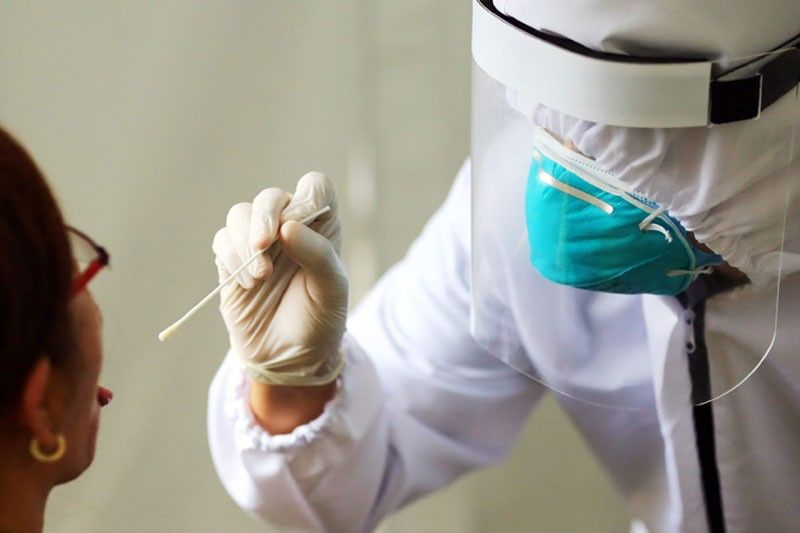
MANILA, Philippines — President Duterte has approved the immediate purchase of about P3.3 billion worth of polymerase chain reaction (PCR)-based and rapid testing kits through the Office of Civil Defense (OCD), as the government embarks on the mass testing of people for coronavirus disease 2019 (COVID-19).
“I’m clearing the way. I will ask (Health) Secretary (Francisco) Duque to talk to the people in charge, Secretary (Carlito) Galvez. And they can proceed to buy it immediately, as fast as you can at this time,” Duterte said in his televised address late Monday night.
Presidential adviser for entrepreneurship Joey Concepcion, who has been pushing for the purchase and use of rapid testing kits, lauded the President’s decision. He said ordering the kits in bulk would lower their price by $5 to $6 per unit. Concepcion attended the meeting with the President at Malacañang earlier on Monday.
At the meeting, Concepcion said the President did the right thing when he placed Luzon under immediate lockdown. He said Sen. Bong Go, Defense Secretary Delfin Lorenzana, National Action Plan (NAP) chief implementer Carlito Galvez Jr. and Cabinet Secretary Karlo Nograles were “instrumental” in approving the initiative of the private sector to revive the economy “in a safe, secure and sustainable manner.”
In his televised address, Duterte noted that the DOH is barred from buying such health equipment and supplies without getting the nod of the Health Technology Assessment Council (HTA).
While stressing that he recognizes the strict standards followed by government agencies, Duterte said he would direct the procurement of kits and place them under the responsibility of the OCD.
Purchase of the PCR and rapid testing kits is considered emergency procurement, the President pointed out.
“I will take the risk. I will order the health department and everybody. In the meantime, the private sector is doing it. Maybe we can take over someday or do it together with your help. I am clearing the way by ordering the purchase since there is no FDA local,” he said, referring to the Food and Drug Administration.
The NAP task group is having difficulty determining the number of COVID-19 cases as more people are showing symptoms of the disease.
“There is a kind of a ruckus now regarding the procurement of the PCR testing kits of 900 (thousand) people, essential kits and other kits in activation supplies, (PCR) consumables, seven (PCR) machines, 10 automated extracting machine and 10 biomedical freezer additional equipment for subnational and regional testing laboratories,” he said.
The President gave the order as his administration assesses the impact of the Luzon-wide lockdown, which is believed to have slowed down the spread of the disease.
The administration is also rushing the unveiling of quarantine facilities in Metro Manila and other regions as hospitals – both private and state-owned – have reached full capacity.
Galvez said the government needs to purchase 40,000 PCR kits which can cover 900,000 tests.
Apart from the PCR kits, Galvez said the government also aims to buy two million rapid test kits but the approximate cost of the kits is not yet available.
“Actually we will test – rapid test two million and 900,000 for the PCR for the confirmatory,” he said.
According to Galvez, there is a need to also conduct a PCR testing on those subjected to rapid testing kits.
“We really have to have a safety for the false positive and false negative with the PCR. And also, in order for that – for us also to test the efficacy of the rapid test. So that’s the point – that we have to really buy both,” he said.
The Department of Trade and Industry has started looking at rapid testing kits suppliers.
Nograles, spokesman for the Inter-Agency Task Force on Emerging Infectious Diseases, said the government could bypass the restrictions by ordering the OCD to make the purchase.
“So DOH (Department of Health) and PhilHealth (Philippine Health Insurance Corp.) cannot do it but because we are in the state of calamity, OCD can do the purchase,” Nograles said.
Officials noted that section 34 of the Universal Health Care Act, which provides that “investments on any health technology or development of any benefit package by the DOH and PhilHealth shall be used on the positive recommendations of the HTA.”
Clinical setting
But as the government rushes to acquire test kits, a coalition of 26 medical societies, health advocacy groups and civil society organizations has issued a joint statement supporting the use of rapid test kits only in clinical setting.
“We echo the call of numerous experts – rapid antibody tests should not be used outside a research setting at this time. In this time of crisis, we believe that tests and treatments should be carefully assessed before routine use, so as not to aggravate the dangers of the disease and the difficulties already faced by our healthcare system,” said the Stop COVID-19 Coalition.
The coalition is composed of Philippine Medical Association, Philippine Pediatric Society, Action for Economic Reforms, Action on Smoking & Health Philippines Inc., ANG NARS, Asia-Pacific Center for Evidence Based Healthcare, Framework Convention on Tobacco Control Alliance Philippines, Southeast Asia Tobacco Control Alliance, Philippine Society of Private Midwife Clinic Owners Inc.-Davao, Consolidated Council of Health and Allied Professions and United Healthcare Org of the Philippines, among others. Doctors Anthony Leachon and Rogelio Dazo Jr. and Jofti Villen are also included in the coalition.
“Lack of evidence on the accuracy of the rapid antibody tests means that they must only be used in research settings, until there is enough proof supporting its use for specific indications,” the coalition said, citing pronouncements from the World Health Organization.
Dr. Antonio Dans, president of Asia-Pacific Center for Evidence-Based Healthcare, said as much as 72 percent of positive tests using the rapid test kits will turn out to be “false positives.” This means the patient is actually not infected.
“Non-COVID-19 cases will be classified as COVID-19 cases and this will lead to errors in management. Numerous non-COVID patients will be sent to COVID centers, exposing them to patients with COVID-19 and occupying scarce beds during this great time of need,” Dans cautioned.
Last April 1, the FDA approved the use of five rapid antibody test kits in the country but stressed that confirmatory tests would still have to be done using RT-PCR or real time-polymerase chain reaction to validate the finding.
FDA director general Eric Domingo said that while RT-PCR measures the viral loads of a patient, the rapid antibody testing kit only determines the antibody that a patient has.
Domingo said the body takes time to develop antibodies from a bacteria or virus that has infected it. This means a test may result in false negative if test is made when antibodies are not yet developed.





- Latest
- Trending