How Marine Conservation breeds life: A dive into Sumilon’s decades of protection
(First of two parts)
CEBU, Philippines — Every day, residents of Barangay Bangcogon cross the waters toward Sumilon Island for a reason that would be beneficial for the fishing community: to ensure their sanctuary is protected.
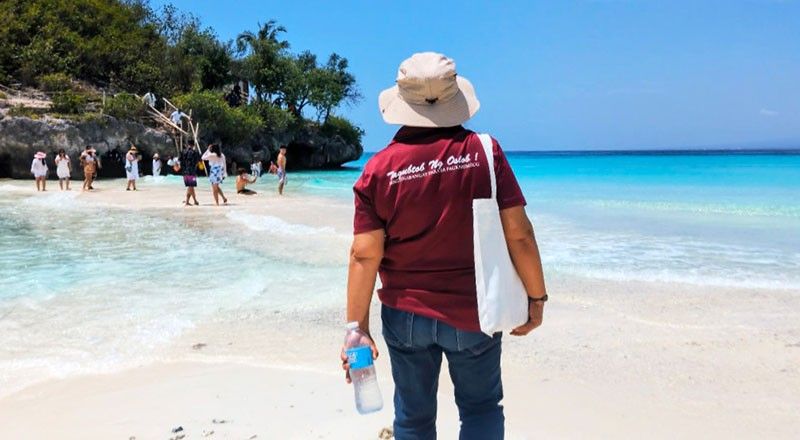
Calling themselves the Bangcogon Oslob Fishermen Association (BOFA), they clean its shores, assist tourists, guide divers, monitor the area, and help protect waters that have been closed to fishing for more than five decades.
For the people of Bangcogon, Sumilon is not simply a line on a government map. It is a workplace, a source of income, a protected breeding ground and, for some, a promise that there will still be fish for their children and grandchildren.
But 52 years after Sumilon became the Philippines' first marine protected area, the community now faces a question larger than simply whether the sanctuary has survived.
Can five decades of protection still deliver the ecological and livelihood benefits that made Sumilon a model for marine conservation in the first place?
The question comes as the country works toward the global 30x30 initiative — protecting 30 percent of its ocean by 2030.
Sumilon offers one of the country's longest-running examples of marine protection, but its present condition also exposes the difficulty of measuring whether decades-old conservation efforts continue to work.
Its own 2026-2030 management plan identifies a major scientific gap: the lack of recent comprehensive records on coral cover and fish biomass following successive typhoons.
That means that despite the island’s long conservation history, its current ecological scorecard is still being established.
A 52-year-old experiment
Sumilon was established as a marine protected area in 1974, initially with Silliman University playing a role in its management before responsibility was eventually transferred to the community.
In data gathered by THE FREEMAN, the sanctuary's management plan calls it a national legacy of conservation and credits its history with helping demonstrate the concept of a “spillover effect” — the idea that protecting a core area can allow fish populations to recover and benefit surrounding fishing grounds.
The protected marine area now covers 39.75 hectares around the island, including reef areas and waters near its shifting sandbar.
Sumilon itself has no permanent civilian residents.
The management plan comprises a division of land management, with the municipality claiming stewardship over portions of the intertidal area, sandbar, and terrestrial land, while the majority of the 24-hectare island landmass is leased by Bluewater Sumilon Resort.
The plan, however, states that the marine sanctuary and its 20-meter buffer zone remain under the jurisdiction of the local government for ecological conservation and public benefit.
Because there are no permanent residents on the island, much of its day-to-day community presence comes from Bangcogon and BOFA members who travel from the mainland to perform conservation and tourism-related duties.
THE PEOPLE BEHIND THE PROTECTION
For Ana Soriano Luna, BOFA president, protecting Sumilon has become part of community life.
Luna, who served as Bangcogon barangay captain from 2010 to 2023, said BOFA grew from 86 members to 140.
Around 20 members are assigned each day to assist visitors, including tour guides and cleaners.
BOFA members also help maintain the island and participate in coastal cleanups conducted every third Wednesday of the month.
Their work has created an economic connection between conservation and the community.
Under the sanctuary's revenue framework, tourism fees are collected for activities including entrance, snorkeling, diving, and boat docking.
The management plan lists a P100 marine or entrance fee, P500 snorkeling fee, P1,000 local scuba-diving fee, P1,500 foreign scuba-diving fee, and P1,500 boat or docking fee.
The plan provides for revenue sharing among the municipality, Barangay Bangcogon, and BOFA.
Luna said BOFA members can earn from the tourism-related work, with monthly income sometimes reaching around P3,000 to P4,000.
For the association, however, the sanctuary is not only about income.
“Mag-amping sa isda, sa kinaiyahan, sa mga corals nga dili yatak-yatakan,” Luna said.
She said the community has a responsibility to protect the sanctuary because it is one of the remaining places where fish can reproduce without being caught.
“Dili unta nila hilabtan ang sanctuary kay ang sanctuary baya nalang na sa among kabataan,” she said.
WHY OSLOB KEPT ON PROTECTING THE SANCTUARY
Oslob Mayor Atty. Ronald Guaren said the municipality has continued to protect Sumilon through an ordinance and strict enforcement.
“Walay makapangisda diha kay we reserve that for breeding purposes,” Guaren said.
The fish, he said, are left undisturbed.
The expectation is that fish populations inside the protected area will increase and eventually move into surrounding waters where local fishermen can benefit.
The management plan calls this Sumilon's “Fish Bank” function, with mature breeding fish producing eggs and larvae that may move beyond the sanctuary into mainland and neighboring municipal waters.
It also identifies the core zone as habitat for large, mature breeding fish, or “Mega-Spawners,” while the shifting sandbar and surrounding shallow areas provide nursery habitat for juvenile fish.
But the plan also identifies the removal of these breeding fish as a threat.
If large breeders are illegally taken from the sanctuary, the plan says, the spillover effect could be reduced and catches in surrounding waters could eventually decline.
From one sanctuary to five
The influence of Sumilon has extended beyond the island.
Guaren said other communities began seeking marine sanctuaries after seeing what happened in Sumilon.
Oslob now has marine protected areas in Gawi, Bonbon, Poblacion, Hagdan, and Mainit, with several still undergoing establishment.
“Instead of one, nahimo natong lima,” Guaren said.
He said the establishment of new MPAs was initially resisted because fishermen would lose access to certain areas.
But that resistance eased as residents saw the potential benefits.
The municipality does not intend to close all fishing grounds, he said, but to identify areas with potential as breeding sites and protect those portions.
The system behind the sanctuaries
Jefferson Booc, Oslob fisheries technician and Municipal Fisher's Coordinator, said the municipality has strengthened its MPA management plans and community participation.
He said an MPA assessment conducted with the Coastal Conservation and Education Foundation showed an improved score compared with previous assessments.
Booc said maintaining MPAs requires not only local government support but also organizations and the Marine Fisheries and Aquatic Resources Management Council.
“Dili ta makahimo ug wala ning MPAs kung wala puy Marine Fisheries Aquatic Resources Management Council,” he said.
The management plan for Sumilon formalizes this shared-governance approach.
It identifies BOFA and Barangay Bangcogon as primary community guardians of the sanctuary, working alongside the local government.
It reflects an evolution from purely top-down protection toward community-led stewardship, combining LGU authority with the daily presence of local residents.
The plan also creates a Development Advisory Board involving the mayor, environment officials, agriculture, planning, tourism, engineering, the barangay, and BOFA.
The board serves as a recommendatory body for development proposals within the municipality-claimed portion of Sumilon.
But the sanctuary is not untouchable
Protection has not eliminated threats.
Booc said illegal fishers continue to enter Oslob's MPAs, including some who use compressors to stay underwater longer, which disturb corals while catching fish.
Municipal fisheries data showed six fishermen had been apprehended this year for entering an MPA to fish.
But enforcement has its own limitations.
Oslob currently has two fiberglass pump boats, which Booc said are slower than the double-engine boats used by some illegal fishers.
“Di pa kasabay sa ilaha,” he said.
The municipality is having two additional pump boats built to improve interception.
Fish wardens are also being assigned to individual MPAs.
Luna recalled one incident when police, Bantay Dagat, barangay personnel, and pump boats attempted to intercept suspected illegal fishers but failed to catch them because their boat was faster.
She also recalled that the group was confronted by men carrying firearms.
While Sumilon continues to combat foreseen and familiar threats, some threats cannot be stopped by a patrol boat. — /IHM (FREEMAN)



- Latest