Before you add, learn to subtract
A long time ago, a Japanese childless couple, who despite their advanced age, continued praying at a shrine for a child. Miraculously, they were granted a tiny boy no bigger than a thumb. He was called the Issun-boshi or the one-inch boy, similar to Tom Thumb of the English folktale. Though small, Issun-boshi was clever enough to outwit children bigger than himself.
When he grew older, he set out for the city to make his fortune, carrying only a needle as a sword, a soup bowl as a boat and chopstick as a paddle. Along the way, he was hired as a servant by a wealthy landlord.
One day, while escorting the lord’s daughter, a demon with a magical hammer attacked them. Issun-boshi used his tiny size and simple tools to defend themselves. He climbed swiftly into the demon’s body through its mouth and ear while stabbing it inside with the needle.
That forced the devil to drop its hammer. Issun-boshi jumped into it. As soon as he touched the magical hammer, his appearance turned into a handsome, human-size prince. Then, he married the princess and lived happily after that.
The tale’s lesson for me is simple: effectiveness does not always depend on size, sophistication or expensive equipment. Sometimes, resourcefulness and simplicity can accomplish what elaborate solutions cannot.
‘Less engineering’
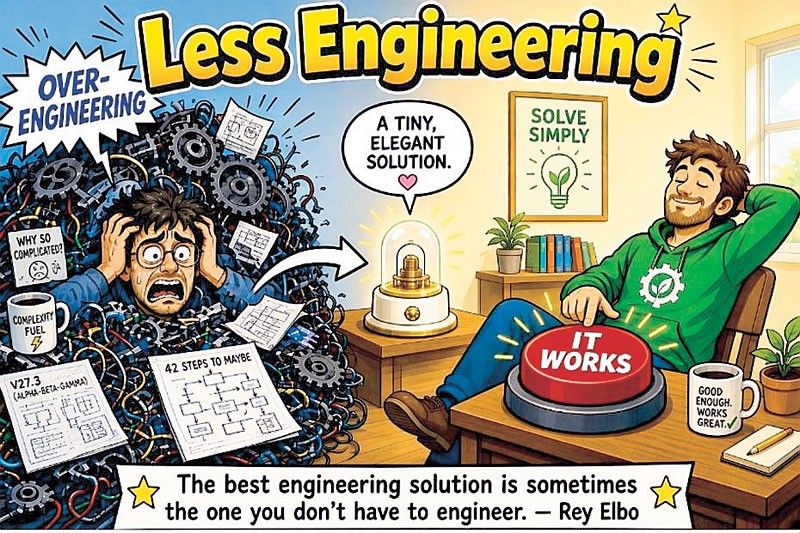
That story captures the spirit of Tomoo Sugiyama’s concept of “less engineering.” Sugiyama was a Japanese Yamaha executive whose work is cited by Masaaki Imai in his 1997 “GembaKaizen” book.
The idea behind “less engineering” is deceptively simple: instead of immediately asking what we can add to solve a problem, ask what we can eliminate. Sugiyama used the concept to help people identify waste and avoid needless complexity.
Imai, who was my former boss at Kaizen Institute wrote a list of Sugiyama’s “less engineering” examples in his book. What follows are four of the basic Ms of production, together with my interpretation:
1. Manpower. Make work look-less by designing equipment and processes to avoid constant monitoring. Make people walk-less by arranging the workstation that minimizes unnecessary movement. Make them search-less by placing tools and materials within easy reach.
2. Machine. Arrange equipment to reduce unnecessary space between processes and minimize the need for conveyors. The goal is to create a more compact flow while reducing wasted space, unnecessary movement and excessive utility consumption.
The same principle applies to deliveries. Use packaging and vehicles efficiently so that you are not paying to transport empty space.
3. Material. Make it bolt-less by designing modular fixtures or jigs that interlock without clamps or bolts. Have it burr-less so that parts leave a machine and move directly to the next process or into packaging without passing through a clean-up or staging area.
Design material trolleys that protect edges during transfer reducing the need for protective handling. This makes the situation wait-less and stop-less.
4. Method. Make the system bottleneck-less by developing flexible work methods and training multi-skilled operators who can move to areas where they are needed. This helps prevent delays, waiting and unnecessary stoppages.
Use a stock-less system in which the container itself serves as both the transport and storage device. This eliminates unnecessary unpacking, restocking and intermediate storage.
Subtraction is key
The essence of “less engineering” is subtraction. When faced with a problem, our first instinct is often to add something, like a machine, a software program, another employee, more space, resulting in a bigger budget.
Sugiyama challenges that instinct with a different question: What can we remove?
Unnecessary movement? Waiting? Excess inventory? Wasted space? Of course, removing the need to transport air.
That philosophy produced a dramatic discovery at Yamaha: 93 percent of the packaging volume for motorcycle mufflers and exhaust pipes was simply air. Sugiyama recognized that empty space as waste. By redesigning the packaging, Yamaha achieved substantial savings and later expanded the idea into a broader air-less engineering campaign.
As I often say in this space and elsewhere, Sugiyama’s philosophy fits remarkably well with my favorite Elbonomics — “Problem-solving is not progress if you’ll spend money on the solution.”
To put it in another world, the best engineering solution is sometimes the one you don’t have to engineer.
Rey Elbo is a quality and productivity activist. Send your comments, questions or stories to [email protected] or via Facebook, LinkedIn, X or https://reyelbo.com.



- Latest
- Trending