


Agricultural output up 1.8% in Q3
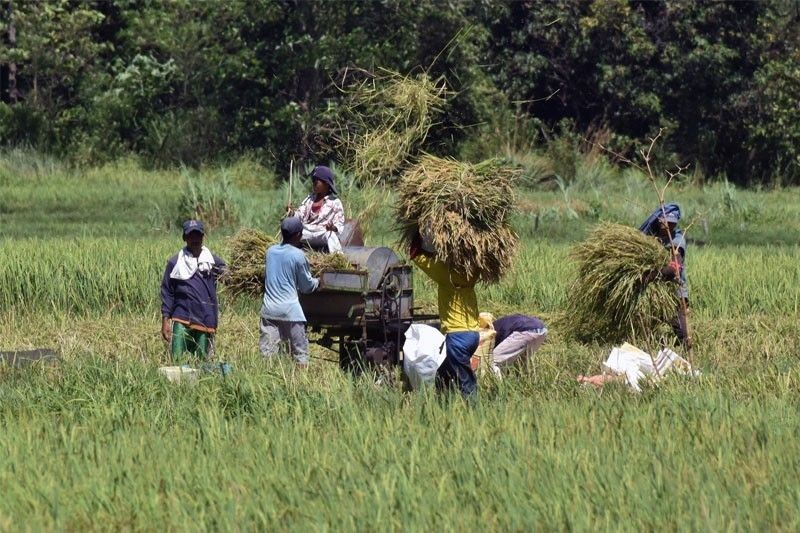
MANILA, Philippines — The country’s farm production recovered in July to September, snapping two consecutive quarters of contraction, driven by the crop, fisheries and livestock sectors, according to the Philippine Statistics Authority (PSA).
Agriculture and fisheries output grew by 1.8 percent – a reversal from the 0.3 percent and 0.6 percent contraction in the first and second quarters, respectively.
The third quarter growth also reversed the 2.6-percent contraction in farm production in the same period last year.
“Base effects helped third quarter post a positive gain, with the livestock sector managing to slowly bounce back after the 2021 African swine fever (ASF) episode,” ING Bank senior economist Nicholas Mapa said in a text message.
The sector’s overall performance from January to September inched up by 0.3 percent, a turnaround from the 2.5 percent decline in the same period last year.
“The better measure of agri-fisheries performance is January to September 2022 vs. January to September 2021. Using this metric, overall, the entire sector had zero growth. Crops, as well as palay, posted slight declines,” Federation of Free Farmers (FFF) chairman Leonardo Montemayor said in a text message.
The agricultural sector, at current prices, grossed P501.58 billion in the third quarter, up 12.3 percent from P446.77 billion in the same period last year.
Total value for the nine-month period reached P1.53 trillion, 6.25 percent higher than the P1.44 trillion in the comparative period.
“We were expecting a worse output mainly due to the effect of fertilizer and fuel prices. This might be reflected more fully in the fourth quarter,” FFF national manager Raul Montemayor said in another text message.
From July to September, the PSA noted that output of crops, livestock and poultry posted increments while fisheries production dropped during the quarter.
Crops, which accounted for 53.9 percent in the total value of production, went up by 1.8 percent.
Palay or unhusked rice production increased by one percent while corn production expanded by 2.5 percent.
Sugarcane and abaca also registered double-digit growth at 78.8 percent and 21.7 percent, respectively.
At current prices, the crop subsector grossed P240.97 billion, up 4.2 percent year-on-year.
Commenting on the crop subsector, Samahang Industriya ng Agrikultura (SINAG) executive director Jayson Cainglet said the PSA report is wanting as the data used is the standing crops.
“As it is on the ground, because of expensive fuel and fertilizers, farmers have not used as much fertilizers as they wanted, so that will have an impact on production, which you cannot gauge on the standing crops,” he said.
While growth is noted for the subsector, the third quarter figure is prior to the recent typhoons that heavily devastated the rice and corn sectors, Cainglet said.
Super Typhoon Karding’s damage to the rice sector was valued at P2.05 billion and P65.4 million in the corn sector, according to the Department of Agriculture.
Meanwhile, Severe Tropical Storm Paeng caused P1.95 billion worth of damage to rice and P160.32 million to corn.
Livestock, which contributed 15.6 percent to the total, rose by four percent on higher dairy, hog, carabao or water buffalo and cattle production.
The livestock subsector’s value amounted to P94.49 billion, an 18.7 percent increase from a year earlier.
Similarly, poultry – which had a 15.2 percent share – grew by 6.4 percent as all commodities, except for duck, registered gains.
On the other hand, fisheries production, which accounted for 15.3 percent in the total, recorded its third straight quarter of contraction as it declined by 4.2 percent.
Double-digit decreases were noted in mudcrab (alimango), blue crab (alimasag), Indian mackerel (alumahan), tiger prawn (sugpo), Bali sardinella (tamban), grouper (lapu-lapu), and milkfish (bangus).
Lower production was also noted in tilapia, big-eyed scad (matangbaka), slipmouth (sapsap), roundscad (galunggong), and frigate tuna (tulingan).
In total, the fisheries subsector grossed P77.97 billion, up 10.3 percent from last year.
Mapa said the “fishing ban implemented from May to August this year could have negatively impacted the fisheries sector.”
In a statement yesterday, Pambansang Lakas ng Kilusang Mamamalakaya ng Pilipinas (PAMALAKAYA) has sought concrete compensation for the loss and damages of climate crisis, which has gravely affected the livelihood of fisherfolk.
“Specifically, we demand an adequate support for the loss and damages caused by severe climate change impacts. This is long overdue given that the threats of climate change continue to wreak havoc in the most vulnerable countries like the Philippines,” PAMALAKAYA said.
The group said the Philippines’ coastal communities remain to be among the most vulnerable places to the threats of climate change.
“It is still more than a week since Severe Tropical Storm Paeng (international name Nalgae) struck the country and left a trail of destruction mostly in rural communities,” it said.
The call was made amid the 27th Conference of the Parties (COP27) of the United Nations Framework Convention on Climate Change (UNFCCC) in Sharm El Sheikh, Egypt.


- Latest
- Trending


