


Conservation efforts intensified for Irrawaddy dolphins after San Miguel Bay sighting
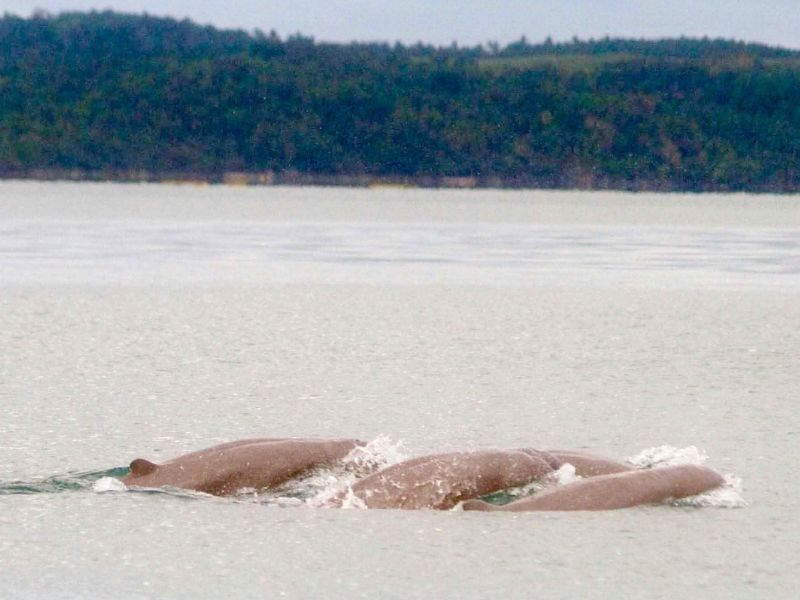
MANILA, Philippines — The critically endangered Irrawaddy dolphin (Orcaella brevirostris) has been sighted again in San Miguel Bay following a comprehensive marine mammal survey conducted by the University of the Philippines Institute of Environmental Science and Meteorology (UP IESM) from July 26 to August 1.
The objective of the scientific assessment — carried out in partnership with the Department of Agriculture - Bureau of Fisheries and Aquatic Resources Regional Office V (DA-BFAR 5) — was to evaluate the population status, distribution and habitat use of the species.
The presence of the dolphins was first detected through acoustic monitoring on July 27 near Sipocot, Camarines Sur, proving their presence in the bay prior to visual sightings. On July 29, researchers made direct visual contact with a pod of approximately nine Irrawaddy dolphins between Siruma and Tinambac, Camarines Sur.
A second group consisting of about four individuals was observed in the same area on July 31, confirming consistent activity in these coastal waters.
Although vessel-based transects conducted on July 28 and 30 yielded no direct sightings, they provided vital environmental and spatial data. These habitat evaluations offer crucial insight into the species' movement patterns and ecological requirements, establishing a solid scientific foundation for future conservation planning and targeted protective measures.
The Irrawaddy dolphin is one of the most threatened marine mammals in the Philippines, with San Miguel Bay hosting one of only three known resident populations in the country, alongside Palawan’s Malampaya Sound and the Iloilo-Guimaras-Negros Occidental waters.
Unlike open-ocean dolphins, Irrawaddy dolphins inhabit shallow coastal areas, estuaries, and river mouths, making them uniquely vulnerable to human activity, fishing gear entanglement, vessel traffic, pollution and habitat degradation.
“With small numbers and low reproduction rates, the loss of even a single dolphin threatens the population's survival. We urge continuous monitoring, stronger environmental protections, and sustainable fishing practices,” said BFAR national director Elizer Salilig.
The conservation and increase in population of this iconic marine mammal ultimately hinges on close cooperation between government partners, researchers, LGUs and local fishing communities. (Contributed story)








- Latest


