This time, it’s for real?

After so many pronouncements, threats, deadlines and reversals from President Trump, the US and Iran finally signed a memorandum of understanding aimed at paving the way for a permanent peace deal. This time, there is a signed agreement, a reopening of the Strait of Hormuz and immediate relief in oil markets.
Oil loses its war premium
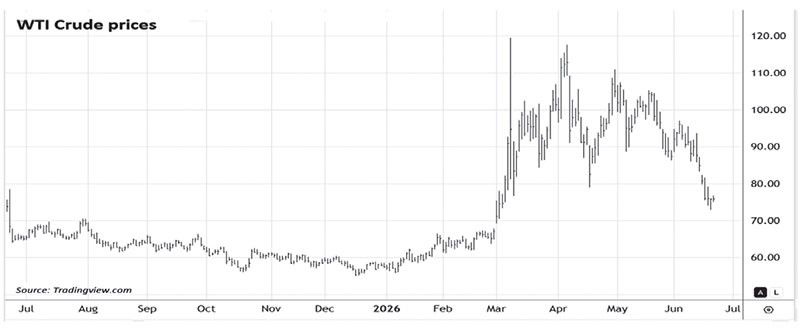
Oil prices were already telling a different story even before the deal was signed. From a March peak of almost $120 per barrel, Brent crude has fallen back toward the $80 level, while WTI is trading near the mid-$70s. After fears of a prolonged shutdown of the Strait of Hormuz had pushed prices sharply higher earlier this year, crude is back just above pre-war levels.
The chart below shows that traders were pricing in the reopening of Hormuz, the resumption of Gulf exports and the replenishment of global supplies. This reflects the unwinding of the war premium in crude.
Supply glut ahead
Beyond the immediate drop in oil prices, the bigger story may be supply. The International Energy Agency (IEA) expects the global oil market to swing into a large surplus by 2027 as Middle East production and exports recover from the disruption caused by the war.
The IEA expects global oil supply to increase by around eight million barrels per day, bringing total supply to roughly 110 million barrels per day in 2027. Demand, by contrast, is expected to increase by only two million barrels per day, bringing total demand to 105.3 million barrels per day. That gap points to a potential surplus of almost five million barrels per day.
The easing of sanctions on Iranian oil exports, along with waivers on Russian oil sales, is adding supply back into the market. One effect of the US-Iran war is the accelerated adoption of electric vehicles (EVs), solar panels and other alternatives. This should reduce future dependence on oil.
Relief for oil importers
Lower oil prices are especially good for the Philippines and the rest of Asia. The Philippines imports almost all of its crude oil from the Middle East, while many Asian refineries that supply our finished petroleum products also depend on Persian Gulf crude.
Last Monday, the PSEi surged by 6.14 percent to 6,272.88, one of the biggest moves globally that day. The sharp rally reflected how sensitive Philippine assets are to oil prices, inflation risks and Middle East tensions. For a market weighed down by high fuel costs and a weak peso, the collapse in the war premium provided a much-needed sentiment boost.
Food commodities decline
The Middle East is also a key supplier of fertilizer inputs such as urea and ammonia, with a large share of global fertilizer trade passing through the Strait of Hormuz. As Hormuz reopens, fertilizer prices have started to ease, reducing one of the biggest input costs for farmers.
Lower fertilizer prices eventually reduce pressure on future food prices. In fact, prices of wheat, corn, soybeans and other agricultural commodities have softened as energy prices retreat and fertilizer supply fears ease. For a food-importing country like the Philippines, this helps reduce pressure on flour, bread, meat, cooking oil and other staples.
Inflation relief
Energy and food are among the biggest drivers of Philippine consumer prices. Oil affects fuel, transport, power and logistics. Fertilizer affects farm costs. Food commodities affect grocery prices. When all three move lower, inflation pressure eases and Filipino households get some breathing room.
Peso and stocks rally
The same inflation relief helps explain why the peso strengthened and the PSEi rallied after the deal was announced. The move is also part of a broader rally in emerging markets, with EM ex-China (symbol: EMXC) posting back-to-back weekly gains of around six percent. For under-owned markets like the Philippines, this rotation into emerging markets is a welcome development.
AI still dominates
The main headwind is the strong dollar, as US rates remain high and new Fed Chair Kevin Warsh has sounded more hawkish than expected. At the same time, the strong US market, still dominated by AI themes, continues to attract capital from around the world. The trillion-dollar IPO pipeline and the AI infrastructure buildout help support demand for dollar assets, keeping the US dollar firm. War or no war, semiconductors, memory, optics and other beneficiaries of hyperscaler AI spending remain the market’s strongest theme.
Will it last?
The agreement is not yet a permanent peace treaty. It is a fragile 60-day ceasefire that reopens the Strait of Hormuz and allows oil flows to resume, but leaves the core issues unresolved – Iran’s nuclear program, sanctions relief, regional security and Israel’s conflict with Hezbollah in Lebanon.
This is why the question remains: is this time for real? Nuclear talks have hit a snag. The Israel-Hezbollah ceasefire remains fragile. Iran has waived Hormuz fees during the 60-day negotiation period, but its proposed permit system and transit fees could become flashpoints.
And yet oil prices have fallen even before a final peace deal is sealed. For markets, this signals easing oil supply fears and a coming surplus – a tailwind for global markets and a welcome boost for the Philippines through lower inflation, a stronger peso and firmer stocks.
Philequity Management is the fund manager of the leading mutual funds in the Philippines. Visit www.philequity.net to learn more about Philequity’s managed funds or to view previous articles. For inquiries or to send feedback, please call (02) 8250-8700 or email [email protected].


- Latest
- Trending