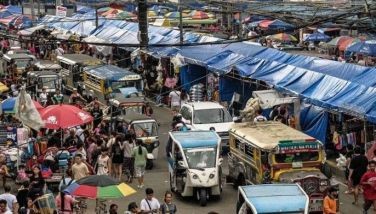
Philippines lifted to upper-middle income status

MANILA, Philippines — The Philippines is now classified by the World Bank as an upper-middle-income economy, a milestone that reflects broad economic growth but does not mean most Filipinos are suddenly middle class.
The World Bank Group's latest country income classifications, released July 1, moved the Philippines from lower-middle-income to upper-middle-income status based on 2025 gross national income per capita estimates.
The country's GNI per capita reached $4,850, above the $4,636 threshold for upper-middle-income economies.
Under the updated thresholds, upper-middle-income economies are those with GNI per capita of $4,636 to $14,375. Lower-middle-income economies are those with GNI per capita of $1,176 to $4,635, while high-income economies are those above $14,375.
The Philippines was among six countries that moved to a higher income category in the latest update. Jordan, Micronesia, the Philippines, Sri Lanka and Vietnam moved to upper-middle-income status, while Togo moved from low-income to lower-middle-income status.
"The Philippines achieved its reclassification through broad-based expansion," the World Bank said in a post. "GDP grew at an average of 5.8% per year over five years, reflecting gains across all major industries, not a single sector boom, but an economy-wide shift."
What the label means
The classification matters because the World Bank uses income groups as a global reference for tracking development and economic progress. These groupings also help determine which countries can access concessional loans and development assistance.
GNI per capita is measured in U.S. dollars using the Atlas method, which smooths out short-term exchange-rate swings.
Its limits? Because it is a national average, it does not show how income is distributed across households, regions or sectors.
The World Bank also cautioned that "no single measure can fully capture the complexity of a country's development." The move to upper-middle-income status serves a macroeconomic marker, but does not indicate that poverty, inequality, low wages or high living costs have been addressed.
The updated classifications will remain as a global reference until the end of June 2027.





- Latest
- Trending