The bird, the fish and the hybrid workplace

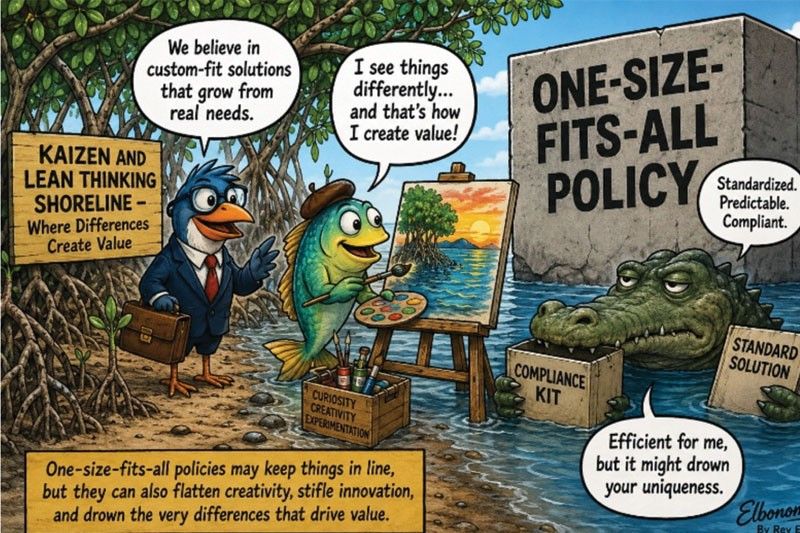
There’s a popular saying that asks: “A bird may love a fish, but where will they build a home together?” The question isn’t whether they love each other. The real question is whether they can thrive in a common environment. A bird belongs to the sky; a fish belongs to the sea. Forcing either one to live in the other’s world is a recipe for failure.
In business, pairing birds with fish is like forcing cross-functional teams with opposing cultures to work under the same assumptions. So, how would you build a productive habitat for them?
Give the bird a scuba suit or teach the fish to breathe air? In a corporate setting, this looks like coercing a highly creative design team adhering to a rigid factory checklist or demanding a software team use physical assembly-line metrics.
Let me give you my real-world experience. Thirty-two years ago, when I was the human resources manager of an animation production studio, our animators, cartoonists and illustrators were required to follow a strict attendance policy: 8:30 a.m. to 5:30 p.m., Monday to Friday. On my first week, however, I discovered the studio had a monthly average of 50 percent tardiness rate.
Many artists arrived 30 minutes to an hour late. They were suspended without pay, but the company experienced declining productivity, missed deadlines and agitated foreign customers.
Also, it created massive time and effort for HR to ensure due process for the offenders. My maverick mind told me that forcing complete adherence to a standard system could kill the unique value of artists in a creative ecosystem.
Recognizing the seriousness of the problem, I proposed three major solutions: One, flexi-time with non-negotiable core time from 10:00 a.m. to 6:00 p.m. Two, introduction of a work-from-home setup. And three, project-based employment for future artists. Each proposal recognized that artistic creativity depends more on output than rigid clock-watching.
My ideas were rejected by the CEO because they were not industry standards. I asked him: Do we have to follow an old blueprint or do we create something revolutionary?
Three months later, I accepted an opportunity elsewhere. Years later, many creative and dynamic organizations adopted flexible schedules and remote work, not as employee perks, but as productivity tools.
Common interest
If a bird and a fish want to cohabitate, they must look for a common interest, like the mangroves which are neither entirely land nor entirely sea. They can succeed because they create an environment where different species can flourish together.
Organizations need similar transition spaces, which could be done through the following approaches:
1. Create a joint problem-solving team. Focus on the system, not the personalities. Use root cause analysis tools like Five Whys or the Fishbone Diagram to strip away emotion and discover the policy flaw.
2. Establish common ownership. When both workers and their managers are actively involved in designing the solution, pushback drops to near zero. Then, map out where their worlds naturally intersect.
3. Cultivate trusting relationships. Through continuous feedback loops, both managers and their workers could optimize the relationship by proactive consultations, including the prompt resolution of minor issues.
4. Implement a trial period. Agreeing to a permanent change can terrify managers, while doing nothing frustrates the workers. Agree on a solution with measurable KPIs. If it works, it becomes policy; if it fails, change something based on data, not guesswork.
New ecosystem
The dream is a new ecosystem where incompatible forces are constrained to win together. It’s like marriage. You marry someone from a completely different background and wish to convert them.
Therefore, the next time your organization faces a structural contradiction, then don’t force an unnatural merger. Instead, find common ground like true lovers.
Start with something, even if they’re not part of industry best practices. You don’t need to change the nature of the bird or the fish; you just need to design a better way for them to meet at the surface, like mangroves.
The lesson is simple: don’t force the bird to swim or the fish to fly. Design a shoreline where both can contribute their strengths. That’s what effective Kaizen and Lean Thinking is all about.
Rey Elbo is a quality and productivity activist. Send your comment, question, or story to[email protected]or via Facebook, LinkedIn, X orhttps://reyelbo.com





- Latest
- Trending