Shortfall in rice tariff collection seen to impact fiscal balance
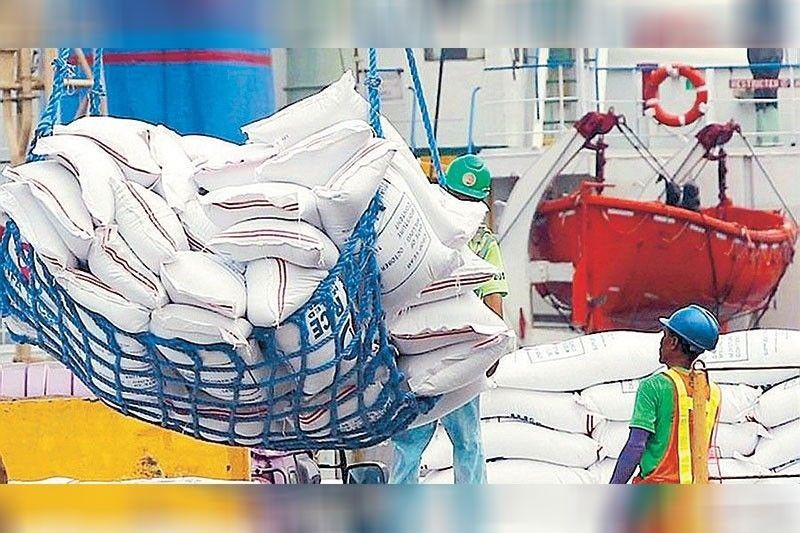
MANILA, Philippines — A foreseen shortfall in the rice tariff collections this year may further strain the government’s already limited fiscal space, potentially increasing its reliance on borrowings next year to sustain rice programs, experts warned.
Former agriculture undersecretary Fermin Adriano said that if rice tariffs remain at a record low of 15 percent this year, then the government faces a “deficit problem” in 2026 since collections this year might fall short of the minimum P30 billion for the rice competitiveness enhancement fund (RCEF).
Rice tariffs collected each year are earmarked by the government to bankroll the RCEF, aimed at improving the local rice industry’s competitiveness.
However, in the event that rice tariffs collected fall below P30 billion, the deficiency would be sourced from the regular budget of the Department of Agriculture (DA), under the amended Rice Tariffication Law.
This, experts noted, could pose a problem to the overall budget of the DA since it would mean that some programs of the department might face an allocation cut to fill in the deficiency in the guaranteed RCEF.
“(The National Rice Program) will most likely be adversely affected because of substantial overlap with RCEF assistance,” Adriano noted.
He pointed out that the budget from slow disbursing programs of the DA might also be taken away to fill in the possible gap in RCEF allocation next year.
Adriano noted that the absorptive capacity of the DA has averaged below 80 percent in recent years.
“In short, there should be no problem if the DA budget is managed properly,” he said.
Philippine Chamber of Agriculture and Food Inc. president Danilo Fausto said the rice tariff collection shortfall would add more burden to the government’s fiscal space. This, he said, could lead to the government jacking up its borrowing program next year just to sustain its key programs.
“It will have to compete with the regular fund of other programs of the government,” Fausto said.
Industry players earlier noted that rice imports must increase by at least half or even double this year for the government to collect P30 billion in tariffs if the rate would be kept at 15 percent throughout the year.
Last year, the government collected a record high of P34 billion in rice tariffs. The reduced rice tariff rate took effect only at the start of the second half.
If the entire 4.8 million metric tons of rice imported last year had been slapped with a 15-percent tariff, the government’s collections would have been just around P20.8 billion, or P9.2 billion short of the P30-billion RCEF.
Raul Montemayor of the Federation of Free Farmers agreed that funding for the RCEF may start to rise beginning in 2026 since tariff collections starting this year may not reach P30 billion annually. With this, the RCEF would have to depend on savings in the DA budget or even on unprogrammed funds, Montemayor said.
“In this case, it will be very hard for implementing agencies to plan and prepare if they do not know if their funding will come or not and how much it will be,” he said.
The government’s rice tariff collections in January plunged by 70 percent on an annual basis because of lower tariff rates and a decline in import arrivals.
Bureau of Customs data showed that it collected P1.43 billion in rice tariffs last month, P3.31 billion lower than the P4.74 billion recorded in the same period last year.
Rice import volume in January fell by more than a quarter to 330,501 metric tons from 474,194 MT in the same month last year.
Last month, the DA requested President Marcos to restore the P10 billion in its national rice program (NRP) budget after it was slashed in the 2025 General Appropriations Act (GAA) because of the hike in the RCEF.
The NRP, a banner program of the DA aimed at supporting local rice farmers, had a proposed budget of P31.4 billion under the 2025 National Expenditure Program (NEP), slightly higher than the P30.88 billion allocation in 2024.
However, the program only received P21.68 billion in the 2025 GAA. The DA noted that the reduction in the NRP budget could be because of the increase in the guaranteed allocation for the RCEF to P30 billion from P10 billion.
“We are seeking an additional P9 to P10 billion for the rice program. And it would depend on the Department of Budget and Management where they will source the fund,” Agriculture assistant secretary and spokesman Arnel de Mesa earlier said.


- Latest
- Trending