Underfunded for years: The price of shortchanging Filipino students
An opinion piece by Nicolette Reanmari E. Cenas, Kristine Sugar V. dela Rosa, Moira Anne M. Jarangue, Shaira Audrey Laudit, Charles Gio A. Lumanlan and Summer Andi S. Reoteris
The Philippines must sustain and strengthen its investment in the education sector because quality education requires sufficient resources and government support. Literacy is a necessary life skill for our survival as active participants in society. For a society to be efficient and productive, we must all be literate. However, years of insufficient funding for the Philippines' education sector have hindered student performance and left many Filipino students without the resources they need.
The Philippines allocated a record P1.345 trillion to education in 2026, equivalent to 4.36% of its gross domestic product. While this meets UNESCO's recommended spending of 4% to 6% of GDP, decades of underinvestment have left the country with persistent shortages in classrooms, teachers and learning materials that a single year's budget increase cannot resolve.
For a better future for Filipinos, the government must sustain this level of investment and ensure that funds are effectively utilized to provide the necessary resources for quality education. The consequences of longstanding underinvestment continue to undermine the achievement of the United Nations Sustainable Development Goal 4.
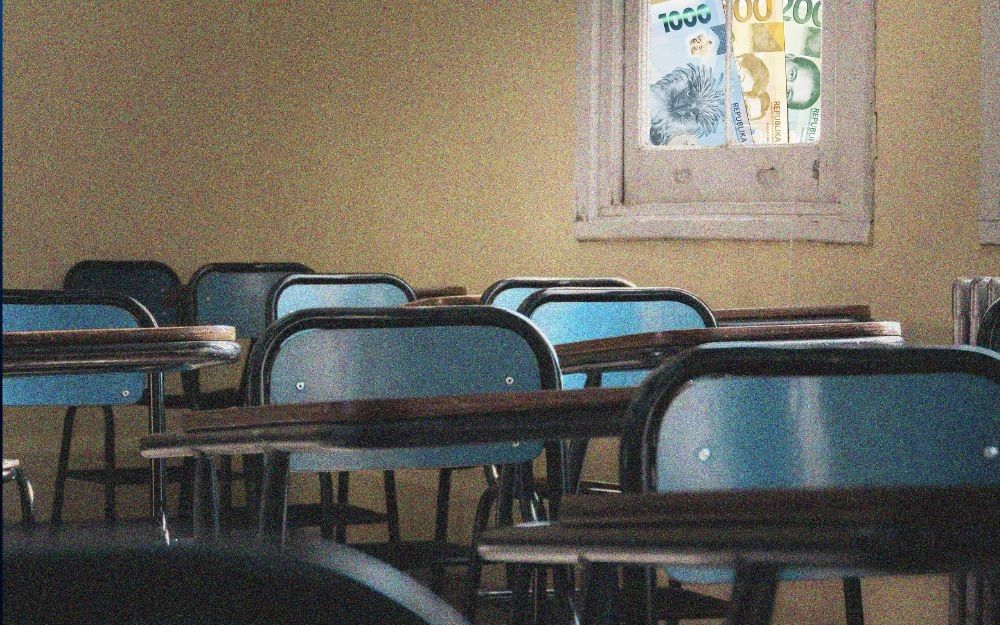
Years of inadequate funding, compounded by difficulties in budget utilization, have contributed to persistent problems in public school facilities, especially the lack of classrooms. According to the Commission on Audit in 2024, the Department of Education completed only 192 (3.01%) of its 6,379 targeted classrooms in 2023. Furthermore, 4,391 classrooms were still under construction, while another 550 had yet to undergo the required procurement stages.
These figures demonstrate the difficulties in supplying adequate learning facilities for students. Even when financial resources are allocated, delays in procurement, project planning and implementation can prevent schools from receiving the amenities they urgently need.
Thus, many students continue to experience overcrowded classrooms and uncomfortable learning environments, which may affect their concentration and academic performance and even compromise their well-being. If we put ourselves in their shoes, we may find each day a battle to survive and lose our motivation to study.
The Second Congressional Commission on Education (EDCOM II), moreover, notes how the country's education system faces interlinked problems involving insufficient government spending on education, shifting funding priorities and limitations in the use of allocated funds.
The findings indicate that government spending on education has historically fallen below international benchmarks. They also highlight how funding priorities have shifted away from basic education toward higher education since 2017.
In addition, DepEd's limited capacity to effectively utilize its appropriations has contributed to billions of pesos in unspent funds and ongoing shortages of teachers, classrooms and learning materials.
This shows that the problem is not only about the amount of money allocated but also how the funds are distributed, managed and utilized. This raises the question: How can we ensure that these funds reach the schools and students who need them most?
Falling short of students' needs
According to the Organization for Economic Co-operation and Development (OECD) in 2023, only 24% of Filipino students achieved minimum reading proficiency in the 2022 Programme for International Student Assessment (PISA), while a mere 16% reached the same standard in mathematics.
EDCOM II's 2024 report revealed that of the P12.65 billion allocated for textbooks and instructional materials between 2018 and 2022, only 7.5% was disbursed. These statistics paint a dreary picture: A system that has struggled to secure sufficient resources has also struggled to make effective use of the funds already available.
Even students attending school regularly are not exempt from these rampant problems. The OECD reported in 2023 that 43% of Filipino students attended schools where principals identified teacher shortages as an obstacle to instruction. Additionally, EDCOM II reported in 2024 that delayed textbook distribution forces teachers to produce alternative learning materials, sometimes at their own expense.
Teachers have to balance the responsibility of passing on knowledge to the next generation with an overwhelming workload due to staff shortages. They also have to find room in their own paychecks to buy things that should realistically be covered by the school budget, such as test answer sheets, paper and supplemental materials.
These struggles leave teachers with little time or resources to focus on learners falling behind, as they are too preoccupied with merely keeping themselves afloat.
Investing in better learning outcomes
Given the longstanding gaps in education, the government must make the most of its increased budget allocation for the sector. Instead of spending on unnecessary things, the government should prioritize providing updated learning materials, raising teachers' salaries and building or repairing learning facilities.
Additionally, local communities can use local tax revenues to pay for tutors and reading materials and build learning hubs without tapping into the national DepEd budget. Communities can become productive learning environments and work hand in hand in shaping students, allowing the national education budget to be used for other pressing needs in the country's education sector.
Increased funding for the education sector is associated with improved academic performance and narrower equity gaps among Filipino students. While the Department of Budget and Management prioritizes education in the national budget annually, years of underinvestment have left many students without access to resources that meet their basic needs.
With sustained funding and effective spending, students' learning environments could be transformed through access to essential resources, such as up-to-date learning materials, competent teachers and functional facilities.
Thus, the quality of the education system in the Philippines and student outcomes could improve greatly if the government sustained its increased investment in education and ensured that the allocated funds translated into tangible improvements for students and teachers.
How much higher could students fly if given access to proper facilities, textbooks and modules, and the means to stand on equal footing with their peers?
The authors are senior high school students at the University of Santo Tomas.




- Latest