Government eyes 25% drop in new COVID-19 cases
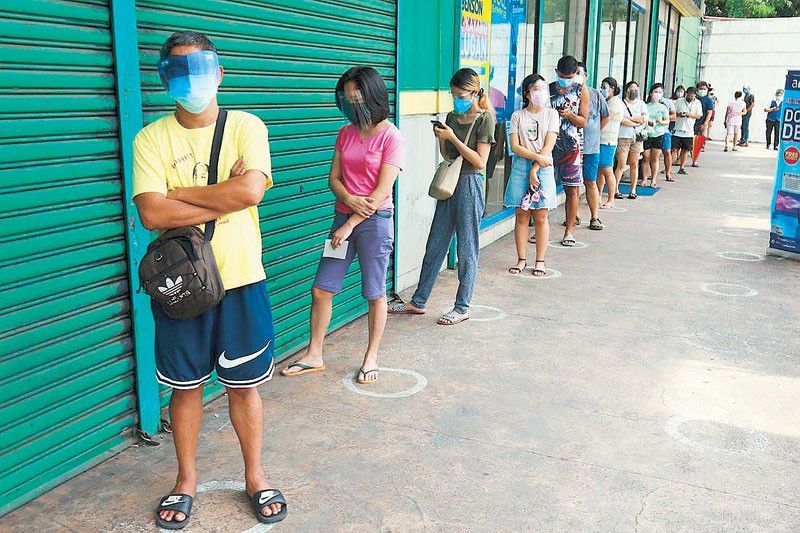
MANILA, Philippines — The government is seeking to reduce the number of daily new COVID-19 infections by more than 25 percent now that pandemic epicenter Metro Manila and four nearby provinces have been placed on a weeklong lockdown, according to Malacañang.
Presidential spokesman Harry Roque said the growth in the number of infections is expected to slow as mobility would be limited due to the enforcement of the strictest enhanced community quarantine (ECQ) starting today until April 4 in Metro Manila, Bulacan, Cavite, Laguna and Rizal.
“I think the expectation is that (the reduction in the number of daily new infections) will be higher than 25 percent because this is ECQ,” Roque said at a press briefing last Saturday.
The Palace spokesman admitted that it is possible that the number of infections might rise again if the health and safety measures are relaxed.
“That’s a possibility, so we continue to balance it. We are pursuing our goal to promote the total health of everyone without sacrificing the right to survive, the right not to go hungry,” he said.
“I believe that Filipinos cooperated last year, and they will continue to do so. We just need to have a voluntary stay at home. I’m sure our countrymen will do that,” he added.
The government placed Metro Manila, Bulacan, Cavite, Laguna and Rizal – areas under the so-called National Capital Region (NCR) Plus bubble – under ECQ after the country logged more than 8,000 daily new infections in the past few days.
The lockdown, which will affect more than 20 million people, aims to slow the increase in the number of pandemic infections and to prevent the overwhelming of critical health care facilities.
Mobility restrictions in ECQ areas include requiring minors, people above 65 years old, those with health risks and pregnant women to stay home, except when accessing essential goods or services and reporting for work; and the enforcement of common curfew hours of 6 p.m. to 5 a.m. Gatherings of more than 10 persons are also prohibited.
Roque said the government would intensify contact tracing and detection efforts to contain the spread of the virus. He added that government personnel would go from house-to-house to look for persons with COVID-19 symptoms.
“Actually, if they have symptoms, it is already a ground for isolation... There is no violation of human rights because this is part and parcel of an ongoing quarantine,” the Palace spokesman said.
“We will make sure that local governments will isolate not just those who tested positive, but also suspected cases and those who had close contact with them. We will intensify testing, contact tracing within 24 hours of detection,” he added.
Roque emphasized that 95 percent of the close contacts should be traced, isolated and quarantined within 24 hours of case notification.
The government also aims to buy at least 500,000 antigen test kits to ensure that many people would be tested for COVID-19.
“Also part of our effort is the parallel implementation and the intensified vaccination efforts in high-burden areas. That includes Metro Manila, Laguna, Cavite, Rizal and Bulacan, and also Cebu City and Davao City,” Roque said.
He also clarified that persons who are allowed to go out of their homes do not need to present quarantine passes to security forces enforcing the lockdown.
“For the one-week period, it may be impossible to issue a new quarantine pass. If you still have the (old) quarantine pass, use it. If you do not have it anymore, an explanation on why you have to leave your house would be enough,” he said.
9,475 new cases
Confirmed COVID-19 cases jumped to 721,892 as the Department of Health (DOH) logged additional 9,475 cases yesterday.
The DOH said active cases stand at 105,568 or 14.6 percent of total cases. Bulk or 98.1 percent of the active cases are mild and asymptomatic.
Additional 22,000 recoveries brought to 83.6 percent or 603,154 the total number of those who have recuperated from the illness, according to the agency.
Eleven additional deaths pushed to 13,170 the number of COVID-related fatalities. The figure accounts for 1.82 percent of the total cases.
Yesterday, the DOH also reported that bulk of the additional 400,000 doses of Sinovac vaccines donated by China are set to be distributed in Metro Manila and nearby provinces.
“About 75 percent of the 400,000 doses of the vaccines are to be deployed in the NCR, Bulacan, Laguna, Cavite and Rizal,” Health Undersecretary Myrna Cabotaje said in a radio interview.
“We decided that because these areas are considered hot spots, we need to concentrate our supplies here,” Cabotaje added.
The remaining 25 percent were deployed to other areas seeing surge in COVID cases, such as Batangas, Cebu, Davao, Cordillera Administrative Region and Western Visayas, according to the DOH official.
“This is so we can continuously protect our health care workers and other vulnerable population,” Cabotaje said.
On top of the 600,000 doses of Sinovac that arrived in the country last month, the Philippines received 400,000 more doses of the vaccines from the Chinese government.
The DOH reported that as of March 23, a total of 508,332 vaccines out of the 1,125,600 doses available in the Philippines had already been administered. Most or 98 percent of the available vaccines had been deployed to vaccination sites.
Stringent protocols
Meanwhile, the Department of the Interior and Local Governemnt (DILG) has directed all local police and barangays to strictly implement stringent protocols as Metro Manila and surrounding provinces brace for another weeklong lockdown starting today.
DILG officer-in-charge Undersecretary Bernardo Florece said there are enough personnel from the Philippine National Police (PNP) to enforce protocols as the NCR+ bubble reverts to ECQ.
“There is a directive from the PNP to deploy barangay tanods for the barangay level to keep people from crowding and going out of their homes. Even when we just had the bubble areas initially, we already have our PNP. The police could do it,” Florece said in English and Filipino in an interview over radio station dzBB.
He added that they have also tapped the Armed Forces of the Philippines (AFP) to implement strict stay-at-home orders and restrict the movement of people to curb the rising transmission rate of COVID-19.
The strictest level of lockdown is being imposed over Metro Manila, Laguna, Cavite, Rizal and Bulacan over the Holy Week, a traditional holiday for many Filipinos.
The DILG will strictly enforce checkpoints around and even within the NCR+ bubble to ensure that the public is following protocols and the uniform curfew, acording to Florece.
He said they are also in coordination with other government agencies to ensure that health standards are being followed at work establishments allowed to operate and even in public transportation.
Over 9,000 cops deployed
Over 9,000 police officers have been deployed to man 1,106 checkpoints that have been set up in areas covered by the ECQ, the PNP said yesterday.
PNP deputy chief for operations Lt. Gen. Cesar Binag said the officers have been deployed as early as 6 p.m. yesterday to prepare for the full implementation of ECQ rules at checkpoints in Metro Manila, Cavite, Laguna, Bulacan and Rizal by midnight.
Binag added that at least 9,356 officers would mainly check whether persons are indeed authorized to leave their households, like essential workers, health frontliners, government officials and frontline personnel, people traveling for medical or humanitarian reasons, leaving to work overseas and people heading home.
“The PNP chief ordered flexibility (in enforcing rules in checkpoints) because we are doing this to help lower the cases of COVID-19, not to restrict our citizens,” he said at a press conference on Sunday.
Aside from checkpoint personnel, the PNP will also deploy officers to points of convergence, like markets, groceries and pharmacies, to ensure that health protocols are being followed. These areas, according to Binag, should also be closed once curfew hours are in effect.
He asked Filipinos who do not belong to the category of essential workers or APORs to stay at home because police would only order them to head back to their residences.
For areas that have ordinances to penalize violations, he said police would issue tickets and haul offenders to established areas like gymnasiums, where they would be reprimanded and made to watch instructional videos for health protocols.
Those who are qualified to head outdoors are asked to bring identification cards or certificates of employment for quicker passage. – Romina Cabrera, Neil Jayson Servallos, Elizabeth Marcelo, Pia Lee-Brago, Paolo Romero





- Latest
- Trending