DOT probes ‘stock footage’ in tourism video
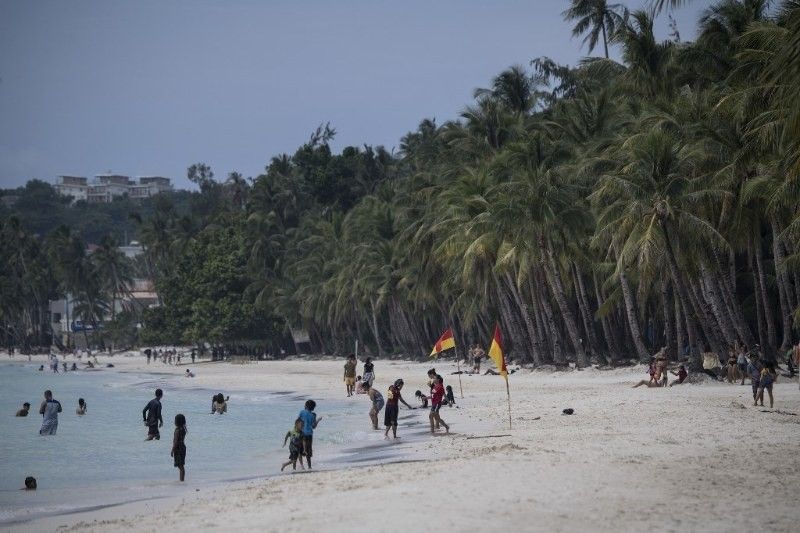
MANILA, Philippines — The video ad urges viewers to “love the Philippines” – and features rice terraces, though not in Ifugao but in Indonesia, and sand dunes in Brazil.
The Department of Tourism (DOT) is now investigating its new “Love the Philippines” tourism campaign video released last week, after allegations surfaced about the use of foreign stock footage taken from the internet.
“(The DOT is) conducting an exhaustive investigation to determine the veracity of, and to gather the full faculty of facts on, these allegations,” the DOT said in a statement yesterday.
Social media users found that several shots used in the campaign video featured locations in other countries including Thailand, Indonesia, the United Arab Emirates, Switzerland and Sri Lanka.
Advertising agency Doyle, Dane and Bernbach Philippines apologized for what it described as the “highly inappropriate” images.
“Proper screening and approval processes should have been strictly followed,” DDB said in a statement, describing it as an “unfortunate oversight on our agency’s part.”
“The use of foreign stock footage in a campaign promoting the Philippines is highly inappropriate, and contradictory to the DOT’s objectives.”
Tourism Secretary Christina Garcia Frasco earlier told CNN Philippines they spent P49 million for the “Love the
Philippines” campaign. She said the DOT conducted a global survey which found that, in the post-pandemic era, tourists wanted “authentic interactions with communities.”
The new slogan replaced “It’s More Fun in the Philippines.”
The DOT gave assurance that “no public funds have been paid for the AVP in question.”
The audiovisual presentation, as well as the “Love the Philippines” campaign, was prepared by DDB Philippines.
“The DOT... repeatedly sought confirmation from DDB on the originality and ownership of all materials contained in the AVPs and key visuals presented to the Department. In all these occasions, DDB repeatedly assured the DOT that the originality and ownership of all materials are in order,” the DOT said.
The promotional video was pulled from the DOT’s Facebook and YouTube accounts.
“It is important to note that the AVP was produced by DDB Philippines at its own expense, and no public funds were released, or would be released, to fund the video. This was a DDB initiative to help pitch the slogan,” the advertising agency said in a published apology.
DDB Group Philippines won the bidding process for the new tourism campaign.
The winning bidder is tasked with producing “a maximum of five AVPs with a duration of no more than 120 seconds per video and three 60-second television commercials.”
Philippine blogger Sass Rogando Sasot had posted on Facebook that several images in the campaign video were from other countries.
Analysis by AFP’s Fact Check team confirmed that the video showed places in Brazil, Indonesia, Switzerland and the UAE.
Some of the images used in the promotional video can be found on the websites of stock footage providers.
For example, footage of rice terraces is on Pond5, which identified the location as Ubud on the Indonesian tourist island of Bali.
Videvo has the same aerial shot of sand dunes as the one used in the Philippine ad but says the location was Cumbuco in northeastern Brazil.
Other footage shows a fisherman casting a net while wearing a hat that is not typically worn in the Philippines and a person driving a buggy over sand dunes in the Emirates.
Albay Rep. Joey Salceda had earlier complained that Mayon Volcano was not included in the promotional video.
Netizens, particularly journalist Howie Severino, on the other hand suggested adding a comma between “love” and “the Philippines” would make a world of difference.
Tourism is a key industry in the Philippines, which boasts pristine dive spots and white sand beaches, but arrivals lag those of its neighbors due to poor infrastructure and high costs.
There were 2.7 million inbound tourists to the Philippines last year, down 68 percent from pre-pandemic levels in 2019, according to United Nations’ World Tourism Organization data.
COA flags TPB
Meanwhile, the Commission on Audit (COA) has flagged the DOT’s marketing arm for procuring P9.868 million worth of tokens or giveaways in 2022.
The Tourism Promotions Board (TPB) did not submit supporting documents such as acceptance reports, a list of recipients, and recipients’ acknowledgment that they received the supposed tokens or giveaways.
The COA added that while the procurement was supported with official receipts, official receipts, billing invoices, delivery receipts, purchase requests, purchase orders and quotations, it still lacked an Inspection and Acceptance Report (IAR) and a Requisition and Issue Slip.
“Without the said listings or their equivalents, the Audit Team could not verify whether the promotional materials were distributed to the intended recipients or used according to their purpose. Also, in the absence of the IAR, it could not establish whether these items were completely delivered in good condition,” the COA said in its annual audit report.
The TPB’s Procurement & General Services Division and Accounting Division also revealed that the agency “has no existing policy/control governing the distribution of promotional items” to intended recipients.
“In view of the foregoing, the propriety of the distributed promotional materials could not be established. In addition, absence/lapses in control could increase the risk of losses,” the COA noted.
The COA recommended that the TPB should submit proof of distribution and “adopt a policy/guideline for a uniform procedure on the distribution of promotional materials that will serve as a guide to project officers/end-users.”
In response, the TPB said that promotional giveaways were given to high-level officials or delegates in the tourism industry and consumers during trade fairs.
“Thus, it will be impractical for the TPB to require the recipients to sign an acknowledgment receipt for the given items,” the TPB said.
In the same audit report, the COA reminded the TPB to remit to the Bureau of Treasury (BTr) funds amounting to P196.853 million, which remained idle in the Board’s bank account for more than three to six years.
The idle funds were received by the TPB from the DOT from 2015 to 2018 for the implementation of various programs and projects.
However, the funds remain unutilized for several years and must be returned to the BTr.
“Verification showed that the said funds are still intact with the Land Bank of the Philippines and is yet to be reverted/remitted to the BTr as of December 31, 2022,” the COA said.
The TPB’s Accounting Division informed the audit team that a disbursement voucher for the remittance of funds to the BTr had already been transmitted to the DOT in 2022, but COA said the whereabouts of the voucher could no longer be located due to the change in administration. — Mark Ernest Villeza, Elizabeth Marcelo


- Latest
- Trending