Marcos: Don’t panic over weakening peso
MANILA, Philippines — There is no need to panic over the weakening of the Philippine peso as efforts are underway to defend the local currency “as hard as we possibly can,” President Marcos said yesterday.
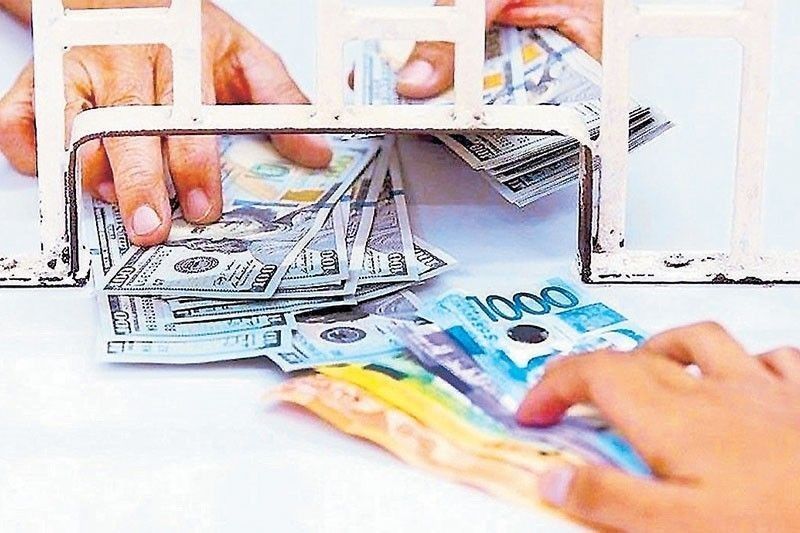
The peso dropped to a record low of P64.17 against the dollar on Tuesday, a development seen to benefit the families of migrant workers, but may also hike import costs and foreign debt.
Energy Secretary Sharon Garin recently noted that a weaker peso could raise the cost of imported coal, diesel and liquefied natural gas and may affect electricity rates.
“First of all, do not take it with alarm. Don’t panic. It is still an effect of the rising prices of oil and fuel and its impact on the economy,” Marcos told reporters.
“However, people can take solace in the fact that our policy toward the peso is to continue to defend the peso as hard as we possibly can,” he added.
Marcos gave assurance that while the dollar is becoming “very strong,” the government has the means to prevent the further depreciation of the local currency.
“With that in mind, we will continue to do all that we can to make sure that the value of the peso does not continue to go down, especially relative to the dollar,” the Chief Executive said.
“Our foreign exchange reserves are healthy... And that is what we are getting to defend the peso. So we will continue to defend the peso.”
Marcos acknowledged that monetary measures could only go so far in terms of stabilizing the prices of basic goods as inflation is coming from the supply side.
“We have to do other ways. It’s basically oil we can do nothing about. Food, we can. And we are doing, again, everything that we can to make sure that the prices of food come down,” he said.
Inflation rose to 7.2 percent in September from 6.1 percent in August and 1.7 in the same month last year, mainly because of higher food and energy prices. Rice inflation also quickened because of tighter domestic supply and higher transportation costs.
For the militant Bagong Alyansang Makabayan, President Marcos’ “no need to panic” statement only demonstrated his incompetence.
In a statement, Bayan president Renato Reyes said Marcos’ “privileged” assurance comes from a person who does not have to deal with rising prices and high interest rates.
“It is the reaction coming from an incompetent and insensitive regime that does not acknowledge the internal weakness of our economy and conveniently blames only external factors,” he said.
With no clear response to the prevailing economic crisis, the Marcos administration has only shown that it’s not serious about helping ordinary Filipinos.
“He is busy with budget insertions and pork barrel allocations,” Reyes said.
Higher rates loom
In an interview in Singapore, Energy Regulatory Commission (ERC) chairman and CEO Francis Saturnino Juan expressed concern the peso’s continued slide to record lows could push the already high electricity rates even higher.
“We’re alarmed, definitely,” Saturnino said, referring to the peso slide, warning that it could affect pass-through charges, including generation costs.
Generation charge, which covers the cost of power procured by distribution utilities, typically accounts for more than half of electricity bills.
The impact of a weaker peso is particularly evident in franchise areas served by utilities heavily reliant on imported coal, diesel and liquefied natural gas.
“As regulators, we’re quite sensitive as to what the impact of this (peso depreciation) will be on electricity bills,” Juan said.
The ERC chief stressed that this concerns him not only as a regulator but also as a consumer, noting that a weak peso could drive up the prices of other commodities as well.
He said the ERC would explore ways to mitigate its impact without affecting other stakeholders in the energy sector.
Under the Electric Power Industry Reform Act, the ERC is mandated to promote competition, penalize market abuse and regulate the rates charged by power utilities.
As electricity costs face upward pressure, Juan said the agency has yet to assess whether to extend its policy prohibiting electricity disconnections for consumers with unpaid bills.
For the November and December billing periods, the no-disconnection policy will apply only to households with a monthly consumption of 200 kilowatt-hours or less. – Brix Lelis, Emmanuel Tupas





- Latest
- Trending