Opong to bring heavy rain; government work, classes suspended
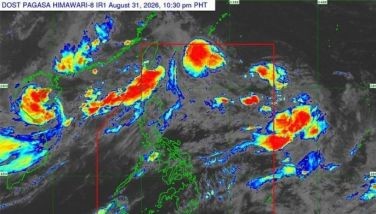
MANILA, Philippines — Malacañang suspended government work and classes at all levels today in Metro Manila and large areas of Luzon and the Visayas as Severe Tropical Storm Opong (international name Bualoi) intensified and threatened to bring heavy rainfall and flooding.
Apart from Metro Manila, work and class suspensions were ordered in Biliran, Eastern Samar, Northern Samar, Samar, Masbate, Romblon, Sorsogon, Aklan, Albay, Antique, Batangas, Bataan, Camarines Norte, Camarines Sur, Capiz, Cavite, Catanduanes, Guimaras, Iloilo, Laguna, Leyte, Marinduque, Negros Occidental, Oriental Mindoro, Rizal and Quezon.
Private companies were given the discretion to suspend work, according to the order signed by Executive Secretary Lucas Bersamin.
Signal No. 3 was hoisted over parts of Samar and Bicol yesterday as Opong moved closer to Eastern Visayas, bringing storm-force winds, heavy rains and the threat of coastal surges.
As of 4 p.m. yesterday, the Philippine Atmospheric, Geophysical and Astronomical Services Administration said Opong was located 195 kilometers east-northeast of Guiuan, Eastern Samar, or 225 km east of Borongan City, packing maximum sustained winds of 110 km per hour near the center and gusts of up to 135 kph.
Signal No. 3 was hoisted over Northern Samar, the northern portions of Eastern Samar and Samar, as well as Sorsogon and the northern part of Masbate, including Ticao and Burias Islands in Luzon.
Meanwhile, areas under Signal No. 2, which may see gale-force winds within 24 hours, include Camarines Norte, Camarines Sur, Albay, Catanduanes, the rest of Masbate, Marinduque, Romblon, Oriental Mindoro, parts of Batangas and Quezon, Biliran, the northwestern portion of Leyte, and the central sections of Eastern Samar and Samar.
Large swathes of Luzon, Visayas, and northern Mindanao – including Metro Manila, Central Luzon, much of Calabarzon and Mimaropa, Cagayan Valley, Ilocos, Eastern Visayas, Northern Cebu, and parts of Northern Mindanao – were placed under Signal No. 1, where strong winds may be felt within 36 hours.
The weather bureau said Opong could intensify into a typhoon before its projected landfall in Northern Samar or northern Eastern Samar early Friday, then cross Bicol and southern Luzon before emerging into the West Philippine Sea by Saturday.
Residents in high-risk and low-lying areas were urged to heed evacuation orders.
Mayon lahar
State volcanologists on Wednesday issued a lahar advisory for Mayon Volcano as Opong is forecast to bring heavy to intense rains over the Bicol Region starting Thursday afternoon until Friday.
In its 9 p.m. advisory, the Philippine Institute of Volcanology and Seismology said rains triggered by the cyclone could generate volcanic sediment flows or lahars, as well as muddy streamflows and runoffs in rivers and drainage areas surrounding the volcano.
Heavy rainfall, it warned, may mobilize loose pyroclastic materials from the 2018 and 2023 eruptions, particularly within the watershed areas of the Miisi, Mabinit, Buyuan and Basud Channels.
Older eruption deposits on Mayon’s eastern and western slopes may also be remobilized, leading to non-eruption lahars through erosion of riverbanks and channel beds.
Communities at risk include those near the Miisi, Binaan, Anoling, Quirangay, Maninila, Masarawag, Muladbucad, Nasisi, Mabinit, Matanag, Basud and Bulawan Channels in Albay province.
Power firms ready
Government agencies and power firms are ramping up preparations to swiftly respond to the potential impact of Opong on the country’s energy infrastructure.
The Department of Energy has encouraged stakeholders to take proactive and resilient measures, as Opong is forecast to make landfall over Samar on Friday morning.
Energy Undersecretary Felix William Fuentebella emphasized the urgent need to upgrade distribution and transmission lines to withstand typhoons with wind speeds of up to 280 kilometers per hour, reinforcing efforts to ensure reliable power services.
The National Grid Corp. of the Philippines, for its part, said precautionary measures are already in place to minimize the impact of Opong on its transmission operations. As of 5 p.m. yesterday, all transmission lines and facilities were under normal operations.
The National Electrification Administration reported that over 68,000 households remain without power due to the impact of Super Typhoon Nando, which exited the Philippine area of responsibility last Tuesday.
The initial cost of damage to electric cooperatives’ infrastructure was estimated at P10 million, based on the latest NEA data.
Canceled flights
Forty-eight domestic flights were canceled as of 6:30 p.m. yesterday due to unfavorable weather conditions brought by Opong.
AirAsia Philippines canceled 24 domestic flights from Manila-Tacloban-Manila, Manila-Kalibo-Manila and Manila-Caticlan-Manila.
Philippine Airlines canceled four domestic flights from Manila-Catarman-Manila and Manila-Calbayog-Manila.
Cebu Pacific canceled 15 domestic flights and sister company Cebgo canceled DG 208/209 from Manila-Iloilo-Manila, Manila-Tacloban-Manila, Mactan-Daraga-Mactan.
Cebu Pacific also offered flexible options to passengers who wish to postpone their flights to and from Butuan, Calbayog, Legazpi (Daraga), Masbate, Naga, San Jose (Mindoro), Siargao, Surigao, Tacloban and Virac on Sept. 25 and all flights from Sept. 26 to 27.
Passengers on these flights may avail themselves of free rebooking and travel fund up to two hours before their scheduled departure.
P964 million agricultural damage
Damage to the country’s agriculture from the combined effects of Tropical Depression Mirasol, Super Typhoon Nando (international name Ragasa) and the southwest monsoon has climbed to P964.45 million, according to the Department of Agriculture (DA).
In a bulletin issued yesterday, the DA reported that at least 32,738 farmers across six regions were affected, with production losses estimated at 82,557 metric tons covering 32,384 hectares of farmland.
The bulk of the losses were recorded in rice, corn, high-value crops and livestock, as well as agricultural infrastructure. Most of the affected areas are in the Ilocos Region, Cagayan Valley, Central Luzon, Calabarzon, Mimaropa and Western Visayas.
The National Food Authority has 2.44 million bags of rice ready for release to local governments and relief agencies. – Rudy Santos, Brix Lelis





- Latest
- Trending