Francis Libiran’s fight: Preserving the soul of Filipino fashion in an era of imitation

In the glittering, high-octane world of fashion, the true measure of a designer isn’t just found in the applause that follows a runway finale or the flashbulbs erupting on a red carpet. It is found in the integrity of the needle, the audacity of the vision and the resilience required to protect that vision when the world tries to dilute it.
Lately, the Philippine fashion industry has been gripped by a conversation that is as uncomfortable as it is necessary. It is a conversation about the soul of creativity in the age of the algorithm — the rampant, unchecked copying and mass reproduction of original designs that have left many of our country’s most talented couturiers feeling vulnerable. Yet, amidst this storm of “fast fashion” piracy, one name stands as a bulwark of excellence, a testament to the fact that while a design can be duplicated, the mastery behind it cannot: Francis Libiran.
When we talk about “world-class,” the term is often tossed around with reckless abandon. But in the case of Francis Libiran, it is a descriptor earned through decades of uncompromising detail. Look at the breadth of his portfolio, and you realize he isn’t just dressing bodies, he is dressing history.
From the pride of our Olympic athletes — most notably the “Sinag” designs that saw the likes of Nesthy Petecio and her peers draped in garments that felt like armor forged from sunlight — to the sleek, modern silhouettes donned by the kings of P-Pop, SB19, Francis has redefined what it means to be Filipino in the 21st century. He has been the silent partner in the victories of our beauty queens, including the iconic gowns that carried Megan Young and Kylie Verzosa to their global crowns.

His reach even extends to the hallowed halls of power. Just last week, during the high-stakes atmosphere of the ASEAN events, the eyes of the region were fixed on President Ferdinand Marcos Jr. and First Lady Liza Araneta-Marcos — and they were fixed on Francis’ craftsmanship.
The First Lady’s ensemble was a masterclass in subtlety and power, a sentiment mirrored by the reception given to Thailand’s First Lady Thananon Charnvirakul, who moved with effortless grace in an all-black Francis Libiran creation that blended the modern with the traditional and the year-long mourning of the country.
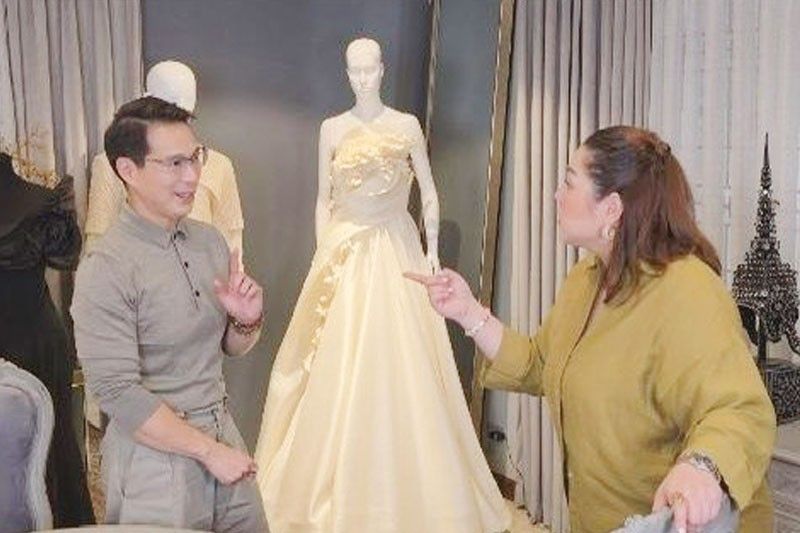
“It’s the first time that they saw Madam in that orchid color that looks vibrant on her,” Francis shared with me, his tone humble yet reflective. “The simplicity of it matches her personality. Positive comments naman ang narinig ko.”
Just last April, he stood alone as the only Filipino designer featured at a prestigious event in Harbin, China. Francis is a bridge between the archipelago and the international stage, proving that Filipino design is not a sub-genre of global fashion. It is a leading voice within it.
But for all the accolades and red-carpet moments, there is a biting reality. Walk through the digital corridors of the “orange app” or any major e-commerce platform, and you will find it: a cheaper, inferior, mass-produced version of a piece that likely took a team of artisans weeks to perfect. It’s very easy to see.
The rise of online rip-offs is not just a nuisance; it is an existential threat to the industry. It undermines the livelihoods of the bordadores and the tailors who labor in the ateliers, and it devalues the intellectual property of the creative mind.
Francis knows this pain firsthand.
“When we did the SEA Games, I was so happy because (of) all praises. It was something new,” he recalled. “Then it ended up on Shopee during the pandemic. Ang dami kong time noon. So, sabi ko, ‘Let me order one.’ I compared it, and it’s different. Sabi ko, ‘Next time, pahihirapan ko sila,’” he shared with a sheepish grin.
It is a frustration shared by many. The “fight” here is not just about litigation or takedown notices; it is about education. It is about convincing a generation accustomed to “add-to-cart” culture that there is a profound difference between a garment stitched by a machine in a sterile factory and one infused with the heritage and intent of a Filipino couturier.
How does one fight an industry that thrives on duplication?
For Francis, the answer is simple but profound: “The one people remember is the one who made it first. Advantage pa rin ‘yon, because ikaw pa rin ang nakikita nila.”
He urged the younger generation of designers to lean into this philosophy. In a market flooded with replicas, identity becomes the only currency that matters. You cannot copy the soul of a designer’s statement. You cannot replicate the history of the hands that made it.
“For the younger generation, you really need to think carefully when creating something,” he advised. “Put your identity into it. You may get inspiration from somewhere, but make it your own identity, and that’s what makes it unique.”
It is heartening to see that the younger wave of designers is listening. Francis spoke glowingly of the new guard, those who are “very fierce when it comes to leveling up the Filipino style of dressing.” They are dismantling the outdated notion that Filipino traditional wear — the terno and the barong — is strictly for formal galas.
“Hindi naman kailangan naka-terno all the time,” he laughed. “There are women’s barongs now. There are layers and silhouettes that make it unique. It’s an innovation that develops as we go along. We want something that is very unique and represents us.”
This shift in perspective brings us to the new state of fashion. We are witnessing a move away from the “disposable” culture of the last decade toward a more intentional approach. Repeat performance is in. If there is a trend that is here to stay, it is the focus on sustainability and “rewearability.”
The modern consumer, particularly the younger demographic, he said is increasingly price-conscious, yet paradoxically, they are also more invested in value. They are beginning to realize that the cheapest option is rarely the best investment.
“The generation now, they’re very price-conscious,” Francis noted. “I feel bad when a barong is worn only once. That’s why we came up with layers of barongs that you can stack, and when you take a layer off, it becomes an entirely different look.”
This is the essence of the new Filipino fashion movement: it is functional, modular and deeply respectful of the resources used to create it. It is fashion that acknowledges the reality of the climate crisis and the economic constraints of the consumer without sacrificing the aesthetic integrity of the Filipino identity.
As I wrapped up my conversation with Francis, I couldn’t help but think about the sheer weight of what he and his contemporaries are doing. Behind every stitch, every delicate thread of embroidery and every calculated drape, they are doing more than creating clothing. They are building a national identity.
When a world leader wears a Francis Libiran, they aren’t just wearing a piece of fabric, they are wearing a narrative of Filipino excellence, perseverance and artistry.
When a young Filipino puts on a modernized barong on a regular Tuesday, they are asserting their heritage in a globalized world.


- Latest
- Trending