‘Squid Game’: The cultural mirror we never expected
Parting with one of your favorite shows is like breaking up with a really good friend.
You invest time, emotions and even a piece of your identity into its world — only to be left with an empty screen and a flood of feelings when the final credits roll.
For millions of viewers around the globe, “Squid Game” wasn’t just a hit series. It was a cultural experience, a wake-up call, and, yes, an emotional rollercoaster that’s hard to say goodbye to.
When “Squid Game” first dropped on Netflixa in September 2021, no one quite expected a blood-soaked Korean survival thriller to become a global phenomenon. What makes it even more compelling is the story behind the story. I remember the almost soap opera-ish tale of director Hwang Dong-hyuk — how he nearly gave up on the project after years of rejections. At one point, he reportedly had to sell his laptop just to afford basic expenses while trying to pitch the script. It was a raw, personal struggle that mirrored the desperation of the characters he created. The irony? The world that once ignored “Squid Game” would later celebrate it as a global phenomenon.

Yet here we are — years later — and the impact of “Squid Game” continues to reverberate across pop culture, social commentary and even fashion. It didn’t just entertain, it held up a mirror to society’s darkest inequalities — and forced the world to look. There have been mixed emotions and heated reactions surrounding the “Squid Game” ending as it finally bid farewell last week.

Some viewers were heartbroken, others frustrated, and many left with a lingering sense of discomfort. But perhaps that’s exactly how it was meant to make us feel.
After all, “Squid Game” was never about giving us closure. It was about confronting uncomfortable truths. The lack of emotional payoff isn’t a flaw; it’s a feature. A mirror held up to a world where not everyone gets a happy ending. It is a social commentary series after all.
Created by writer-director Hwang Dong-hyuk, “Squid Game” is set in modern-day South Korea, yet the story’s themes have universal resonance: suffocating debt, capitalist exploitation and the dehumanizing grind of survival.
The 456 contestants, all desperate for financial salvation, compete in a series of deadly children’s games for a W45.6 billion prize. It’s twisted, yes, but uncomfortably familiar. The horror of “Squid Game” doesn’t lie in the gore, but in the reality it reflects.
In many ways, Squid Game is less dystopia and more documentary.
We celebrated the long-awaited “Squid Game” Season 3 with global activations that brought the show’s most iconic games to life. One of the most memorable for me was right here in BGC, Taguig, where Netflix recreated the jump rope game held by the creepy-yet-iconic doll duo, Cheol-su and Young-hee. It looked deceptively simple… until you tried it.
Spoiler alert: I didn’t survive one bit. But that’s the magic of “Squid Game” — even outside the screen, it pulls you into its world, reminding you just how unforgiving the games (and the themes they represent) really are.
The pink guards were there, too — stoic and silent, just like in the series — guiding us through the experience while keeping the immersive tension high. And as if that wasn’t eerie enough, the iconic black coffins wrapped in pink bows were scattered all around BGC. It was surreal. You weren’t just watching “Squid Game” anymore, you were living it, if only for a few minutes. The attention to detail was chilling and brilliant, turning the streets into a playground of fear, fun and fandom.
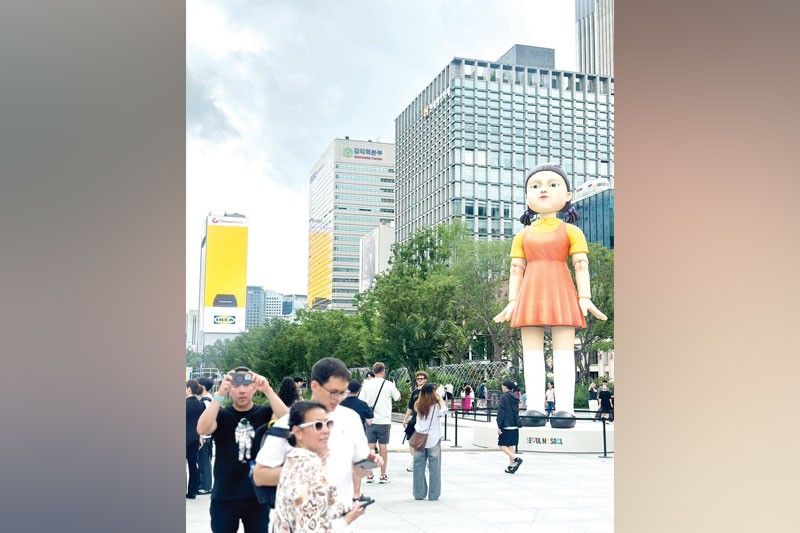
This week, we woke up in Seoul, South Korea, for a yet-to-be-revealed coverage — but we couldn’t pass up the chance to visit the iconic Gwanghwamun Square, where the largest “Squid Game” activation has taken over. The setup was a stunning tribute to the series, with installations and exclusive merch that threw us right back into the high-stakes world of the games. The space paid homage to the most unforgettable moments from the first two seasons, blending nostalgia with spectacle.
We were there with Netflix Philippines publicity specialist Francis Romero and content creator Marc Gabriel, reliving childhood memories through the lens of “Squid Game”’s twisted innocence, while also reflecting on the show’s cultural grip. We talked about how the series evolved, the emotional weight of the finale, and what this all means for the future of Korean storytelling on the global stage.
While K-dramas have long had a dedicated international fanbase, “Squid Game” catapulted Korean storytelling into uncharted territory. It shattered Netflix records yet again.
For the Korean entertainment industry, it was a watershed moment. Suddenly, the world wasn’t just consuming K-pop or K-beauty — they were absorbing Korean narratives with all their cultural nuance, emotional depth and biting social commentary.
From “Parasite” to “Hellbound and The Glory,” “Squid Game” helped pave the way for Korean media to dominate not just on screens, but also in hearts and headlines.
At its core, “Squid Game” works because it hits close to home. It’s a show about survival, but more specifically, about how systems are rigged to make true escape nearly impossible. It asks: How much of our dignity are we willing to sacrifice for a chance to win?
“Squid Game” is more than a show. It’s a social reckoning disguised as entertainment. It captured the zeitgeist of a world on the brink: angry, disillusioned and desperate for change. It didn’t give us hope. It gave us reflection. And in a world obsessed with happy endings, maybe that’s exactly what we needed.


- Latest
- Trending