Crazy rich movie
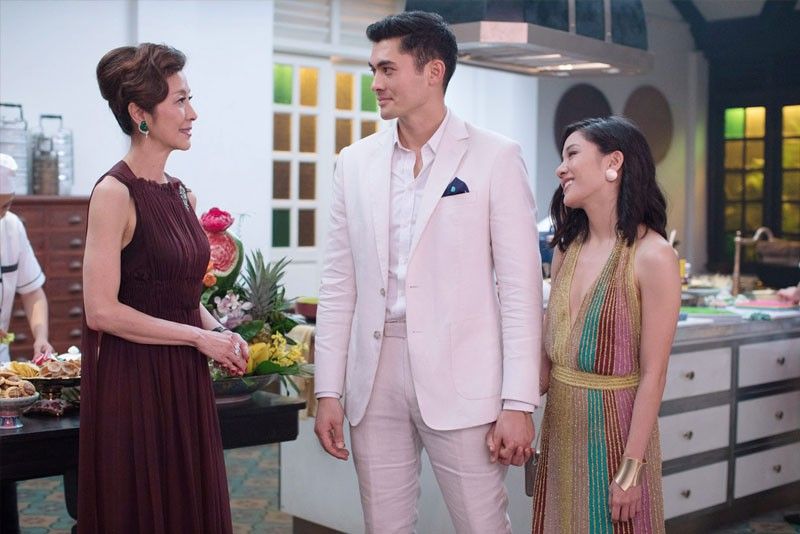
Film review: Crazy Rich Asians
MANILA, Philippines — “Oh, East is East, and West is West, and never the twain shall meet,” so said poet Rudyard Kipling in his renowned The Ballad of East and West. But in this movie megged by veteran actor-director Jon Chu, both East and West did meet. And the end result is propitious.
Billed as a romantic comedy, Crazy Rich Asians (CRA) is, of course, all that, and more. One of the few Hollywood movies shot in Asia with an almost totally Asian cast and telling a story from an Asian outlook, it manages to wittingly insert and convey oriental values and culture (and a piercing message thrown in) between the laugh lines.
The story starts out unassumingly enough in New York City: Rachel Chu (Constance Wu), a young New York-bred economics professor at the New York University, who also teaches “game theory”, has been steadily dating Nick Young (Henry Golding), a Singaporean expatriate, for over a year. One fine day, Nick asks Rachel if she would come with him back to his home country; his best friend was getting married, and he was Best Man. Rachel says yes but is reluctant: he scarcely talks about his family, and she is apprehensive that she may not know what to do when she is finally face-to-face with them. “Maybe he’s poor, and he sends money home to them, just like any good Chinese boy would do,” surmises Rachel’s mother (Tan Keng, who bears a striking resemblance to Maria Ressa), a self-made first-generation Chinese immigrant to New York.
As it turns out, Nick’s poverty is the last thing Rachel need worry about. The mystery about her boyfriend’s filiation begins to clear up the moment they board their plane to Singapore. They are ushered into the first-class cabin, where the complimentary pajamas are “finer than my own clothes”, as Rachel ruefully notes. Settling into the opulent seats, Rachel asks Nick, “Is your family rich?” Nick replies, “We’re comfortable.” Understatement of the decade!
Once they arrive, the magnitude of Nick’s family’s wealth slowly begins to sink into Rachel, and she is overwhelmed. Visiting an old college chum, Goh Pei Lin (Awkwafina), whose family belongs to the city state’s nouveau riche, it is explained to her that her lover’s family is not just rich, but they are “old rich”, and what is more, obscenely rich. “They were rich when they left China,” her friend narrates, hilariously using a designer bag with a world map printed on it as prop, “and now they are the biggest property developer in Singapore and Malaysia and Thailand and Brunei. They are the biggest landlords in the most expensive cities in the world.” It seems that Rachel has hit the jackpot. Or has she?
Rachel gets to meet the members of Nick’s family, who have attained great levels of success in other Asian countries (Taiwan, Shanghai and Hong Kong) symbolic of the Chinese diaspora and the peculiar ability of the Chinese to thrive wherever they are transplanted. She visits their ancestral home, an opulent old mansion where the lavish party scene is right out of a fairy tale. But all is not well in Wonderland. Nick’s mother Eleonor (Michelle Yeoh), imperious and petulant, evinces an immediate dislike for her, for reasons Rachel could not immediately fathom. It is this conflict that drives the movie’s story and powers the catharsis to its inevitable conclusion.
As a romantic comedy, there is nothing new here, but its makers give us more — much more — of what makes a good rom-com. For starters, the cast is brilliant: gathered from all over Asia, they played their roles perfectly. Chu and Golding exhibit chemistry as the quintessential “rich boy/poor girl” couple. Nico Santos, as the “poor relation” who makes himself indispensable to his rich cousins by being the family troubleshooter, is funny without even trying. Awkwafina, as the dyed-hair parvenu sidekick of Rachel, supplies the right laughs at the right time without being overbearing. Yeoh, specifically, is spot-on as the icy, snobbish mother of Nick, who managed to imbue a sympathetic slant to what should have been the role of main villain. Her deft insinuations that she was motivated solely by her attempt to protect the best interests of her favorite son, is something every Filipino mother could identify with. Her constant invocation, tacit and implied, of the very Asian principle of “Family First,” which Rachel finally begins to understand towards the end, is the primary thematic cement that holds the film together.
The filmmakers give us glimpse of — to use a shopworn cliché — “the lifestyles of the rich and famous” in Singapore. Extravagant parties, flashy cars, public adulation and media attention insofar as the main characters are concerned, are very much in evidence. While we should enjoy these cinematic feasts, however, we should not miss one important subtext the movie wishes to impart, and that is, that the era of world dominance by America and the former European colonial powers have passed. The Asians have arrived, and the next hundred years could be The Asian Century. This the movie subtly, and oftentimes, uproariously conveys by way of pointed jabs: the pet dogs of the socialites are named after former American Presidents, the movie uses cover versions of American hits like Material Girl and jazz standards but sung in Mandarin, opulent celebrations are held in exotic islands, imposing mansions and elegant locales, but the attendees wear clothes and accessories by Asian designers, chow down on Asian gourmet foods and adopt Chinese party themes. The message is quiet but clear: the Asians have beaten the Westerners at their own game. The West is passé; the East is the future. The particular use of the game of mahjong at an important juncture of the film to underscore an important cinematic point — that sometimes one should throw away one’s winning “card” in order to win — is actually pure and unadulterated genius.
In fine, Crazy Rich Asians is a movie every Filipino steeped in the local rom-com tradition will enjoy from the start right down to its (happy) ending. Quite crazy in execution, and definitely rich in imagery and oblique messaging, its being Asian lies in its cleverness in cloyingly hiding the meat within. Much like dimsum.




- Latest
- Trending