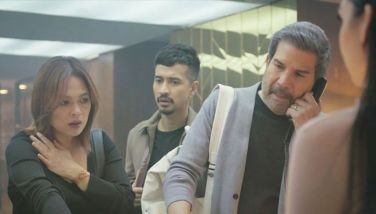
Q&A: Lara Fabregas
Here is a portrait of an actress' actress who can play every role imaginable very convincingly. At 24, Lara Melissa Caballero Fabregas is a woman with extraordinary fortitude and ability -- a survivor. At a young age, she has had to endure her parents' divorce (her mother then re-married to the late Finnish diplomat Ilka Russo), growing up on the move in places as New York, Helsinki, Kuala Lumpur and Manila. Lara has tried her hand at everything from hosting, ramp and commercial modeling, stage, TV and movie acting. She even became a VJ. The best part is that she credibly pulls everything off. In addition to being versatile, Lara has the right attitude.
The actress was invited to chat in www.pinoycentral.com upon the request of chatters -- due in part to her exemplary performance as Josephine Bracken in Mike de Leon's Bayaning Third World. When she finally joined the Artista chatroom of Pinoycentral.com recently, chatters were in awe of Lara's colorful life and her winning attitude. Chatters were curious about her equally talented brothers, Miko and Paolo, as well as her relationship with her famous father, Jaime Fabregas. Truly, artistic talent runs through her veins. You could see it manifested in everything she does. When Lara talks to you, she is animated -- with matching facial expressions. Her laughter and enthusiasm are infectious. It is easy to fall under her spell. But no matter what role she assumes, playing herself is still the part Lara does best. No matter where her wandering spirit takes her, the lady will always find a way back home -- for her heart belongs to the Philippines.
YOUNG STAR: What did your fans ask you when you chatted online?
They asked me about my brother, if it's hard being in showbiz. They were nice people and it's was so much fun to chat.
What did you find fun about it?
I just got caught up in it. People that logged on were Filipinos from all over the world. One of them asked me if I could go out on a date with him on his birthday. I told him, "What if you are a serial killer?" He just laughed and said "You are very funny."
Could you tell us more about your family? Tell us about Paolo.
I watch his plays; he watches mine. We live together and we are good friends.
How did you handle your parents' divorce?
It was difficult to accept it, but I'm so over that. I don't remember anymore how bad it was -- it's like a memory.
Do you have any advice for young people whose parents are on the brink of divorce?
You just have to be understanding and look at your parents as human beings. They make mistakes, that's okay. Relationships are like that -- things happen. Only when you get older and have relationships yourself do you understand what it is really about and what marriage stands for. It's scary because it's so easy -- you sign a piece of paper and you are married. But it's easier said than done. Easier to tear a piece of paper, too, and that's divorce. It's like the words are so big. Marriage, divorce -- big words, right?
How did your international exposure shape the way you think now?
I am more open-minded. I have more respect for different cultures. I love all kinds of food from all over the world. I love languages. I speak five -- Spanish, English, German, Finnish and Tagalog.
How did you learn to speak all five?
I went to a language school when I was in Finland called SYK. Basically, the people that went there spoke three languages. It's like high school. I had six subjects: Math, English, Spanish, German, Finnish, Biology and Geography -- sciences and languages.
How long did you live in Finland?
I lived there from 1989 to 1993.
What is Finnish in you?
Love for nature. The water there is so clean water, you can even drink it. I really appreciate the countryside. We used to go on holidays there every summer. We'd plant vegetables; I loved it. We would chop wood and mushroom-picking, strawberry-picking -- all kinds of berries. It starts at the end of July for berry picking, sometime after for mushroom picking. It's so much fun!
What's your fondest memory of Finland?
It's quiet -- something that I miss because in the Philippines, everything is so loud. There, everything is quiet. People don't even talk loud. They have soft voices.
What is one trait that you have developed that you are proud of?
Adaptability. When I moved back to the Philippines, I didn't get culture shock. It was like I never left. I always came back to the Philippines for holidays. I knew what the Philippines was like.
What were some of your most beautiful memories as a child living in New York?
I lived there when I was 11 to 14 years old -- the "fantasy" years. I lived in Westchester in a New York suburb called Largemond. It was like Wonderland to me -- fine houses, big spaces, beautiful trees, young families with young kids. All of them worked in Manhattan but had houses in the suburbs. There were parties -- we had ballroom dancing every Friday. Imagine, I was 12 years old then. The kids would get dressed. I put my gloves on, my friends would pick me up and we'd all go dancing. All the 12-year-old boys were cute and the girls are in dresses and we'll be in separate ends of the room. It was a wealthy neighborhood.
So what was great for you then? The fact that you were able to wear nice clothes?
No, the fact that everything a little girl wanted was possible -- anywhere in the world. When I was there, I had dreams. I'm gonna be this, I'm gonna marry this... you know, all these dreams.
What was your dream then?
I wanted to marry Bono of U2, and be a rock star. You know what I mean? That age when you are so sheltered.
Why? Do you consider yourself sheltered?
I guess not.
Did you ever experience being discriminated against while living in the US?
No. Maybe because I don't really look Filipino. They would get confused and say, "Where are you from?" You know what? I was lucky because the neighborhood I lived in and the school I went to had good people. It was a very rich neighborhood -- most were Jewish with a few Catholics and some Protestants.
I never saw discrimination in my school. People there were so politically correct.
Is it education that spells the difference?
Maybe because what I noticed is that the people that were racists were losers. The people that get into fights or brawls and calling other people names... nobody likes them. They had no friends in school so maybe that's why they are like that. Because the more popular kids didn't do that.
Were you among of the popular kids in school?
Yeah, hahaha (laughs)!
How did you discover that you had a talent for acting?
I always wanted to do it. I would always audition for plays.
So far, which theater role did you have the most fun portraying?
Playing a bimbo in Hurly Burly. Usually, when you are preparing for a play, you stay backstage and are nervous. In order to motivate yourself, you have to be angry. But for this part, all I did was stand backstage.
Since you have portrayed various characters already, what is your dream role?
I don't understand the dream role concept. If it's a good script, if it's anything, it could be a dream role. Like this play I am doing now called, A Fool For Love, which will be staged at Republic of Malate this June. The part I am playing, May, is a dream role.
Why do you consider it as a dream role?
Because it's such a good part -- it's about a girl who's has experienced incest with her brother. It's a struggle with a love that can't be.
What's so challenging about that?
What's so challenging about it is that at the end of the day, when you are acting, it's playing yourself down the line. Sometimes emotions are embarrassing. You don't want to be sad. For me, the hardest part is shouting -- being in despair. I really have a hard time because that's like abandonment -- like mourning and suffering. When you do that in front of people, it's like baring yourself. It's hard when you don't want people to see these things. That's the thing with this play.
Tell us about the most difficult scene in that play.
There's a scene there where she shouts at the top of her lungs to her main lead, Lee Robin Salazar, "Eddie! Eddie!" and runs to the door and hugs the door like this (demonstrates) then she calls around the room, sobbing, hugging the walls like "Huhhhhh!" (pretends to sob) It's major drama, man.
What did you learn in theater that you apply to your movie and television career?
The discipline and breaking down of scripts. When I study a script, I study a character, analyze it and you think about it. For plays, I rehearse for like a month and do the same thing over and over again until the director says, "I believe you." Even at opening night, you don't know if it's going to go right.
What are the major differences between acting in TV, movies and the stage?
How you project your voice. In theater, you have to be very careful about diction. Even your emotions have to be bigger. You have to hold your body in a certain way for the audience. It's a little bit unnatural. For example, stage whisper is loud. It's different. That's the nice thing about film, though -- you can go so small. Actually, I love acting in film.
In TV, you do it one take -- okay lang. You go like "Huh?" and in a play, you rehearse for one month and you don't even know whether it will be okay. In TV, it's like "Take! Wala ng iba, wala ng papalit sa iyo!" then the director goes, "Good take!" Then you go. Huh? Excuse me? Was I believable? Good na ba 'yon?"
Theater acting is honest but it's not real. It's "theatrical" meaning it's still real but you have to be heard - you have to speak louder, On film, it's completely natural. You can sit whatever you want, you don't' have to think like "Do I have my back to the audience?" You don't have think about projecting. You are just "you." You are just a human being. You are not acting.
Is the sense of fulfillment the same when you act in a play and in a film?
The adrenaline, immediate gratification when you finish a play, that's the difference. When you finish a movie, you are just tired (laughs). When you finish your scene, you go home, wala, tapos ka na.
Then you have to wait for so many months for post production. Whereas in theater, hoorah, let's go out! Let's go drink and party, party!
As an actress in a movie, what kind of fulfillment do you get when your movie is finally shown?
It's not a personal gratification with a movie. You hope it does well, that people like it . You hope that it's a good film but you have no control over that. You hope you do but at the end of the day, you really don't. You are not the one editing. You are not doing the sound. You have no control. In theater you work hand in hand with the director. You are together. You are a team. It's also like in the movies but it is a big, big team.
What about the fulfillment that you get when being part of a commercial?
The money (laughs). Everybody -- directors, make-up artists, ad agencies -- knows that commercials are about the money. I think a lot of our really good directors in this country are commercial directors because that's where the money is, not in the movies. Even in Hollywood, very good directors do ads.
What about ramp modeling?
I've done it a few times. Everybody is like 5'10 and I'm only 5'5. I'd go " I'm out of here!" I didn't like it. It really made me feel insecure.
You? Insecure? Why?
I was different then. When I was modeling in Malaysia, I was small and I wasn't that skinny. The girls were super tall and super skinny, that's why I didn't do ramp.
What is your greatest fear as an actress?
That I'm lying to myself. I've seen some people who are so proud of their work and they think they are good. But then I watch their work and they're bad. I'm afraid to be like that. My fear is to think that I am better than I actually am. I don't want to get to that point.
Who is your greatest critic then?
Friends. Sometimes, when I do a movie, I would tell myself it's okay. But then I need to hear it from somebody if I did well. When somebody says "Yes,you were good!" I don't believe them. I'd say "No I wasn't. You are just saying that!" (laughs)
Is it hard to find real friends in show business?
Yeah. Because people are wary of each other. You don't know what you can say. You don't know what you can share. Everybody is very careful.
How different are the people you work with -- from theater to modeling?
I think it's the conversations -- maybe I'm lucky because the people that I work with are my friends in theater. Bart Guingona, Michael Williams, Dodo Lim -- they are friends. So it's like hanging out with my friends. It's like, "Hey guys, what's up?" It's so relaxed. But then you work hard. You are friends but everybody is dedicated. You love the same thing. There's no money in theater so what are you all doing there? You are there for the work.
Would you say they are more of the artists?
Yes -- you really want to work.
What about the people you work with in commercials?
In commercials, they make a big fuss about you physically like, "You gotta bleach your eyebrows, ha -- ang tapang kasi eh!" (laughs). It's more like fun when you do a print ad. People look at your face all the time, fixing your hair all the time. You hear comments like "Ah, you gained weight, ha!" or "Ang payat mo naman!" They look at your image because you are trying to sell something.
What don't you like about being in the limelight? Do you lose your privacy?
It depends on how much you want to show people. Unless you see me living my life out there when I am with my friends, you don't really know me. You may say, she's going out with this and that person.
In essence, you are saying that it's up to you on how much you want to disclose?
Yeah. I don't understand why people would go to talk shows and babble about their love affairs. I would never guest on a talk show to talk about my boyfriend! "Kasi sinaktan niya ako." So you do have control. People would always come to you and want to know everything and it's really up to you on what you want to share.
Unless it comes straight from your mouth -- all the chismis -- they can believe it but they can't actually prove it.
Did it ever happen to you that you got so caught up in your role that you had to actually snap out of it?
Yeah, it happened when I played Laura in Glass Menagerie, a Tenesse Williams play. I was playing an insecure and crippled girl and even after the play, I was lisping. My friends would go, "Lara, Lara, you are not in the play anymore! Stop!"
Did you ever turn down any roles?
Yes, action movies where I had to play a bimbo. It's the part I don't want to play.
Do you ever dream of getting a lead role?
I don't want to be a star. I don't want to carry a film because when it flops, you start going down. It's hard to be a star. Can you imagine Julia Roberts? Because she's not a character actress, she can't take on support roles.
So would you rather take on character roles?
Yes, because it has a longer life span. I want to work. I want to be 60 and still work as an actress.
Do you plan your future?
No, I don't have a short- or long-term plan. I don't have anything like that. I just grab the opportunities as they come. All I know is that I know what I want and don't want.
Do you want to go international?
Yes, but more for development. Having the chance to work with good directors, good scripts, it's not really just to go international but to get better, better and better. I mean, where do you go from here? Might as well plan. You might not get that far but at least, you are looking far.
You were part of this Claire Danes movie that was shot here? How did you get that?
I was called by a casting agent. I was a just a stand-in. I would watch them rehearse a scene and I'd take her place, go through the scene so they could see the lighting.
What insight did you get from being part of a Hollywood movie?
Hollywood films are so good because they pay attention to detail. They light it by looking at an actor's face and their cheek bones and they light it.
What are the other differences?
Budget, budget. I think that if you pay people well, they will work well. It's hard for the crew like the cameramen. These cameramen travel and make good living and they travel the world. Here, how much does a cameraman make? And they work really hard. In Hollywood, they have the money to pay somebody so he has to do a good job.
Any advice for aspiring actresses on how to internalize for roles?
You have to be honest. It's not something you put on. You have to mean what you say. You have to study the character. Is she feminine? Is she insecure? That gives you a clue how her body moves. So if she is insecure, she'll most likely slouch or probably move with her head first. Once you get that in your head, your body just follows.
Lara Fabregas is also featured in the Stars section of www.pinoycentral.com. An exclusive portfolio of the actress is at Stars Galore and Unmasked. For those who missed Bayaning Third World, check out the movie trailer at the movie database as well as the review at Pinoycentral's movie section.






- Latest
- Trending