China at grave risk if it uses force

Communist China mouths two contradictory lies. One, that it never aggresses its neighbors. Two, that it wins in the end. History disproves both lies.
In 1289, Yuan emperor Kublai Khan dispatched Meng Qi to the Malay capital of Java to demand homage. Rejecting foreign taxation, King Kertanegara cut off the envoy’s nose and ears, then sent him bleeding back to Dadu, now Beijing.
Furious, Kublai Khan ordered an invasion. Twenty thousand Han foot soldiers and 10,000 Mongol horsemen, equipped with gunpowder weapons and catapults, set sail on 1,000 ships. The armada landed in Java early 1293. Kertanegara had just been assassinated in a palace coup by rival Jayakatwang.
Prince Raden Wijaya, Kertanegara’s son-in-law and heir, met the invading commanders with an offer: he’d turn over royal maps and censuses with palace treasures if they helped him regain the throne. The invaders agreed. Their combined forces deposed the usurper.
Raden Wijaya sought permission to retrieve the homage from his settlement in Tarik timberland. He staged a sneak attack on the scattered Yuan troops. The invaders, unused to humid tropical jungles, were decimated. Fearful of being trapped in monsoon storms for another half-year, remnants staggered back to China.
About 18,000 Yuan soldiers died from combat, disease and shipwrecks. Kublai Khan demoted the fallen generals and confiscated their estates. He died plotting a second invasion.
Kublai Khan twice attempted to conquer Japan. In 1274 his army of Mongols, Han and Korean conscripts landed in Hakata Bay, now Fukuoka. Firing poisoned arrows and gunpowder bombs, they dominated the daylong battle. But the Kamakura Shogunate pushed them back by gusty dusk. That night a severe storm struck the fleet, destroying most ships and forcing survivors to limp back home.
Crushing the southern Song Dynasty in 1281, Kublai Khan amassed wealth for a second invasion. A thousand ships with 40,000 troops sailed from Korea, while more ships with 100,000 soldiers set out from southern China. Japanese fortifications prevented their safe rendezvous in Hakata Bay. For weeks the fleet was stranded in nearby islands.
In late August typhoon struck the densely-packed fleet. Tempest smashed the vessels into each other and onto the rocky shores. Eighty percent of the armada was destroyed, and tens of thousands of soldiers drowned. Stragglers were slain or enslaved by Japanese samurai. Kamikaze (divine winds) again saved the country.
Yuan rulers invaded Vietnam in 1258, 1285 and 1288. All were fiascos. Gen. Tran Hung Dao thrice routed 500,000-strong enemy forces.
In 1979, China attacked anew. Vietnam, newly reunited after a 30-year war against colonizers France and America, had struck the brutal Beijing-backed Khmer Rouge regime in neighboring Cambodia. Deng Xiaoping declared that “China needed to teach Vietnam a lesson.”
Up to 300,000 People’s Liberation Army troops poured into the northern border by surprise. China had not fought a battle since the 1950s Korean War. Vietnam’s two divisions were busy in Cambodia, so only local regional forces, border guards and rural militias repelled the PLA. Around 26,000 Chinese were killed and tens of thousands more wounded. China’s stated goal to expel the Vietnamese from Cambodia failed. The PLA withdrew after a month.
In Manila last week, Chinese Ambassador Jing Quan boasted, “If we want to use force, we may easily win; but no, we will not use force; you know, we love peace.” He said that during a forum on China-Philippine ties amid maritime disputes.
President Bongbong Marcos took it as “a threat, very undiplomatic.” It wasn’t the first time Jing Quan mentioned possible military violence.
Filipinos love peace. They will not be pushed either. In December 2025, 79 percent considered China the Philippines’ top threat.
China had a one-child policy in 1979-2015. Those born then are now 11 to 47 years old. Average age of PLA troops is 27; officers, around 35; majority are under 30 – all single offspring.
China must avoid violence in the West Philippine Sea. For every soldier that falls, three sets of seniors could lose a breadwinner: the parents and the paternal and maternal grandparents. Jing Quan, 51, should think of that.
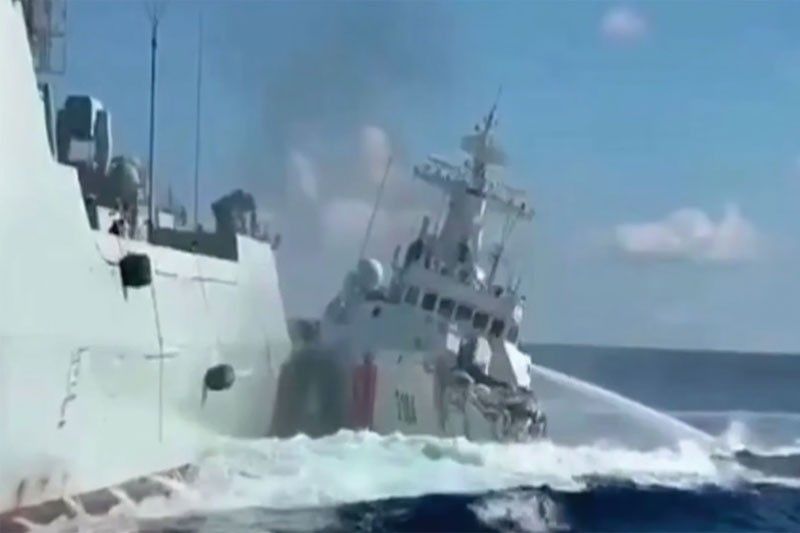
On Aug. 11, 2025, a Chinese navy warship collided with a China coast guard gunboat that was water-cannoning a Philippine patrol near Panatag (Scarborough) Shoal. The menacers collided with each other. Two Chinese water-cannoneers were thrown overboard.
The Philippine vessel stopped to offer help in rescuing them. The Chinese ignored the gesture. Only on Aug. 5, 2026 did China admit the loss of two coast guards: Yi Xinyu, 21, and Cheng Long, 25.
* * *
Catch Sapol radio show, Saturdays, 8 to 10 a.m., dwIZ (882-AM).
Follow me on Facebook: https://tinyurl.com/Jarius-Bondoc





- Latest
- Trending