Strengthening resilience to climate extremes


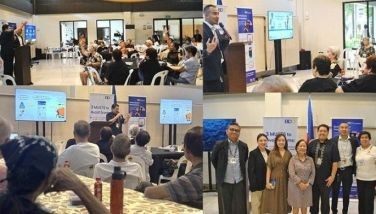
The very strong rain and howling wind battering my room window right now in the onslaught of Habagat (the Filipino term for the Southwest monsoon, a seasonal wind pattern that brings warm, humid air and heavy rainfall to the Philippines from late May or June to October) reminded me of that recent time when the National Resilience Council convened a dialogue to discuss resilience in the midst of and in the aftermath of natural disasters.
Present at that dialogue were Kamal Kishore, Special Representative of the UN Secretary-General for Disaster Risk Reduction and Head of the United Nations Office for Disaster Risk Reduction (UNDRR), and former Environment and Natural Resources Secretary Maria Antonia “Toni” Yulo-Loyzaga, Special Envoy of the President for Disaster Risk Reduction, together with private-sector leaders and officials from the National Disaster Risk Reduction and Management Council (NDRRMC) to talk through UNDRR’s priority resilience agenda.
The National Resilience Council (NRC) in the Philippines is a science- and technology-based public-private partnership that links government, the academe, civil society, and business leaders to strengthen local government units (LGUs) against climate change and natural disasters.
It was formally launched in November 2017 and began with the signing of a “Pledge of Partnership for Resilience” following a series of regional consultations and dialogues in the wake of Super Typhoon Haiyan (local name: Yolanda).
In 2024, it was incorporated as a non-profit organization under the name National Resilience Council Foundation, Inc. and, in 2025, it was formally recognized by the Department of Science and Technology (DOST) as an official Scientific Foundation.
I was glad to be a part of that conversation alongside a genuinely cross-sectoral group: Hans T. Sy of SM Prime, chairperson of the National Resilience Council and ARISE Philippines; Austere Panadero, president of the Zuellig Family Foundation and NRC vice-chairperson; VAdm. Alexander Pama of the ARISE Global Board; Guillermo Luz, Chief Resilience Officer of the Philippine Disaster Resilience Foundation (PDRF), and PDRF president Rene “Butch” Meily; Gerardo Borromeo of Philippine Transmarine Carriers; Assistant Secretary Bernardo Rafaelito Alejandro of the Office of Civil Defense; Senior Undersecretary Irineo Espino of the Department of National Defense; Marco Toscano-Rivalta, UNDRR’s Regional Chief for Asia and the Pacific, and UNDRR Programme Management Officer Chinatsu Endo; Kin Lichauco of the San Miguel Foundation and Cecile Ang of New NAIA Infrastructure Corp.; Mariana Zobel de Ayala of Ayala Corp.; Liza Silerio, ARISE Philippines co-chair; former DENR Undersecretary Marilou Erni; and NRC Executive Director Silvestre Barrameda Jr.

The timing of the dialogue was not incidental. PAGASA already raised its ENSO Alert to reflect a weak-to-moderate El Niño now present in the tropical Pacific, with the state weather bureau’s own outlook putting the odds of that El Niño intensifying into a strong event during the August-to-October window at roughly seven in 10.
More significant, PAGASA’s latest climate outlook, covering August 2026 through January 2027, puts the probability of a very strong El Niño taking hold between October and December at 81 percent, persisting into January 2027, with roughly a 97-percent chance that El Niño conditions overall will remain in place through the first half of next year. Independent monitoring from NOAA’s Climate Prediction Center points in the same direction, flagging a greater than 90-percent chance of a very strong event over the coming fall and winter.
What that means on the ground is already visible. Rainfall this year has been running an uneven, front-loaded pattern: near-normal to above-normal in parts of the Visayas and western Luzon through the Habagat season, even as forecasters warn that dry spell and drought conditions are expected to emerge in select areas by the end of August, with the driest stretch likely to begin around November and deepen into early 2027.

In other words, the country is not waiting for a future El Niño. It is watching one build in real time, month by month, ahead of a peak still several months out. That is precisely the window, after the warning signs are unmistakable but before the worst effects arrive, in which coordination either gets built or gets missed.
This is precisely the backdrop against which UNDRR’s priority resilience agenda takes on real weight, and it is what made the dialogue feel less like a courtesy call and more like a working session against a deadline.
The conversation reinforced a principle that Kishore himself has raised in other regional forums: the fight against disasters is ultimately won or lost at the level of cities and communities, not in national plans alone. That means local government units need better, more localized risk data; national agencies need to integrate land-use planning with disaster risk management rather than treat them as separate exercises; and the private sector needs to be a consistent, structural partner in that system, not one that only shows up once a calamity has already been declared.
What struck me most in the room was how much consensus there already was, across very different institutions, on where the gaps remain. Everyone seemed to already be aligned at some point even before the discussions started.
True, financing for localized resilience work is still thin and data and technical capacity vary widely from one local government unit to the next. And, more importantly, too much disaster preparedness in this country still happens in silos where government, business, and civil society each build their own systems, rarely built to interoperate when an actual emergency hits.
The dialogue was, at its core, an attempt to close those gaps through shared commitment rather than another layer of parallel initiatives: UNDRR’s global expertise and priority framework, matched against the on-the-ground reach of Philippine institutions like the NRC, ARISE Philippines, PDRF, and the NDRRMC network, with the private sector like the MVP Group of Companies treated not as a funding source on the side but as an embedded partner in the resilience system itself.
With October now sitting on the horizon as the point at which forecasters expect this El Niño to sharpen into its most intense phase, and with the historical pattern suggesting an equally severe wet-season correction following such events, the choice in front of every institution represented at that table is the same: build the coordination and the data systems now, while there is still time to plan, or manage the consequences later, at far greater human and economic cost.
Dialogues like this one, sans fanfare and hoopla, are exactly the kind of work that determines which of those two paths the country takes.
Convening it now, with the peak of the event still weeks away rather than already underway, is what makes it significant rather than simply well-intentioned. *ae








- Latest