Senate-SC tag team trash all future impeachments

The Senate and Supreme Court acted like a tag team. As in pro wrestling, they took turns thrashing VP Sara Duterte’s impeachment.
For “pampalubag-loob” the Senate and SC said the House can file a new impeachment rap when the one-year bar ends on Feb. 6, 2026.
But it’s unknown how long SC will take to review itself. It can go beyond Feb. 6.
Meantime, its decision stays – including its “unconstitutional” seven new rules on impeachment:
• Evidence must be detailed;
• Impeached officer must be given a chance to refute the complaint;
• He/she must be shown the evidence;
• All 317 House members must have access to the complaint and evidence before plenary voting;
• All must execute affidavits of having read and understood the Articles of Impeachment;
• The plenary must lengthily deliberate beyond securing endorsement by one-third of House members;
• The House must conduct a hearing with defendant present.
Those new rules easily can thwart a genuine impeachment.
For one, an ally of VP Sara can beat the clock by filing a frivolous case at 12:00:01 a.m. of Feb 6. A lawyer did that twice before for president Gloria Macapagal Arroyo.
Or, if a real rap manages to sneak in, only one out of 317 congressmen can void it by claiming he never received or understood the complaint and evidence.
The tag team delayed action since February. Senate President Francis Escudero defied constitutional duty to commence trial “forthwith.” The SC sat on lawyer Catalino Generillo’s Feb. 14 plea to compel the Senate to act.
Constitutional framers, law school deans, professors, religious leaders, ex-generals and civil society howled.
Grudgingly on June 10 senators convened as impeachment court. To downplay the silliness of three senator-judges’ motion to dismiss the Articles of Impeachment, they voted 18-5 to “remand” it to the House.
Adjourning the next day they were booed by the public. Protest demos were set starting July 28, Congress’ resumption.
Seemingly tagged by an unseen hand, SC jumped into the ring. On July 8, it told the House to answer six unusual questions. The latter answered three on Monday, July 21.
Storm canceled the SC regular en banc the following day, till Thursday. As if under deadline, 13 justices held special en banc amid floods Friday, July 25. No memorandums, no freeze orders, no oral arguments. By midafternoon they announced to release a voluminous 97-page voiding of VP Sara’s impeachment.
Grounds: the House supposedly broke the one-year bar on multiple impeachment complaints, and denied VP Sara due process. Resolution: seven new but retroactive rules on impeachment, for immediate compliance.
Two constitutional framers, two ex-chief justices and two ex-justices led a new round of public rebuttals:
• SC’s seven new rules intruded Congress’ turf;
• Senate trial, already delayed, is due process;
• Justices are conflicted since they’re also impeachable officers.
Still out of wind, senators postponed any action on the impeachment till Aug. 6, then watched from outside the ring.
Aug. 5, Tuesday, SC received a House motion for reconsideration. Plus, several motions by reformist groups to intervene. Justices routinely ordered VP Sara to reply, then reiterated that their July 25 ruling was immediately executory.
VP Sara’s office couldn’t say where she was. Malacañang disclosed she flew to Kuwait – without requisite travel clearance from the President.
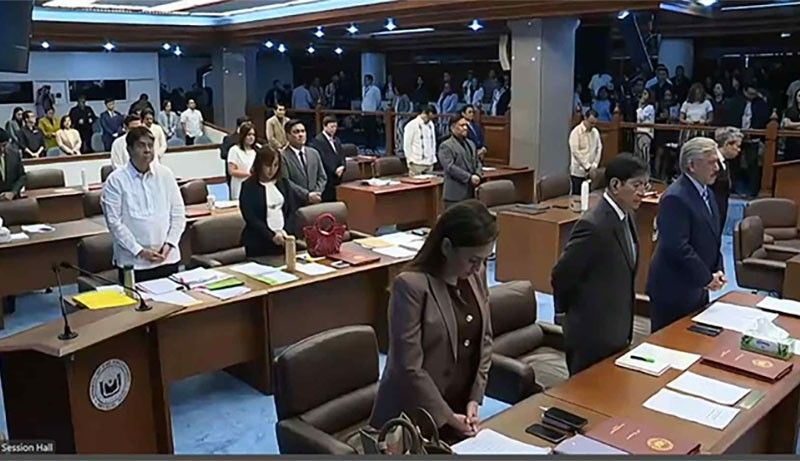
Aug. 6, Escudero refused to swear in new senator-judges and convene the impeachment court. He entertained emotion by neophyte Rodante Marcoleta, VP Sara’s political ally, to dismiss the Articles.
After six-and-a-half hours of debate, 19 pro-VP Sara senators voted to archive it. Tito Sotto and Risa Hontiveros of the Minority, and Kiko Pangilinan and Bam Aquino of the Majority, dissented. Ping Lacson abstained.
* * *
Metro Manila produces 11,000 tons of solid waste every day. Most are dumped in landfills or creeks. These use up scarce land, emit noxious methane and worsen floods. MMDA reported that 600 tons of trash, mostly plastic, clogged flood-control pumps the other week.
The scale and consequences of this crisis are growing.
But so is the opportunity for Waste-to-Energy, experts say.
WtE is clean and climate friendly. Facilities are not incinerators of old. They’re high-tech, emission-controlled and internationally regulated.
Most important, they convert residual waste into usable electricity, dramatically reduce landfill volume and protect public health.
Methane, released by decaying organic waste in landfills, is 80 times more toxic than carbon dioxide over a 20-year stand. WtE facilities avert this by diverting waste from landfills and neutralizing methane production at source. For a country vulnerable to climate change like the Philippines, this should be prime strategy.
Modern WtE technologies use multi-stage pollution controls, including baghouse filters, Selective Catalytic Reducers of nitrogen oxides, Spray Dryers for acid gases and activated carbon for dioxins and heavy metals.
Facilities pass the Clean Air Act and DENR rules and are equipped with Continuous Emissions Monitoring Systems for full transparency.
Clean energy from WtEs translates to jobs and savings. Local governments spend billions a year on hauling and tipping fees. WtEs can make that money work harder by generating power, employing thousands and freeing up land otherwise locked in for decades as dumps.
WtE is often misconstrued as being anti-recycling. In truth, it processes only residual waste, the leftover fraction that cannot be composted or recycled. In successful global models, WtE strengthens segregation by fostering garbage sorting and penalizing contamination. The Philippine Renewable Energy Act and Clean Air Act permit and support WtE. Public-Private Partnerships are being made for Manila WtE facilities. Investors take on upfront risks for long-term performance-based fees. Local governments can modernize waste systems without massive capital costs.
As of 2025, the Manila project is under full permitting and technical review. It is structured to serve up to 3,000 tons of waste per day, roughly a quarter of Metro Manila’s total – and supply up to 75 MW of power. That’s clean, reliable energy for over 100,000 homes.
* * *
Catch Sapol radio show, Saturdays, 8 to 10 a.m., dwIZ (882-AM).
Follow me on Facebook: https://tinyurl.com/Jarius-Bondoc


- Latest
- Trending