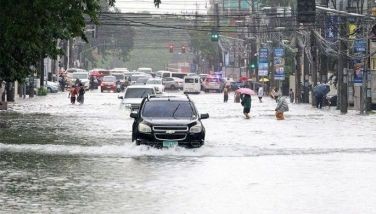
Solutions backed by science key vs floods, expert says

MANILA, Philippines — The recent spate of flooding has compelled the Philippines to confront ineffective flood control projects and address the factors that made these deals problematic.
Drowned out in the political noise and the search for accountability are voices from an often-overlooked field crucial in tackling this decades-old issue: science.
Mahar Lagmay, executive director of the University of the Philippines Research Institute (UPRI), lamented the repeated mistakes made over the years by government officials.
“We’ve been doing flood control infrastructure for so long, and it’s always been focused on cement. It should not be that way,” he said during the Panatag event on flood resilience initiatives in Valenzuela yesterday.
Lagmay – who in 2012 launched Project NOAH (Nationwide Operational Assessment of Hazards), which provides hazard-specific, area-focused and time-bound warnings to local government units (LGUs) during disasters – stressed the need to rethink flood management strategies.
“A whole-of-society and science-based approach is important, where mayors and governors consult scientists to avoid implementing ineffective flood control measures,” the government scientist said.
Much of the existing dikes and similar structures in the country are only designed for floods with a 50-year return period. However, flooding nowadays has a return period of 100 years, like what the metropolis endured during Typhoon Carina in 2024 and Typhoon Ulysses four years before that, and they’re becoming more frequent.
“What used to be a once-in-a-lifetime kind of flooding is now being experienced five to ten times already,” Lagmay said.
On Friday, the UPRI signed a memorandum of agreement with Valenzuela to develop a new urban drainage master plan in the city, replacing its existing two-decade-old plan. This comprehensive blueprint aims to guide future administrations in managing floods more effectively.
“This ensures we are not going around the city blindly. We now have a guide on where to build infrastructure and where not to,” Valenzuela Mayor Wes Gatchalian said.
Hard to reach
For a member of the government’s top advisory body on science and technology, it’s difficult to penetrate LGU officials tasked to address this longstanding issue.
Rex Victor Cruz, part of the agricultural services division of the National Academy of Science and Technology (NAST), said local governments can tap the agency’s expertise in formulating their comprehensive land use plans.
“But for some reason, it’s difficult to actually reach out to them and convince them, ‘Can we do something together here?’” Cruz said in a recent interview with “The Big Story” on One News.
NAST, he explained, has been consulted by policymakers and government agencies on matters like agriculture, but “it’s not equal across sectoral concerns.”
Cruz, an expert in watershed management and climate change adaptation, said a focus on infrastructure problems has overshadowed the need to repair damaged ecosystems.
He highlighted his model showing the interconnectedness of ecosystems within a watershed plane. Called the ridge to reef/watershed ecosystem management (R2R/WEM) framework, it basically illustrates how harm to one natural system can exacerbate flooding.
“For instance, if the forest atop the watershed is degraded, when rain comes down, most will just flow over land because the soil is not in a condition where it can absorb water,” Cruz explained.
“You go downstream, and if you have grasslands that aren’t protected and yearly burnt, that makes the soil so hard and so compacted. Again, rain will not go through it and will just flow over land,” he added.
And with inefficient flood control projects – President Marcos has said they are sources of corruption and often substandard or imaginary – flooding becomes massive and pervasive.
Cruz introduced the R2R/WEM framework in 2023 to unify the fragmented climate action plans between local and national governments.
In his 2023 paper, published by the Asia-Pacific Network for Global Change Research, Cruz and other scientists and environmentalists from the University of the Philippines-Los Baños stressed the need to capacitate LGUs on how to implement the framework in land use and development planning.
Science Secretary Renato Solidum Jr. has previously emphasized the importance of adopting an integrated flood management approach involving multiple disciplines.
During the celebration of the Regional Science, Technology and Innovation Week in Calabarzon, Solidum said flood control projects should be mapped using geographic information systems.
“All drainage river systems should be mapped out so that we can see if these are interconnected or if the capacity of rivers and existing canals will still be enough to accommodate future rainfall,” he said.
The Department of Science and Technology is providing LGUs with technologies for planning under the smart and sustainable communities program.



- Latest
- Trending