


House to provide enough funds for expanded health care
MANILA, Philippines — The House of Representatives will provide enough funds for the expanded Universal Health Care (UHC) program, which the government will start implementing in January next year.
Speaker Alan Peter Cayetano said yesterday that he has asked Quezon Rep. Angelina Tan, chair of the committee on health, to come up with a presentation jointly with the Department of Health (DOH) to enable the House to determine the ideal funding for the program’s first year of implementation.
Cayetano said he also wanted to know the amount of funding this year for health services that are to be rendered under the UHC program, total appropriations available from all sources in 2020 and the projected deficit.
“We also would like to know how much a Filipino spends for medicine, how much of that is shouldered by the government and how much is out of the pocket. And how much of that could be prevented if we focused on preventive medicine rather than on curative,” he said.
Cayetano is expecting the committee on health to submit its report after the approval of the proposed P4.1-trillion 2020 national budget next week.
Majority Leader Martin Romualdez and Deputy Speaker Mikee Romero of 1-Pacman party-list supported Cayetano’s plan to provide enough funds for expanded health services.
Romualdez said Congress passed the UHC law with a promise to expand medical care.
“We have to deliver that promise by appropriating the necessary funds,” he said, adding a lot of Filipinos not covered by the government-funded health insurance through the Philippine Health Insurance Corp. (PhilHealth) expect to benefit from the UHC law and enjoy free basic medical attention in both government and private hospitals.
“We committed to give that benefit to them by passing the law and we should fulfill that commitment,” Romero said.
He said the provision of free medical services, aside from being a health program, is a poverty reduction measure.
“If members of a poor family are healthy, they can go to school. If one or two of them finish high school or college and get employed, they can help lift their family out of poverty,” he added.
Citing the experiences of countries with high incidence of poverty in the past, Romero said social protection measures such as free health care and cash grants are effective poverty alleviation initiatives.
“We hope to significantly reduce our present poverty incidence of 23 percent with our own social protection measures such as the UHC and the Pantawid Pamilyang Pilipino Program or 4Ps,” he said.
Tan said the UHC program aims to provide the more than 100 million Filipinos with free health insurance coverage.
At present, 80 to 85 percent of Filipinos are covered with health insurance.
“If there is funding gap, fewer Filipinos will enjoy the government-funded medical care, and health services can be scaled down,” Tan said.
The proposed 2020 national budget that President Duterte submitted to Congress last month included P166 billion for UHC.
Of the amount, P67.4 billion is allocated for PhilHealth, P9.5 billion for deployment of health care personnel to the provinces, P9.4 billion for medical assistance to poor patients and P5.9 billion for health facilities.
The UHC program will need P257 billion in 2020. To augment the UHC funds, Tan proposed the use of the P1.2 billion that was refunded last year by Dengvaxia manufacturer Sanofi Pasteur.
“We should be able to use the refund to support expanded health services to benefit more of our people,” she said.
Tan said there is still time to appropriate the Sanofi refund while the proposed 2020 national budget for next year is pending before the House.
“Including it in the funding for UHC will reduce the estimated P62-billion budgetary shortfall for the program on the first year of its implementation,” she said.
Health Secretary Francisco Duque III earlier told lawmakers that the P1.2 billion is kept in the national treasury.
Student immunization
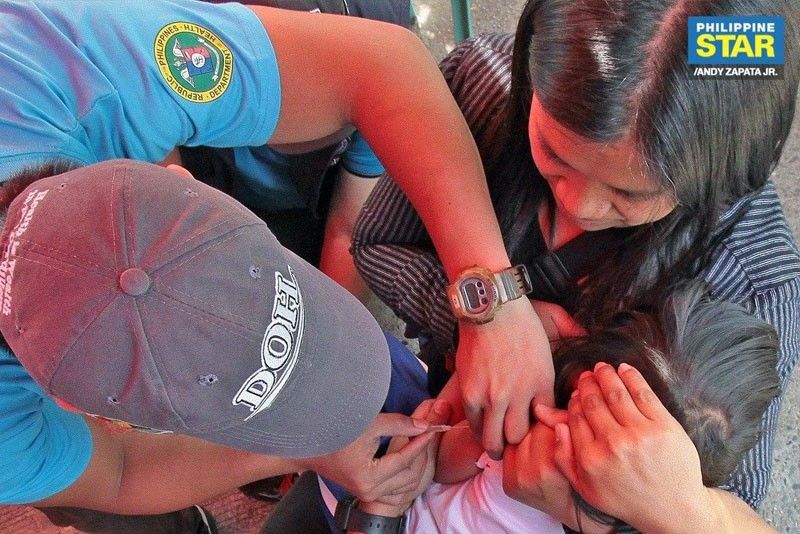
The DOH is aiming to immunize 8.57 million students in kindergarten to Grade 7 against measles.
DOH Undersecretary Eric Domingo said the number of measles cases being recorded on a daily basis has declined compared to previous months.
Despite the decline, Domingo said the DOH does not intend to slow down its immunization campaign.
“Before we were seeing 1,000 cases a day. Now the number is lower. But since there is still community transmission, we cannot stop our supplemental immunization,” Domingo said in a recent media forum organized by DOH.
He said the DOH had switched from community-based to school-based immunization to ensure that all eligible children are vaccinated against measles.
“There will be no letup in our campaign. Supplemental immunization continues as measles is easily transmitted and we want all children protected,” he added.
By December, the DOH is hopeful that all kindergarten to Grade 7 students would have received anti-measles vaccine.
As of August, only 16 percent or 1.4 million of the 8.6 million kindergarten to Grade 7 students have been covered by the immunization programs in communities and schools.
The DOH has achieved 103 percent coverage for infants aged 6-9 months old when it vaccinated 3.9 million babies. The target was 3.8 million.
Data show that of the 2.2 million individuals aged 12 years and below targetted for vaccination, 43 percent or 92,916 were achieved.
In February, the DOH declared measles outbreaks in Metro Manila, Calabarzon (Cavite, Laguna, Batangas, Rizal and Quezon), Western Visayas and Central Visayas due to soaring cases in these areas.
The outbreaks were due to the decline in the immunization coverage as a result of the vaccination scare created by anti-dengue Dengvaxia vaccine.
Domingo said that although there has been a downward trend in measles cases, DOH is not about to lift the outbreak status in these regions.
He said health officials are worried that the public would be complacent and resist vaccination efforts once the oubtreak status is lifted.
Records from the DOH showed that from Jan. 1 to Aug. 24, a total of 40,782 cases were recorded, including 551 deaths.
During the same period in 2018, there were 13,532 measles cases, including 115 deaths.
Calabarzon had the highest cases with 7,423, followed by Metro Manila with 7,119; Central Luzon, 6,454; Western Visayas 2,472; Northern Mindanao, 2,208, and Central Visayas with 2,018. – With Sheila Crisostomo


- Latest
- Trending


