Should the Supreme Court stop the impeachment again?
The principles of separation of powers and of checks and balance are among the most fundamental postulates that every Law student and every lawyer should understand so they can explain the meaning, implications, and nuances of the constant interplay of powers among the Office of the President, Congress, and the Supreme Court.
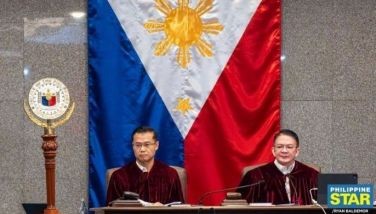
For the second time, the DDS forces protecting VP Sara Duterte have come to the Supreme Court asking it to stop Congress from proceeding to do what the House rules mandate them to. The DDS lawyers were successful in the first round when the Supreme Court en banc, declared as unconstitutional the articles of impeachment for, among others, violating the ban against multiple impeachment within one year, and for denying the respondent her right to due process.
Will the Supreme Court again derail the pending House proceedings before its Justice Committee? It isn’t for us to say. Should the Supreme Court declare that the House of Representatives Justice Committee is guilty of grave abuse of discretion, when it conducts what the DDS call a "mini trial" which function belongs to the Senate? That isn’t for us to say. Should the Supreme Court issue a temporary restraining order or injunction against the issuance of a subpoena duces tecum to the Ombudsman for the submission of the vice president's SALN? That isn’t for us to say again.
The Constitution vests the power of impeachment on Congress, that’s for the House to transmit the articles of impeachment after it determines their sufficiency in form and in substance and the Senate to try the impeachment. The Supreme Court has the power of judicial review to make sure that the Constitution is adhered to in the procedures. The Supreme Court cannot be deprived of its power to review, and then alter, modify, or nullify actions of lower courts and other bodies performing quasi-judicial functions.
For non-lawyers to comprehend the meaning, implications, and nuances about all these, it’s important to realize that there’s a fundamental doctrine in our political and constitutional laws called separation of powers. It’s that principle by which the fundamental law of the land divides government responsibilities into distinct and separate branches; typically the legislative, the executive, and the judiciary. Under the purest form of separation of powers, one branch shouldn’t interfere with the functions of the others.
We all know that the legislative is the maker of laws. The executive is the implementer of laws. And the judiciary is the interpreter of laws and final arbiter on how the law should be understood and implemented. There are other corollary powers vested on each branch to augment the respective functions principally assigned. Thus, Congress has two strong powers: the power of the burse, that is to appropriate public funds through the national budget, and the power of impeachment.
The executive has the power of appointment of judges, ambassadors, Cabinet members, and other presidential appointees. The executive likewise has overall control over the armed forces and the police, as well as supervision over the local government units including the provinces, cities, municipalities, and barangays. The executive is also the chief architect of foreign policies and control over foreign affairs. The judiciary has the power of judicial review.
Which brings us to the principle of checks and balances which is supplementary to separation of powers. It means that each one of the three branches of government is empowered to prevent any form of abuse by the others. For instance, the president, as chief executive, may veto any law passed by Congress and the latter may override such veto. Congress has the power to review appointments of Cabinet members, ambassadors, and top military officials through the Commission on Appointments.
The Supreme Court may nullify acts of Congress as well as acts of the executive if they are found to be unconstitutional. On a number of occasions, the Supreme Court has declared as null and void many provisions of law because they violate the Bill of Rights. Last year, the highest court told Congress that the articles of impeachment against the vice president violated the explicit provision of the Constitution prohibiting more than one impeachment each year. It also violated the due process clause.
Therefore, it’s possible that the current impeachment proceedings may again be nullified based on the Supreme Court's interpretation of the fundamental law of the land. Should the Supreme Court do it? It isn’t for me or you to say.


- Latest