Crisis in Cebu: No water, electricity, shelter
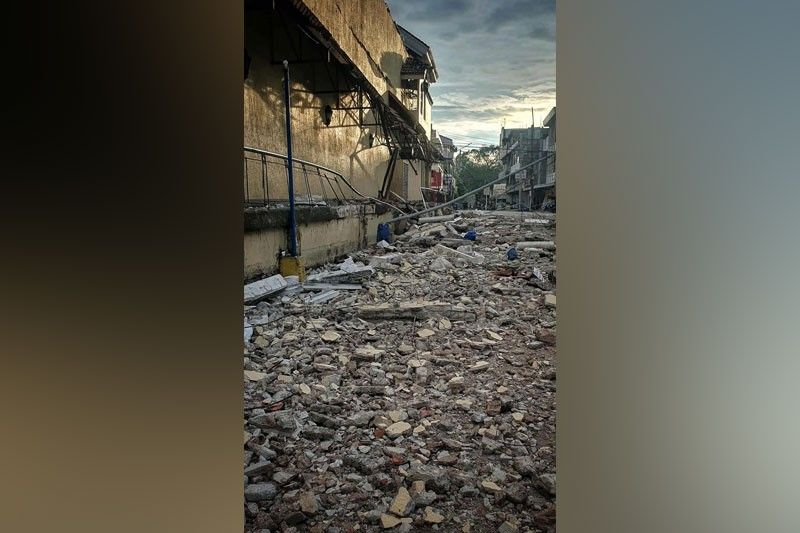
MANILA, Philippines — Four days since the magnitude 6.9 earthquake shook northern Cebu, survivors continue to face challenges in their daily struggle to survive while waiting for basic services to stabilize.
As the needs pile up, local officials have appealed for urgent necessities including food packs, first aid kits, hygiene supplies, modular tents, sleeping bags, potable water, generator sets and caution tapes. Affected families also need psychological support.
Video showed some residents in Medellin sleeping inside plastic bags to shield themselves from the rain due to the lack of modular tents.
People have been reluctant to return to their houses because aftershocks continue, with the strongest registering at magnitude 5.1 off Bogo City at daybreak yesterday.
San Remigio Mayor Mariano Martinez admitted that while help has started pouring in, the pace of delivery remains a concern.
“Several people from the private sector and other LGUs (local government units) have helped us here but we’re expecting DSWD to send family packs,” he said.
He added that about 18,000 to 20,000 food packs from the Department of Social Welfare and Development (DSWD) have been distributed to the municipality. Despite these efforts, some residents feel government aid is not coming fast enough.
Roads remain congested in northern Cebu as a steady stream of trucks carries relief goods to the hardest-hit areas.
Water remains the top demand. The Philippine Red Cross and other organizations have sent water tankers, but families continue to clamor for more.
Adding to the burden, intermittent rains have drenched families staying in makeshift shelters. Families have preferred staying outdoors due to fear of aftershocks but now struggle with wet clothes and bedding.
“We need proper tents because we cannot return home for fear of the quakes,” said 45-year-old Erah in Cebuano.
Jun Tipait from Barangay Maño, San Remigio town shared how his family waits by the roadside for food packs to stretch their meals. “We have no means of livelihood, no food or money so we depend on aid for sustenance,” he said.
Some have received relief goods, but say that it is not enough. “We need more food because the ones they gave we don’t know how many days can it last. We have no work,” said Neralyn Montejo of Barangay Pulambato in Bogo City.
Traveling in the northern part of the province, people are greeted not just by relief trucks but also by handwritten signs. “We need help. Food and water. Don’t just pass by, we need help.”
Power, telco services
In Bogo City, only 14 percent of power supply has been restored, according to the Cebu provincial government. Nearby San Remigio reports 22 percent power restoration, while Sogod and Daanbantayan fare better at 67 percent. Medellin shows the highest recovery rate so far at 94 percent.
The National Grid Corp. of the Philippines (NGCP) said 27 power plants in the Visayas tripped after the quake, cutting 1,444.1 megawatts from the grid and prompting a yellow alert over the region.
According to the Cebu Provincial Disaster Risk Reduction and Management Office, telecom services have also been severely disrupted.
Cell phone signal is now back in Bogo City and Carmen, as well as in Daanbantayan, Sogod, Tudela, Asturias and Catmon. However, San Remigio and Madridejos continue to suffer frequent interruptions.
Tuburan and Tabogon remain in a total blackout for telecom services, while Borbon only has limited access. Providers are racing to restore full connectivity as authorities rely on communications for relief coordination.
Electricity was restored to hospitals, water districts and municipal government buildings across 13 towns in Cebu. Around 64,000 households, however, still had no electricity, Energy Secretary Sharon Garin said yesterday.
Although the backbone or major power lines were repaired on Thursday, Garin said restoring electricity to households remained difficult due to ongoing safety hazards.
Manila Water relief
Manila Water’s local subsidiary and its charitable arm Manila Water Foundation (MWF) have mobilized urgent relief efforts in Cebu, saying that since Oct. 1, its subsidiary Cebu Water has supplied 105 million liters of safe drinking water to families in the municipalities of Bogo, Medellin, Tabogon, Borbon and San Remigio.
In addition, Cebu Water and MWF distributed 21 sacks of well-milled rice to families in Carmen town. The AFP also facilitated the delivery of 500 units of five-gallon potable water.
Fire trucks from different LGUs in Cebu province have also been accommodated at Cebu Water’s Carmen Water Treatment Plant for refilling to support drinking water and sanitation efforts in the area.
Further, Cebu Water and MWF have committed to providing an additional 10,500 units of five-gallon bottled water in affected municipalities.
Aftershocks
A magnitude 5.1 tectonic aftershock struck offshore northeast of Bogo City at 5:39 a.m. yesterday, the strongest tremor so far since the magnitude 6.9 quake on Tuesday.
The Philippine Institute of Volcanology and Seismology (Phivolcs) said the quake, which was felt across Cebu, Leyte, Biliran, Bohol, Masbate and Capiz, is part of an ongoing aftershock sequence expected to continue for several days to weeks.
Phivolcs reported Intensity IV or “moderately strong shaking” in Bogo City, Villaba, Tabango and San Isidro, Leyte. Intensity III (weak) was felt in Cebu City, Ormoc and Hilongos; Intensity II (slightly felt) in Danao, Asturias, Lapu-Lapu City, Talisay, Argao and San Francisco, Cebu and Intensity I (scarcely perceptible) in parts of Masbate, Capiz, Negros Occidental and Northern Samar.
As of 10 a.m. yesterday, Phivolcs had recorded 4,071 aftershocks, with magnitudes ranging from 1.0 to 5.1, according to the Office of Civil Defense in Central Visayas (OCD-7). About 50 additional aftershocks were also logged, including minor tremors in Tabogon, Sogod and Medellin.
Sinkhole
A sinkhole estimated to be three to four meters deep was discovered in Sitio Mayjo, Barangay Paypay, Daanbantayan which was caused by the recent earthquake.
Disaster response expert Dr. Ted Esguerra, along with a team from Valenzuela City DRRMO, inspected the sinkhole earlier Friday.
Esguerra described the natural depression as an oblique dissecting sinkhole, measuring 160 by 224 inches in diameter. Four other sinkholes were also discovered along the shore. However, experts have not examined them further due to the high tide.
Death toll lowered
From a high of 73, the National Disaster Risk Reduction and Management Council lowered the official number of deaths related to the earthquake to 68 yesterday.
On the other hand, the number of reported injuries almost doubled, from only 294 to a total of 559 with zero persons reported missing.
The OCD explained that the lower number of fatalities is attributed to ongoing validation. Under such process, more stringent measures are used to account for the number of deaths based on death certificates, proper tagging and other forms of documentation.
DOT vows help
With widespread damage documented in areas hit by earthquake in Cebu, the Department of Tourism vowed to help restore damaged heritage sites and assist tourism stakeholders affected by the disaster.
Tourism Secretary Christina Garcia-Frasco reported the DOT’s attached agency Tourism Infrastructure and Enterprise Zone Authority (TIEZA) and National Commission for Culture and the Arts would perform rapid assessment on flattened heritage churches.
“We have already deployed teams from TIEZA, our attached agency, to do a rapid assessment and inspection, and we are endorsing as well to the National Commission for Culture and the Arts and the other relevant heritage agencies, so that together, we can ensure that the restoration and the rehabilitation of these symbols and living edifices of our faith and our culture can rise again,” she said.
The agency added it is formally requesting Emergency Cash Transfer assistance from the DSWD for affected tourism workers. Affected tourism workers would also receive food packs from DSWD, while businessmen could avail themselves of the Turismo Asenso Loan Program, it added.
Logistics
The Philippine Postal Corp. (PhlPost) deployed its fleet of vehicles in Central and Eastern Visayas to support the DSWD in transporting relief goods to families affected by the earthquake.
The PhlPost said postal trucks were used to deliver food packs, sleeping kits and laminated sacks for temporary shelters to Bogo City and nearby municipalities.
Postal Area 5 director Marilyn Alcoy said close coordination is being done with DSWD Cebu to mobilize trucks and personnel, ensuring timely delivery of aid to evacuation centers and affected communities.
The Philippine Ports Authority on Friday said major ports remain safe and fully operational with no confirmed major damage to facilities following the Cebu earthquake. — Brix Lelis, Alden Monzon Michael Punongbayan, Bella Cariaso, Ghio Ong, Emmanuel Tupas, Nicholas Jon Malaga, Le Phyllis Antojado, Caecent No-ot Magsumbol /The Freeman


- Latest
- Trending