NTF evaluating Cebu City ground-level response
MANILA, Philippines — The government task force addressing the coronavirus disease 2019 (COVID-19) crisis will evaluate Cebu City’s ground-level response for one week starting tomorrow to determine if it can still stop the continuing increase in the number of new cases and widespread community transmission in most of the barangays in the city.
The evaluation, to be conducted by the National Task Force Against COVID-19 (NTF), has been approved by the Inter-Agency Task Force for the Management of Emerging Infectious Diseases (IATF) through Resolution No. 47.
Cebu City is under the most rigid enhanced community quarantine (ECQ), while Talisay – also in Cebu – is under modified ECQ.
The conduct of evaluation, the six-page IATF order stated, aims “to mitigate and manage the continuing increase in the number of new cases and widespread community transmission in majority of barangays in Cebu City, as well as consistent case doubling time of less than seven days and significant increase in critical case utilization against critical care capacities of Region 7 and the rest of the Visayas.”
An evaluation would also allow the national government to “orchestrate a more calibrated response,” according to the resolution.
The IATF also brought up the possibility of establishing an NTF Emergency Operation Center and designating a Visayas Deputy Implementer for Region 7 and the entire Visayas; and the establishment of out-patient services in existing Temporary Treatment and Monitoring Facilities (TTMFs) in response to the low utilization of such TTMFs and the increasing number of isolated individuals at home.
The move also aims to harmonize regional and national data coming from the Department of Health, Department of the Interior and Local Government and the NTF.
The IATF also wants better management of locally-stranded individuals (LSI) to stop the spread of the disease.
The body also urged concerned agencies to implement a “strict and uniform enforcement of minimum public health standards in high-risk areas such as healthcare settings, wet markets, supermarkets, government offices and workplaces, among others.”
Presidential spokesman Harry Roque, meanwhile, said the IATF will conduct a preliminary review of data for the past week to determine if GCQ would be retained in Metro Manila and other provinces.
Metro Manila and several areas in the country will remain under GCQ until the end of the month.
The IATF also upheld that mass gatherings in higher educational institutions (HEI) shall follow existing guidelines under MGCQ. “Accordingly, the prohibition on mass gatherings in HEIs is hereby deleted,” the IATF said.
On the issue of the increasing number of cases in certain barangays, Roque reminded local officials that they have the authority to impose calibrated lockdowns to isolate affected areas.
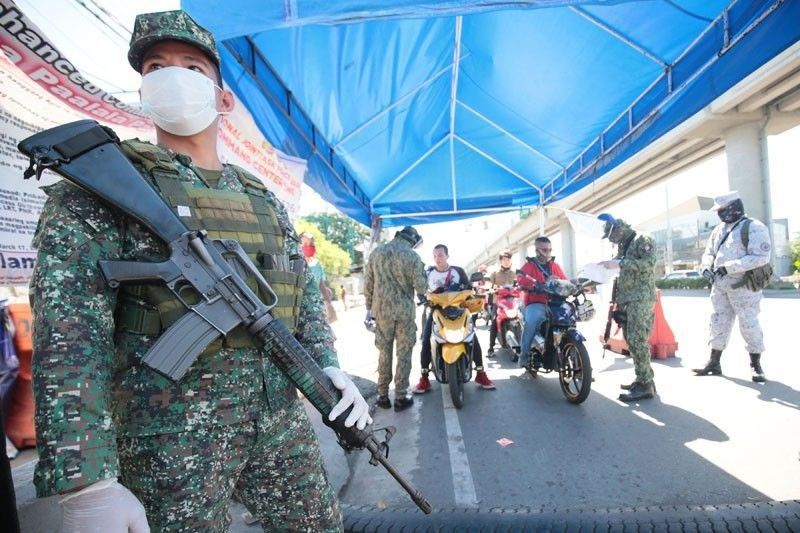
Travel in and out of Cebu City and Talisay City is banned, according to Philippine National Police (PNP) deputy chief for operations Lt. Gen. Guillermo Eleazar, citing an order from Interior and Local Government Secretary Eduardo Año.
“As per instruction of Sec. Eduardo Año, the movement of LSIs coming from or going to ECQ and MECQ areas will not be allowed temporarily,” Eleazar said.
Police officers have beefed up security around the two cities to prevent people from moving in and out. Emmanuel Tupas





- Latest
- Trending