Yearender: Peace talks collapse as Duterte, Jose Maria Sison trade barbs in 2018
MANILA, Philippines — There is no end in sight to Asia’s longest-running insurgency.
The Communist Party of the Philippines (CPP), through its armed wing, the New People’s Army (NPA), has been waging an insurgency against the government since 1968.
Several administrations have tried to neutralize or at least contain the CPP-NPA rebels. All have failed.
Talks with the communist rebels have been conducted on and off for three decades, leaving more than 30,000 people dead in the wake of the protracted war.
Since his election in 2016, President Duterte has revived hopes for successful negotiations with the communists, saying it was his “dream” to forge peace in the country.
But in November 2017, Duterte scuttled the peace negotiations with the communists, in a blow to efforts to end the conflict that has raged for half a century.
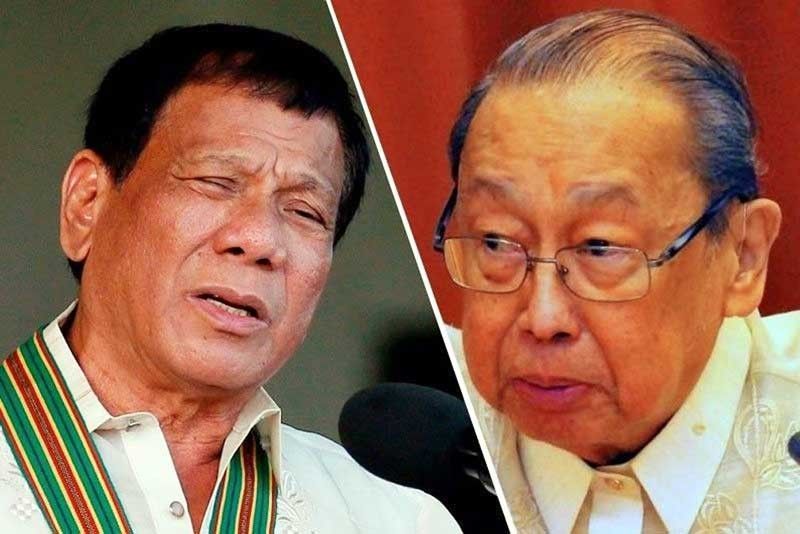
Since then, Duterte and CPP founding chairman Jose Maria Sison have spent 2018 engaging in a word war and below-the-belt personal attacks against each other.
Duterte and Sison swapped insults, trying to outdo each other in name-calling instead of finding ways to come up with solutions to the conflict.
The two bared their mutual disrespect and mistrust of each other.
Sison called Duterte an addict of painkiller Fentanyl and a “bloodthirsty tyrant with malicious criminal mind.”
The peace talks between the government and the National Democratic Front (NDF), the umbrella organization representing the communists in the negotiations, appeared headed for a better conclusion earlier this year.
But it became dim after Duterte unilaterally terminated the peace negotiations in June.
Duterte and Sison concluded the year with consistently unsavory attacks that critics described as “nauseating and uninteresting.”
On Dec. 20, Duterte warned the CPP-NPA that “blood will flow,” vowing to end the rebellion by end of his term in June 2022.
At the height of their verbal tussle widely covered by the media, Duterte last August claimed Sison was suffering from colon cancer and would soon join his Creator.
Sison replied by challenging Duterte to present their respective “true” state of health.
Sison also gave unsolicited advice to Duterte: resign so he can get the rest he badly needs.
In one instance, Sison reportedly claimed Duterte was in coma, forcing former presidential assistant Christopher Go to show a video and pictures of the President in action in social media.
Sison also predicted that Duterte will be ousted in mid-2019.
He said the Duterte government is bankrupt and weakened by bureaucratic and military corruption, excessive military and police spending, counterproductive projects, mounting debt burden and trade deficits.
The self-exiled communist leader said the government has imposed regressive taxes on the consuming public and caused the prices of basic goods and services to spike to unaffordable levels.
He also said communism is not the issue for the people today.
“It is Duterte’s servility to imperialist powers and his aggravation of the oppressive and exploitative rule of the big compradors, landlords and corrupt bureaucrats like himself,” Sison said.
Sison said the current demands of the people are national liberation and democracy, not even socialism and certainly far from communism.
He said the Filipino communists today excel in putting forward the program of the people’s democratic revolution.
“Duterte is an ignoramus about the theory and practice of Marxism-Leninism-Maoism. Genuine Filipino communists understand the Marxist-Leninist teachings of Mao and the revisionist betrayal of socialism and the now more turbulent world of inter-imperialist contradictions and conflicts,” Sison said.
Sison said Duterte is “unfit” to be president because of his “mental incompetence” and “moral depravity.”
Deal breakers
In July, Sison said the three-month review by Duterte of agreements reached by the government and the NDF during backchannel talks and all peace agreements by past administrations was one of four “deal-breakers.”
In an interview with ABS-CBN Europe News Bureau, Sison cited the other deal-breakers in the peace talks were the continuous existence of Proclamation No. 360, which terminated the peace negotiations on Nov. 23 last year, and Proclamation No. 374 designating the CPP-NPA as terrorist organizations, and Duterte and other government officials’ insistence to hold the peace talks in the Philippines.
Duterte demanded the peace talks should be held in the country but Sison was quick to answer, saying Duterte cannot dictate the venue for talks.
Four backchannel talks were conducted in Utrecht, the Netherlands from March to June this year where the two panels agreed to include in the package agreement a coordinated unilateral ceasefire; a certified copy of presidential proclamation to amnesty and release of all political prisoners, and implementation of the Comprehensive Agreement on Social Economic Reforms.
The two parties were set to sign the interim peace package on the scheduled June 28-30 resumption of formal peace talks, but it did not take place after Duterte cancelled it on June 14.
Sison said the resumption of talks is rendered impossible if the government will continue to demand home-based negotiations.
Standing down
On June 8, the NDF signed a stand down agreement with the government, trusting Duterte and government peace panel chairman Silvestre Bello III.
Bello said the stand down deal, which was signed in the Netherlands, provides for a temporary cessation of hostilities on both sides.
Sison, for his part, said he and Duterte tried to settle their differences in peace negotiations.
“Up to sometime May, up to 2017 onwards the relationship deteriorated. Practically, more than one year was wasted because of the termination declared by Duterte,” Sison lamented.
He said that in the two years of Duterte’s presidency, the whole second year of his term had been wasted.
He said the exchange of harsh words between him and Duterte pales in comparison with the actual battles in the field.
“There may be exchange of harsh words, but if the two parties, the responsible leaders of the two parties, would talk to resolve the root cause of the armed conflict then the exchange of harsh words anytime can be overcome by the agreements to settle the armed conflict,” hesaid.







- Latest
- Trending