Sara a multi-billionaire
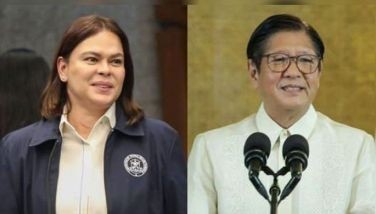
Vice President Sara Zimmerman Duterte became awesomely rich while serving as vice mayor of Davao City from 2007 to 2010, and as its mayor from 2010 to 2013.
During those years, transactions in her bank accounts amounted to P3 billion.
Per the report of the Anti-Money Laundering Council submitted to the House committee on justice, the financial activity of Vice President Duterte increased significantly starting 2007 when transaction value surged to P208.15 million. Says the report: “Financial movements intensified between 2009 and 2013, with consistently high totals exceeding P400 million, including notable peaks in 2009 (P704.93 million), 2010 (P648.58 million) and 2011 (P597.15 million).”
The salary grade of a city vice mayor and mayor is pegged at P178,572 per month. Or P2.07 million a year. From 2007 to 2013 is six years. So multiply P2.07 million by six, that’s P12.42 million. So how come Sara’s bank accounts show over P3 billion in monies? Did she enrich herself while in public office?
That is what the prosecution wants to prove. Enriching oneself while holding public office shows one’s unfitness to serve as a public official.
Defense lawyer Michael Poa has opposed the prosecution motion to summon the bank, tax and AMLC (Anti-Money Laundering Council) records of VP Sara. He claims the subpoena is “a weapon of a fishing expedition, and that is exactly what confronts this very Court today. And that is why the defense has taken the position that the prosecution’s requests must be denied.”
Prosecution lawyer Congressman Chel Diokno explained the issue before the Senate impeachment court last July 15: so that the impeachment court “may know the truth, the whole truth and nothing but the truth, and make its decisions based on that. That is why we have requested the issuance of subpoena duces tecum for the bank records, tax records and Anti-Money Laundering Council reports relating to Vice President Sara Duterte and her husband, Atty. Mans Carpio.”
By having Sara’s bank records examined before the impeachment court, Diokno pointed out, “we will know the truth as regards the allegation in Article II of the Articles of Impeachment (Unexplained Wealth). First, did the Vice President enrich herself extremely, far beyond her legal and legitimate income as a public servant? Second, she has assets undeclared in her statement of assets, liabilities and networth (SALN). Third, while in office as Vice President, she engaged in business, which is prohibited by the Constitution.”
Sara’s defense lawyers contend that the impeachment court has no power to look into VP Sara’s bank records, tax records and AMLC reports.
Diokno dismisses this argument as “not only legally flawed; it is an affront to the authority of this Honorable Court. Accepting this argument, he said, would belittle and insult the impeachment court. “The Constitution vests this impeachment court with extraordinary powers. Only this impeachment court has the power to decide whether the highest officials of the land are fit to be in power. Because this power comes directly from the Constitution, no one, no person, no law, no administrative rule can limit or supersede it. I repeat, nothing and no one can handcuff this court’s power to try and decide this impeachment case.”
Even the Bank Secrecy Law obeys the impeachment court. “The law explicitly states, ‘All deposits are hereby considered as of an absolutely confidential nature except in cases of impeachment.’ There is no doubt, the impeachment court has the right and the power to examine the bank records of VP Sara,” Diokno told the court.
Neither can the Data Privacy Act hinder this power. Diokno said, “The law itself affirms that confidentiality shall not apply, ‘should the personal information be needed pursuant to a subpoena duly issued’.”
Sara’s lawyers insist Sara’s bank records, AMLC reports and BIR records have no relevance since the P3-billion transactions happened while she was not yet vice president or an impeachable official.
During the impeachment trial of Chief Justice Renato Corona in 2012, the Senate impeachment court required the production of his bank deposit records to find out if he did not include his dollar deposits in his SALN, even before he became an impeachable official. The impeachment court denied the defense’s motion to suppress evidence on Corona’s bank accounts.
“There is a deeper reason why this court must resist the attempts of the respondent to exclude evidence that is obviously relevant – it has to do with curtailing the power of this court,” Diokno explained. The Constitution gives this honorable court “the sole power to try and decide impeachment cases.” Only the impeachment court has the power to decide what is an impeachable offense and what evidence is needed to prove a case.
Diokno cites the case of Francisco v. House of Representatives where the Supreme Court declared, “A determination of what constitutes an impeachable offense x x x is a purely political question which the Constitution has left to the sound discretion of the legislation. Such an intent is clear from the deliberations of the Constitutional Commission.”
This was reiterated by the Supreme Court in Gutierrez v. House of Representatives, where the Supreme Court declared, “Francisco instructs that this issue would require the court to make a determination of what constitutes an impeachable offense. Such a determination is purely a political question which the Constitution has left to the sound discretion of the legislature. x x x Clearly, the issue calls upon this court to decide a non-justiciable political question which is beyond the scope of its judicial power.”
Asserts Diokno: “Since this impeachment court has the sole power to determine what constitutes an impeachable offense, no one – not the Supreme Court, much less the defense – can impose limitations on that power. No one can dictate to this court how to exercise the exclusive power to decide what constitutes an impeachable offense.”
Finally, the Constitution is clear: “Public office is a public trust; public officers and employees must at all times be accountable to the people.”
* * *
Email: [email protected]


- Latest
- Trending