Sara Duterte trial recap, July 20: Subpoenas granted, Diokno's legal chops
MANILA, Philippines — On the seventh day, the Senate impeachment court did not rest.
After hours of hearing legal jargon, "fishing expedition" metaphors and different takes on what "unexplained wealth" means, the court on Monday, July 20, granted the prosecution's motion to open the bank and tax records of Vice President Sara Duterte and her husband.
Presiding Officer Chiz Escudero approved the prosecution's two requests to subpoena the bank, anti-money laundering and tax records of Duterte and spouse Manases Carpio covering 2007 to 2025, overruling the defense's objections that prosecutors were on a "fishing expedition" for evidence they don't have.
1. Granted, but with caveats
Escudero ruled that the requested documents passed the tests of relevance and definiteness: they are "reasonably described, readily identifiable, prima facie relevant, and material to the allegations."
In delivering the ruling, Escudero cited the Corona impeachment precedent and the Bank Secrecy Law, which names impeachment as an exception to confidentiality.
The defense's most-cited argument — Section 8-A of the Anti-Money Laundering Act, which it called an absolute ban on disclosure — was rejected outright.
The provision targets leaks by AMLC personnel, the court ruled, and "does not and constitutionally cannot nullify" the court's subpoena powers.
If the Senate cannot be denied AMLC records in aid of legislation, Escudero said, "it most certainly cannot be denied to the Senate sitting as an impeachment court."
Just minutes before handing down the ruling, Escudero drew from defense counsel Michael Poa the confirmation that Duterte and Carpio married in 2007. They had no prenuptial agreement, meaning all their assets are under the absolute community of property regime.
"It is a legal and mathematical impossibility to determine the respondent's true net worth or lawful income without examining the bank accounts of her husband," Escudero ruled.
But the prosecution in the end did not get everything. The court denied subpoenas for two of the listed companies, JTC Group of Companies and Pikimong Pikimong Philippines Corp., finding no prima facie link to the couple.
Foreign currency deposits were excluded as well in the granted motion.
The court, however, granted the motion for 19 corporations.
The AMLC records will first be privately reviewed by Escudero.
Escudero also ruled that the 2007 to 2021 records — covering Duterte's years as Davao City mayor and vice mayor — may only be used to establish a "factual baseline" for measuring her wealth as vice president, not to prove new offenses outside the articles.
The presiding officer said allowing otherwise would violate her due process rights under Duterte v. House of Representatives, the same ruling the defense had invoked.
The BIR subpoena meanwhile does not yet directly translate to an actual production of the requested tax records.
Escudero held that the defense "correctly invoked" Section 71 of the Tax Code, which opens tax records only upon presidential authorization, a foreign tax authority's request or the taxpayer's waiver.
Without one of those, however, the court "shall not receive any subpoenaed records from the BIR."
To recall, the Senate impeachment court had returned the green box containing Duterte's tax records on the first day of its convening, as it did not have the necessary court order to continue holding onto the papers.
2. Prosecution relies on Diokno's legal chops to get through flurry of questions from Duterte allies
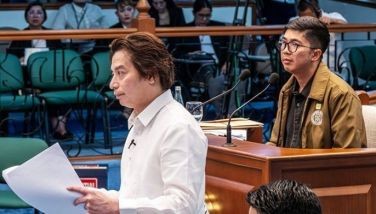
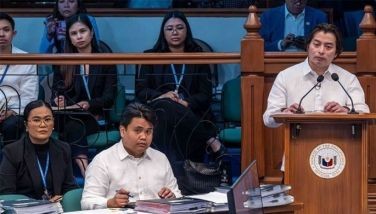
Diokno represented the prosecution and fielded several questions from senator-siblings Alan Peter and Pia Cayetano — both longtime Duterte allies — that hewed closely to arguments the Duterte camp has pressed since the House proceedings. Namely, that the AMLC disclosures during the House's clarificatory hearings were questionable, that the impeachment complaint alleged no ultimate facts, and that prosecutors impeached first and went looking for evidence after.
Sen. Pia Cayetano invoked the fruit of the poisonous tree doctrine and asked what legal basis allowed the AMLC to reveal Duterte's financial information at the House hearings at all.
"Kung yan ay walang basihan na ilabas... hindi yan pwedeng idugtong doon sa mga allegations na meron kayo," she said.
Diokno's answer: Section 8-A "is really intended to prohibit or prevent leaks by officials of the Anti-Money Laundering Council, but it was never intended to prevent subpoenas coming from courts, including the impeachment court."
The Sandiganbayan obtains AMLC records "almost every week," he said. "Confidentiality cannot trump accountability."
Sen. Alan Cayetano's turn meanwhile included a direct question that summed his entire interpellation: "Do you have the evidence, or are you fishing for the evidence?"
He asked whether a gap between income and net worth was enough to impeach "without giving that person a way to explain before you subpoena every single document about their lives."
"That's precisely why, your honor, they call it 'unexplained wealth,'" Diokno answered. Wealth from an appreciated land sale would be "explained wealth," he said — and only the records would show which kind Duterte's is.
"We just want to lay the evidence in front of you, for you to be the ones to say it," Diokno said.
Cayetano's final thrust compared Duterte's treatment with that of President Ferdinand Marcos Jr., whose impeachment complaint the House junked without seeking any financial records: "Would it be unfair to require 20 years of documents from AMLC, BIR and bank accounts from Vice President Sara without requiring the same from President Bongbong?"
Diokno said that complaint contained only conclusions of law, had it alleged ultimate facts, "I would see no reason why the committee on justice should not have proceeded with it."
3. Erwin Tulfo fed up with speeches for the self
Before any of it could begin, the court's opening minutes went to Sen. Robin Padilla, who defended himself in an Ombudsman complaint over his alleged role in helping Sen. Bato dela Rosa evade arrest.
Sen. Erwin Tulfo, visibly frustrated by the end of his speech, reminded his colleagues that the impeachment court was convened to try the vice president. He said it was not proper for senator-judges to use its time for personal defenses.
"Nitong nakaraang araw, napansin ko nagagamit ang oras ng impeachment court para sa pagtatanggol ng sarili ng mga kasamahan natin sa mga akusasyon. This is not the right venue nor the right time to explain your situation," Tulfo said.
Sen. Alan Cayetano, who last week also used the opening minutes of the court to defend himself in the 2019 SEA Games controversy, pushed back, invoking senator-judges' right to rise on personal privilege when they feel unfairly accused.
Sen. Kiko Pangilinan cautioned that the courtesy of allowing such manifestations "in the spirit of liberality" should not be abused.
Escudero let Padilla's remarks stay on record and argued that senators currently have no other forum while the chamber is in recess.
Tulfo delivered a parting snide remark after Escudero's ruling: "Can we start now? We wasted 26 minutes for nothing."
The trial resumes Tuesday at 2 p.m., with NBI Director Melvin Matibag testifying on Article IV, followed Wednesday by House archives director Marivic Pareja and former Landbank managers Violeta Constantino and Nenita Camposano.








- Latest
- Trending