Flood control, 'ayuda' eating into budgets for food, health, jobs – Ateneo
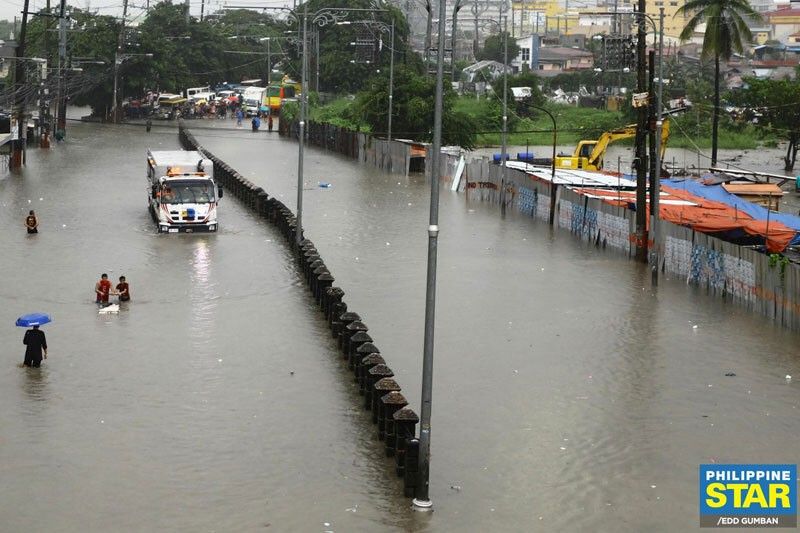
MANILA, Philippines — The Ateneo School of Government has flagged the Department of Public Works and Highways’ (DPWH) flood control budget, which has more than doubled its share of the total government budget in the past decade.
The increase, the school found, came at the expense of funding for agriculture, labor, transportation, and health sectors.
In a position paper released on Monday, September 22, the university reported that flood control projects now account for 4.02% of the 2025 General Appropriations Act (GAA) — more than twice the 1.62% allocated in 2015.
The DPWH’s flood control budget grew from P42.28 billion in 2015 to P254.3 billion in 2025, a sixfold increase that represents nearly one-third of the department’s entire operations budget for the year.
In other words, P1 out of every P3 spent by DPWH on operations goes toward flood control.
This allocation is much larger than the budgets of several key agencies, including:
- Department of Social Welfare and Development: P230.1 billion
- Department of Health: P223.2 billion
- Department of Transportation: P180.9 billion
- Department of Agriculture: P129 billion
The Ateneo School of Government expressed concern over the DPWH’s ballooning budget, noting that “corruption in the DPWH has spanned decades.”
RELATED: How DPWH’s 'special' status in budget process could enable insertions
For the first time, the department’s budget exceeded P1 trillion in the 2025 appropriation, surpassing even the education budget.
The school questioned whether Congress and the executive are prioritizing flood control projects over critical issues like the backlog of more than 160,000 classrooms and the need to rehabilitate seven out of ten classrooms nationwide.
'Bias' of urban development
Which agencies and government-owned or controlled corporations (GOCCs) saw their budgets slashed during the bicameral conference committee deliberations for the 2025 budget?
According to Ateneo School of Government, the following suffered multi-billion-peso cuts:
- National Irrigation Authority: P23.2 billion
- Department of Agriculture: P22.4 billion
- Department of Labor and Employment: P18 billion
- Department of Transportation: P16.7 billion
- Armed Forces of the Philippines Modernization: P5 billion
- Philippine National Oil Company: P2 billion
Where did these funds go? Primarily to the DPWH. Before President Ferdinand “Bongbong” Marcos Jr. vetoed P26 billion, roughly P94.3 billion was diverted to the agency.
Other budget items that saw increases include:
- Local Government Support Fund: P7.2 billion
- Metro Manila Development Authority: P3.4 billion
- National Electrification Administration: P3.2 billion
- Tourism Infrastructure and Enterprise Zone Authority: P1.5 billion
- Philippine Ports Authority: P1.4 billion
The position paper emphasized that prioritizing urban infrastructure “at the expense of rural development” reveals a government bias favoring “urban-based over rural-based development.”
“Budget cuts and movement away from strategic transport, infrastructure, agriculture-based investments, to graft-prone projects like flood control, multi-purpose buildings, and hyper-micro local projects, like local roads, footbridges, and deep wells, interrogate the supposed rural development priority of the administration,” it read.
Funds diverted to ayuda
Poverty reduction and social welfare programs, meanwhile, faced significant budget cuts in the 2025 appropriation, according to the Ateneo School of Government. These include those of the:
- Department of Social Welfare and Development (DSWD): P94.3 billion
- Philippine Health Insurance Corporation (PhilHealth): P74.4 billion
- Department of Health (DOH): P25.8 billion
- Department of Education (DepEd): P12 billion
- Department of Labor and Employment (DOLE): P18 billion
- National Commission on Indigenous Peoples (NCIP): P1.6 billion
These reductions were redirected to other programs, particularly to cash dole-outs, while the rules-based conditional cash transfer program, 4Ps, was cut by P50 billion.
The following assistance programs — which the university criticized for lacking clear beneficiary identification systems — received substantial budget boosts:
- Ayuda para sa Kapos ang Kita Program (AKAP): P26 billion
- Medical Assistance to Indigent and Financially Incapacitated Patients (MAIFIP): P14.3 billion
- Assistance to Individuals in Crisis Situation (AICS): P9.5 billion
- Tulong Panghanapbuhay sa Ating Disadvantaged/Displaced Workers (TUPAD): P3.4 billion
“Social services are headed towards becoming a matter of utang na loob, not a matter of right,” the position paper read.
RELATED: AKAP, other ayuda programs exempted from spending ban
Executive, legislative benefit
So, which agencies benefited from the budget reallocations? Data shows that P17.3 billion was realigned to the House of Representatives — more than double its original allocation — while the Office of the President (OP) received P5 billion and the Senate P1 billion.
For 2025, the total budgets stand at P33.67 billion for the House, P13.93 billion for the Senate, and P15.85 billion for the OP.
This translates to around P8.82 million per representative per month and P48.37 million per senator per month.
The Ateneo school said that compared to 2015, the OP’s budget in 2025 is five times higher, while the budgets for the Senate and House have nearly quadrupled.
“We therefore pose this challenge – if the administration is serious in weeding out corruption, we demand that it carry out an institutional scrutiny up to the highest echelon of power,” the position paper read.
Recommendations
The Ateneo School of Government recommended continuing legislative hearings to uphold Congress’s oversight role but urged an end to “grandstanding and public hearings in aid of reelection.”
As investigations into anomalous flood control projects proceed, the school called on the Independent Commission for Infrastructure (ICI) to investigate the finance and appropriations committees in both chambers, which include former Sen. Grace Poe, Rep. Elizaldy Co, and former legislative chiefs Sen. Chiz Escudero and Rep. Martin Romualdez.
The school added that Executive Secretary Lucas Bersamin and the Development Budget Coordinating Committee should also be asked to explain the budget diversions over the past three years, along with the Commission on Audit for its failure to properly scrutinize budget utilization.
It also called on the Senate and House to publish the bicameral conference committee reports for 2023, 2024 and 2025.
Congress is currently deliberating on the 2026 national budget, with the House realigning P255 billion of DPWH's budget to education, PhilHealth, agriculture and other socioeconomic welfare programs.










- Latest
- Trending