SC justice: Sin tax funds must go to PhilHealth, universal healthcare as mandated by law
MANILA, Philippines — Supreme Court Associate Justice Alfredo Benjamin Caguioa stressed that sin tax laws, which fund the Philippine Health Insurance Corp. (PhilHealth), and the Universal Health Care Act (UHCA), require funds to be appropriated to the state insurer.
This argument stems from deliberations over the petitions filed before the Supreme Court questioning Congress' decision to grant PhilHealth zero government subsidy due to its accumulated excess reserve fund.
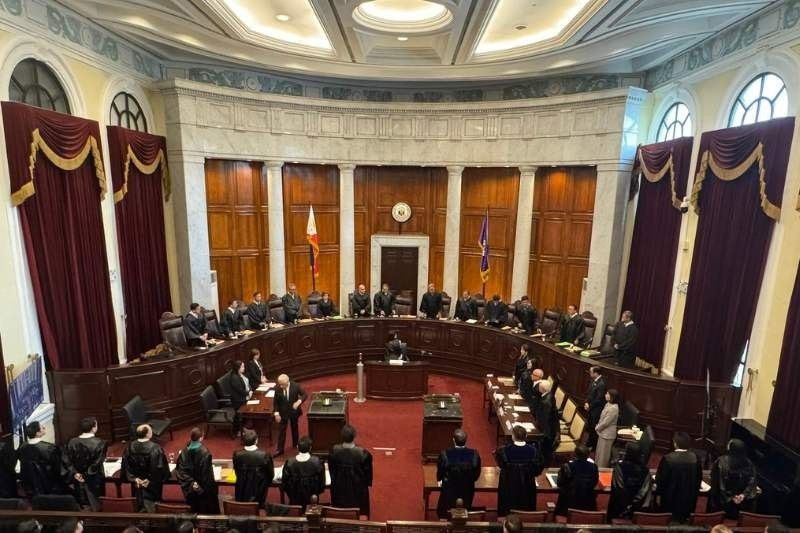
During the Supreme Court’s oral arguments on the PhilHealth fund transfer issue on Wednesday, April 2, Caguioa challenged Solicitor General Menardo Guevarra's claim that Congress has the discretion to decide how much should be allocated to PhilHealth.
Referring to a clause in Section 37 of the UHCA, Caguioa asked: “So to you, it is still Congress that determines the amount to be appropriated [to PhilHealth] or whether any amount should be appropriated at all?”
Guevarra agreed, saying that was his interpretation of the law, as Congress holds discretionary power.
He pointed to phrases in the section — “amount necessary,” “shall be included,” and “shall be appropriated by Congress” — which he argued serve as qualifiers.
He further explained that this clause grants Congress both the constitutional authority to determine appropriations and the power to assess their necessity and allocation.
Caguioa, however, found this reasoning problematic.
What laws state
For Caguioa, Guevarra’s interpretation “totally destroys the mandates of the sin tax laws and UHCA to deliver such funds to PhilHealth for the specific purpose of implementing the universal healthcare.”
The solicitor general stood by his position, disagreeing with Caguioa’s view that the UHCA dictates how sin tax collections should be directed to PhilHealth.
Caguioa also referred to Section 10 of the law, which states that the government’s premium subsidy for indirect contributors “shall be released to PhilHealth.”
Section 10. [...] Provided, That for indirect contributors, premium subsidy shall be gradually adjusted and included annually in the GAA.
Provided, further, That the funds shall be released to PhilHealth.
Provided, furthermore; That the DOH, in coordination with PhilHealth, may request Congress to appropriate supplemental funding to meet targeted milestones of this Act. [...]
Indirect contributors include qualified indigents, senior citizens, persons with disabilities and solo parents. While they are not required to pay premiums, they are still entitled to PhilHealth benefits.
Caguioa also detailed provisions in the sin tax laws mandating the allocation of excise tax revenue to PhilHealth. These are Republic Acts 9334, 10351,11346 and 11467.
He noted that four of these laws specify that the tax must be remitted to PhilHealth “for the purpose of” achieving universal healthcare coverage, while three others state that the funds “shall be allocated” and/or “used exclusively” for the state insurer or universal healthcare.
“If the sin tax laws already determine the source and use of funds to implement the UHCA, even if the funds pass through the General Appropriations Act (GAA), their character as earmarked for special purpose remains intact,” Caguioa said.
He stressed that the laws clearly show sin tax collections are “exclusively earmarked” to fund universal healthcare.
However, Caguioa also pointed out that the release and implementation of these funds still go through the national budget or GAA. This process is necessary to determine the actual amount collected and allocate the appropriate percentage.
“The provisions relied upon by the solicitor general do not really give Congress any discretion to determine the amounts to be appropriated for PhilHealth,” he added.
The associate justice explained that, in his view, allocating funds through the national budget “aligns more” with Article VI, Section 29, Paragraph 3 of the Constitution, which states that:
“All money collected on any tax levied for a special purpose shall be treated as a special fund and paid out for such purpose only. If the purpose for which a special fund was created has been fulfilled or abandoned, the balance, if any, shall be transferred to the general funds of the Government.”
The oral arguments also examined whether sin tax collections remitted to PhilHealth qualify as a special fund. A key issue is that these collections are “commingled” or mixed with other government funds in the general fund, raising concerns that they could be used for purposes not specified in the law.
Under the UHCA, PhilHealth is also mandated to expand benefit packages and reduce contributions using its funds.
Other issues
The Supreme Court is also reviewing how PhilHealth’s reserve funds should be calculated and utilized. It is also tackling the constitutionality of the transfer of P89.9 billion in unused PhilHealth funds to the national treasury for unprogrammed appropriations.
During the March 4 oral arguments, Supreme Court Associate Justice Antonio Kho said the P60 billion in excess PhilHealth funds already transmitted to the national treasury should be returned.
The high court issued a restraining order in October 2024 to block the transfer of the remaining P29.9 billion.





- Latest
- Trending